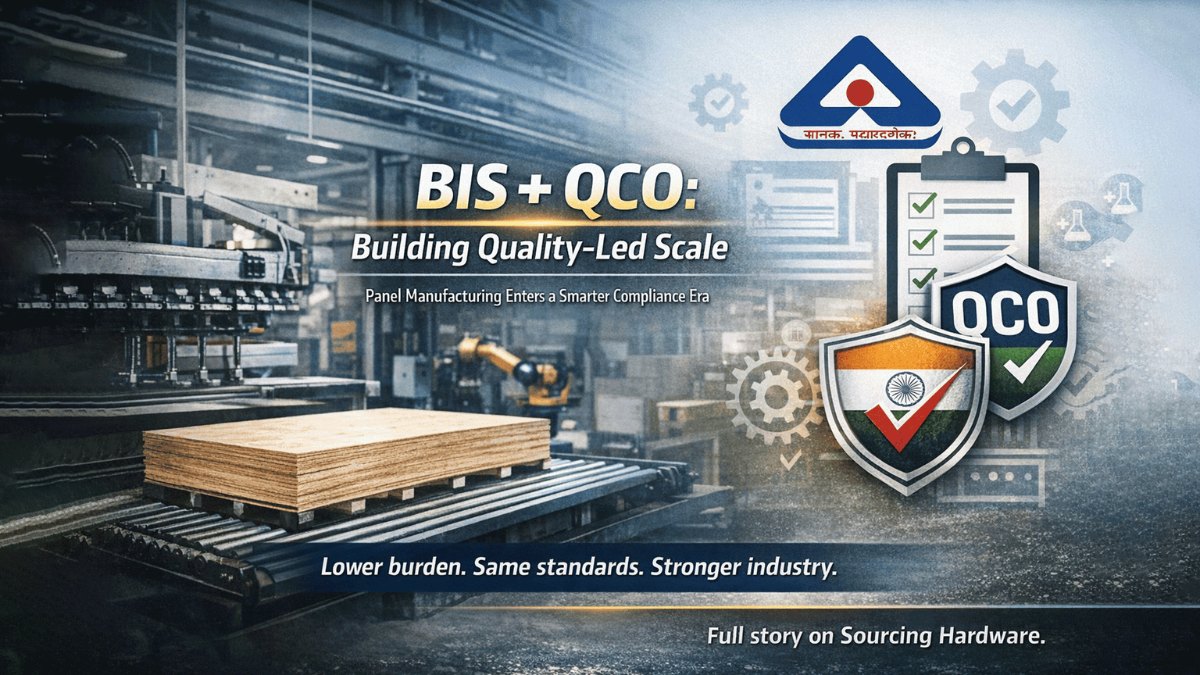
India’s plywood and wood-based panel sector is witnessing a rare convergence of regulatory discipline and operational flexibility. BIS compliance relief for panel industry manufacturers comes at a crucial moment, building on the momentum created by Quality Control Orders (QCOs) that have strengthened domestic manufacturing and curtailed substandard imports.
Following the enforcement of QCOs, the Bureau of Indian Standards (BIS) has issued a
revised circular easing certain product certification requirements. The update offers
manufacturers much-needed operational relief—without diluting quality benchmarks—especially relevant for plywood, MDF, particleboard and allied panel segments.
QCOs have Revived Domestic Panel Manufacturing
The impact of QCOs has been swift and measurable. According to Federation of Indian
Plywood & Panel Industry (FIPPI), domestic plywood production rose by nearly 15% between April and September 2025, increasing from about 10 million cubic metres to 11.5
million cubic metres. The industry is now approaching full utilisation of its installed capacity
of 12 million cubic metres, with demand consistently exceeding supply.
The post-QCO environment has also catalysed large-scale investments. Major manufacturers—including Century Plyboards, Greenply, Action TESA, Merino, Greenlam
Industries and others—have collectively committed over Rs 3,600 crore to expand capacity
across plywood, MDF and particleboard. Supply lead times, once a concern, have stabilised
at 2–3 weeks, signalling improved efficiency and demand management.
The broader policy significance was recently underscored by Union Minister for Commerce
and Industry Piyush Goyal, who noted that QCOs have boosted domestic manufacturing
confidence while curbing low-quality imports across multiple sectors, including wood-based
panels.
BIS Compliance Relief Changes Certification
Building on this stronger quality baseline, BIS has now relaxed key certification norms.
Manufacturers are no longer required to maintain a standalone in-house laboratory. Instead, they may opt for shared testing facilities, cluster-based laboratories, or subcontract testing to BIS-recognised or ISO/IEC 17025 accredited laboratories.
Equally significant is the shift in inspection and testing schemes outlined in BIS product
manuals. These are now recommendatory rather than mandatory, allowing manufacturers
to define their own Quality Assurance Plans (QAPs)—tailored to scale, product mix and
process maturity—while ensuring conformity with Indian Standards.
Infrastructure Compliance to Process Accountability
For manufacturers, BIS compliance relief for panel industry players does not translate into
diluted responsibility. While capital and operating costs fall—particularly for MSMEs and
cluster-based units—accountability for quality, traceability and consistency remains firmly
with the manufacturer.
In practice, BIS audits are expected to place greater emphasis on QAP robustness, sampling logic, testing frequency, batch traceability and corrective-action systems, rather than the physical ownership of laboratory infrastructure. The regulatory signal is clear: compliance is shifting from asset-heavy checklists to process-led quality governance.
Implications for Furniture and Kitchens
Taken together, QCO enforcement and BIS compliance relief for panel industry stakeholders
create a balanced regulatory framework for both upstream panel manufacturers and
downstream consumers such as modular kitchen and furniture makers. Higher and more
uniform material quality, faster certification cycles and lower compliance costs can
strengthen supply chains, improve competitiveness against imports and support export
readiness.
Combined with QCO-led quality discipline, BIS compliance relief for panel industry
participants enables scale and speed without compromising standards. For manufacturers,
the message is unambiguous: quality is non-negotiable—but compliance can now be
smarter, more collaborative and more cost-efficient.
Enjoyed this article?
Receive Kitchen & Cabinetry Intelligence directly in your inbox.
Subscribe to newsletter. Click.
–
ALSO READ