


India’s furniture panel industry is at a moment of reckoning. Success is no longer only about machines and materials—the way people are trained now determines competitiveness. This shift puts apprenticeship in India’s furniture industry at the centre of strategy, linking training quality with product quality. The government’s September 2025 apprenticeship reforms—the most significant since the 2014 amendment—signal that a skilled workforce is essential for global ambitions and for meeting rising standards under furniture-related Quality Control Orders.
Why Apprenticeship Matters Now
For decades, the country’s furniture manufacturing ecosystem has thrived largely on unorganised and unskilled or semi-skilled labour, powered by small workshops and panel
furniture MSMEs. By introducing higher stipends, promoting degree apprenticeships, and
improving inclusivity, the new reforms seek to make structured skilling an attractive proposition for both people and companies. Combined with a spate of recent Quality Control Orders (QCOs) pertaining to furniture fittings and raw materials, these changes are
reshaping the foundation of the world’s fourth-largest furniture market that was valued at
$22 billion in 2024. Put simply, apprenticeship in India’s furniture industry is becoming
the default bridge from training to quality-led production.
Industry experts across the board are hailing the changes as a much-needed step to standardise furniture products in the country and to bring them on par with global products. Rahul Mehta, CEO at the Furniture & Fittings Skill Council (FFSC), drew comparisons with countries like Germany, China, and Vietnam, emphasising how they built strong manufacturing bases through decades of systematic skilling and policy consistency.
“Going into a match without preparation vs going to a match with full preparation: who has
better chances to win?” Mehta said, emphasising that for India to achieve success on a global stage, it needs to move away from shortcuts and focus on sustained investment in
people, skills, and long-term capacity building. He strongly believes the apprenticeship
mandate will enable that.
Skilling Frameworks: Act, Stipends, and the Apprenticeship India Portal
Under the Apprentices Act, 1961, establishments employing 30 or more workers must engage 2.5–15% of their workforce as apprentices, and offer them 6–12 months of on-the-
job training before they are absorbed as full-time employees. It is also compulsory for all apprenticeship contracts to be registered on the Apprenticeship India portal. For companies
having 4–29 workers, engaging apprentices is optional. Registering contracts on the portal formalises apprenticeship in India’s furniture industry and makes outcomes trackable.
This long-standing framework is now being reformed to push manufacturers, especially in
the panel furniture segment, toward structured skilling and long-term workforce development.
The September 2025 reforms to India’s apprenticeship framework introduce a notable increase in the minimum stipend, from a previous band of roughly ₹5,000–₹9,000 per month to a new range of ₹6,800–₹12,300 depending on the qualification of the apprentice.
The government will continue to contribute 25%, or up to ₹1,500, of monthly stipend payments through a Direct Benefit Transfer (DBT). The engagement quota remains the same, but at least 5% is now reserved for freshers and skill-certificate holders. The amendment also reserves training slots for persons with benchmark disabilities. One of the
other pertinent changes is that criminal penalties for minor violations of the Act have been
replaced with advisories and graded fines, a marked shift from enforcement to enablement.
For talent, these changes make apprenticeships financially more viable and career-oriented. For companies, they turn what was largely a compliance exercise into a strategic investment in fresh, certified talent—reducing reliance on informal training and increasing capacity to meet global standards and BIS standards.
What Leading Firms Are Doing
Pioneers in India’s furniture manufacturing sector have long understood the importance of
skilling and have been playing a critical role in its implementation. Companies like Godrej
Interio and Hettich Group and their training arms have recognised that sustained growth in
the industry depends on skilled people as much as on production technology.
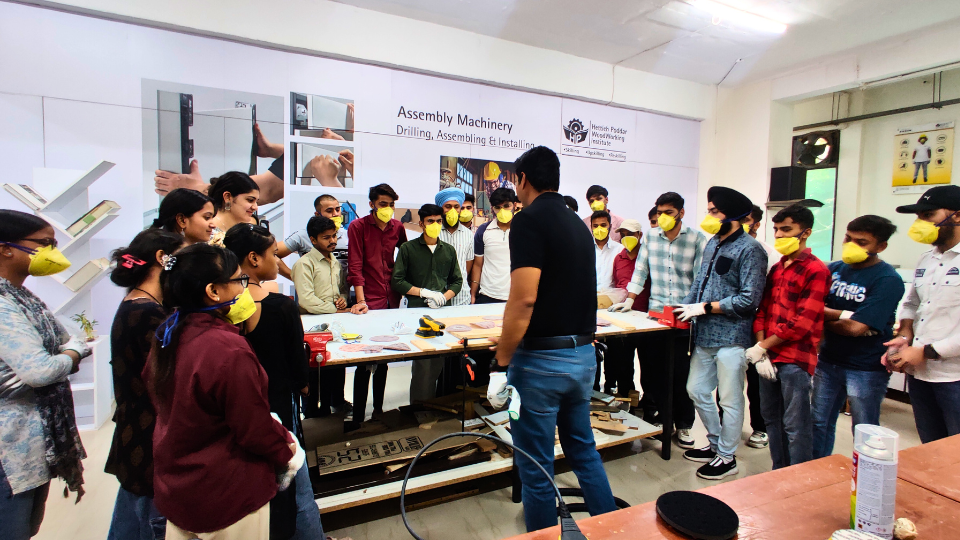
Hettich Poddar Wood Working Institute (HPWWI), an initiative of German hardware giant
Hettich’s Indian arm, focuses on equipping carpenters and technicians with the skills required for assembling modern furniture systems such as advanced hinges, drawer
channels, and telescopic fittings, where traditional carpentry falls short.
Amit Prasad, CHRO at Hettich India and Director of HPWWI, believes that India’s skilling
story needs a far more holistic approach. “One mindset change which I personally feel is
required is that our entire academic setup, or what we call skilling, is very degree focused.
We need to move from degree focused to being skill focused,” he said.
However, since the launch of the National Apprenticeship Promotion Schemes (NAPS) in
2016, only about 4.2 million apprentices have been engaged in the apprenticeship program, which is less than one per cent of India’s 500 million workforce. Participation from MSMEs, which power nearly 80% of the furniture market, remains limited, with most workers still learning informally on the job.
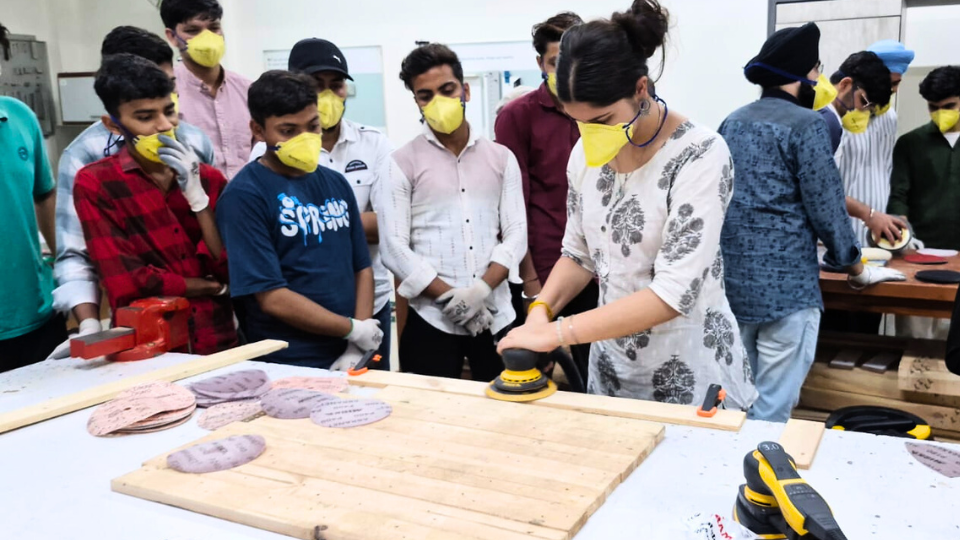
Skilling, Prasad said, doesn’t start in factories; it must start in classrooms. Hettich HPWWI,
whose Faridabad (NCR) campus is recognised as an FFSC Centre of Excellence, runs
structured short-term courses, typically spanning 90 days, that combine classroom
instruction with hands-on training at its in-house factory-like facilities, followed by
assessment and certification. The institute has also adopted 10 Industrial Training Institutes (ITIs) across West Bengal, in collaboration with the Paschim Banga Society for Skill Development (PBSSD), setting up state-of-the-art woodworking labs and delivering a new industry-aligned curriculum through its own trainers, who are also FFSC-certified. Graduates are offered employment opportunities through HPWWI’s network of manufacturing partners.
Meanwhile, at Godrej Interio, workforce development happens at multiple levels. Neville
Amaria, Vice President & Head – Product Supply at Godrej Interio, says the company has
long viewed training as a strategic investment rather than a compliance requirement.
Godrej regularly trains workers in CNC machining, upholstery, welding, and digital design,
combining in-house programmes with apprenticeships. Around 100 apprentices are trained
across its factories each year, with additional collaborations involving ITIs in Karjat and
Uttarakhand and NGOs focused on community-based upskilling, especially in stitching and
upholstery.
For smaller companies though, the effort and upfront cost required may be higher now in
view of these regulations, Amaria noted. For instance, the Furniture (Quality Control) Order, 2025, issued by DPIIT mandates that all imported and domestically produced furniture, ranging from work chairs (IS 17631:2022) and tables (IS 17633:2022) to beds (IS 17635:2022), must carry the ISI mark and comply with BIS ISI standards. The order will be enforced from February 2026. This may require upgrading materials, redesigning products, and aligning with the new quality standards.
“For the smaller players, the unorganised players, there will be a change in the supply
chain,” Amaria said. However, the standardisation will ensure durability and quality of
products in addition to bringing in much-needed consumer confidence. It will also level the
playing field between organised and unorganised players, he added. “Only thing is, some
time will be required to scale up (for MSMEs) if not done already.”
The Role of Skilling Councils
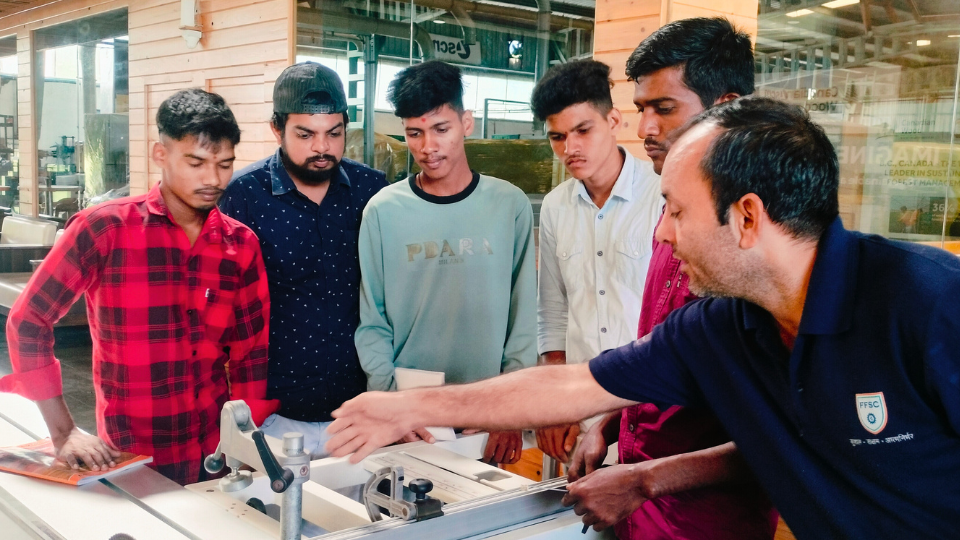
Apart from companies, sector skill councils like the FFSC are at the forefront of bridging the
vast skill gap across design, manufacturing, and business operations. FFSC apprenticeships
are being aligned with the demands of BIS standards to ensure the next generation of
workers is job-ready for a more structured, compliant industry. FFSC is mapping
standards so apprenticeship in India’s furniture industry produces audit-ready skills
for factories and buyers.
FFSC’s apprenticeship-linked skilling model has already begun showing results. Since its
launch, the Council has been working with companies across India to place apprentices
directly into factories and design studios, offering a structured route into employment.
D Venu Gopal Reddy, Co-founder & Executive Director at Hyderabad-based VM Modular,
noted how government-led apprenticeship programmes are helping change the way young
people look at the industry. “Traditionally, for some reason, working on shop floors, working
on machines, is looked down upon, compared to a desk job. So people who used to come
into these jobs had a mindset that this is not worth it. This will not earn respect,” he
explained. “But when the government reaches students at the grassroots and assures them
that this industry is worth their effort and can build a better future, it carries real weight.”
VM Modular has recruited about 10 apprentices through FFSC over the past few years, with
five currently working across its operations. Reddy noted that while many trainees move on
to new opportunities, those who stay are motivated, skilled, and confident.
For 22-year-old Ashwini Kadam, a B.Com graduate living in Palghar district of Maharashtra,
the apprenticeship program has been life-changing. Through FFSC, she joined Nirvana
Furniture as an apprentice in its design team. After six months of training in modular
furniture systems, advanced machinery, and design software, she was hired full-time with a
monthly salary of ₹20,000, a significant step up from the stipend she earned as an
apprentice. Her father is a carpenter and welder, but was never trained formally. The
apprenticeship has boosted her confidence and improved her future opportunities, she said.

Another apprentice, Prajakta Patil, 28, from Virar, joined Goodluck Modular Kitchen through
the same programme after years as a homemaker. She was introduced to the initiative
when FFSC representatives visited a local temple to raise awareness about job
opportunities. “I learnt how to take furniture measurements, use design tools, and operate
machines,” she said. “More than anything, I’ve learnt to be confident and independent.”
Stories like these, Mehta said, reflect a broader cultural shift. For decades, vocational
education was seen as a fallback option; today, it is becoming a viable career path. It is
changes like these, with government support, that will ultimately put India on par with
global giants.
Check out FFSC’s 5-Step Apprenticeship Implementation Guide here.
What Lies Ahead
For India’s furniture industry, the next few years will test how well ambition translates into
action. The apprenticeship mandate combined with reforms like the QCOs provide a blueprint for modernisation. The key lies in implementation, as Mehta from FFSC said. “For
people (and companies) who actually follow it (the regulations) in the mid to long term,
they’re going to reap a lot of benefits out of it.”
Manufacturers, especially panel furniture MSMEs, must now view upskilling as a core
business function, not an optional extra. This involves rethinking processes—from sourcing
BIS-certified raw materials to hiring apprentices—and building internal training pipelines
that can support product quality.
In the long run, these reforms will separate the serious from the short-sighted. As Godrej
Interio’s Amaria said, these regulations will not be mere compliance, but will create an
opportunity for good talent and strong quality practices. “I don’t see the unorganised sector
being wiped, but everybody will slowly graduate to a certain higher level of quality.”
Companies that adapt will gain from improved productivity, consumer trust, and export
potential. Those that don’t may risk being left behind in a market steadily moving toward
global parity. In practice, firms that embed apprenticeship in India’s furniture industry—and
document progress via the Apprenticeship India portal—will be best placed to meet QCO
expectations and build export-grade credibility.
ALSO READ