

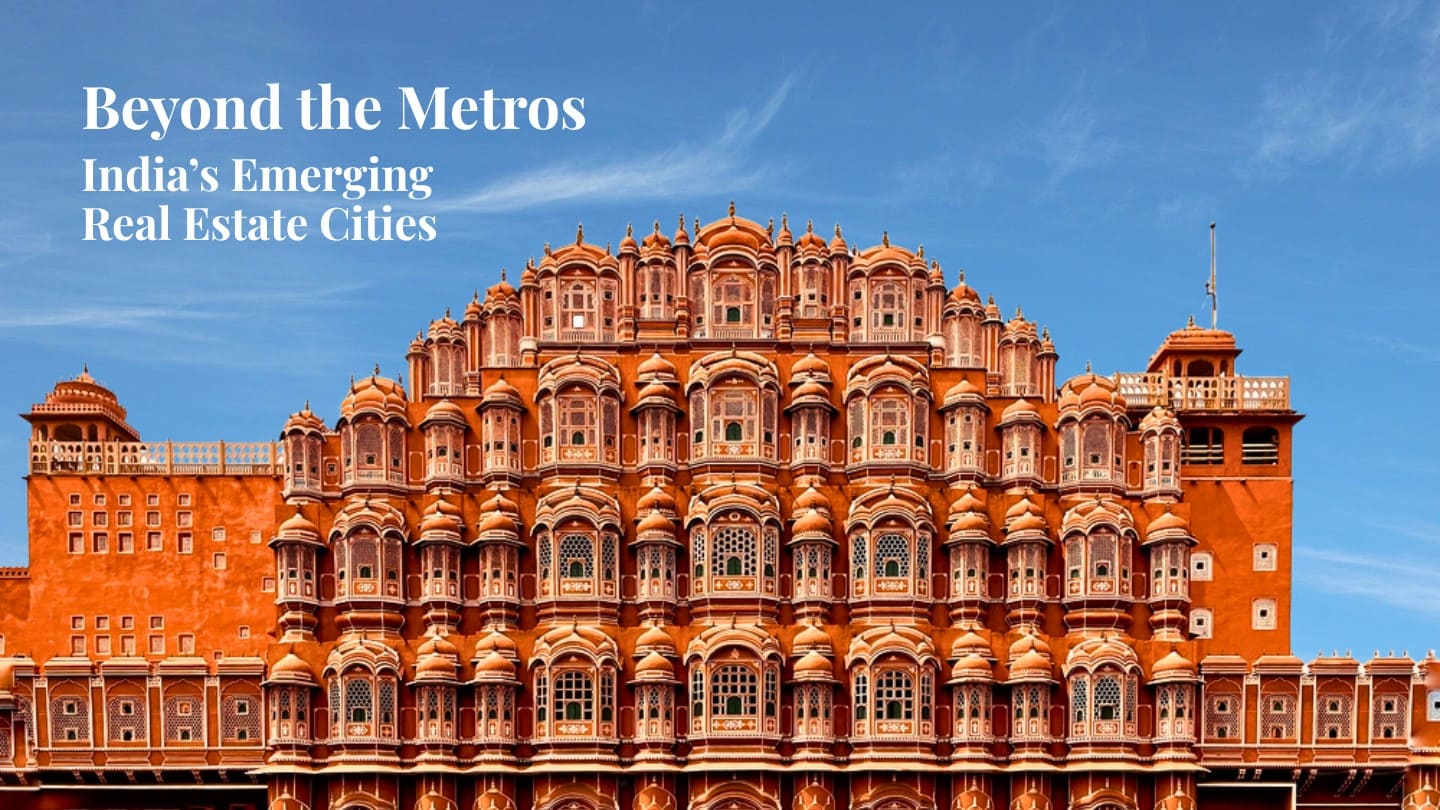
Beyond the Metros: India’s Emerging Real Estate Cities captures a structural shift underway in India’s property market, as Tier II locations emerge as powerful engines of demand for developers, suppliers, and building products & home improvement brands. According to a recent report by JLL, these cities are no longer peripheral, cost-saving alternatives but are fast becoming central to long-term real estate, talent and infrastructure strategies.
A new geography of growth
India’s real estate momentum is expanding well beyond the traditional metro strongholds.
While Tier I cities remain important anchors, the next phase of growth is being shaped by a
cluster of Tier II markets that combine infrastructure readiness, talent availability and improving governance frameworks. JLL’s research identifies nine such markets—Chandigarh
Tricity, Jaipur, Lucknow, Indore, Nagpur, Coimbatore, Kochi, Bhubaneswar and
Guwahati—that together form a powerful new growth bloc.
Collectively, these cities account for more than 25 million people, nearly ₹10 trillion in GDP,
over 70 million sq ft of office stock, and 80 million sq ft of logistics and industrial space. This scale underlines why India’s emerging real estate cities should be viewed not as isolated success stories, but as a systemic rebalancing of India’s urban and economic map.
What is Driving India’s Emerging Real Estate Cities
JLL attributes the rise of these markets to four reinforcing pillars. First is infrastructure
investment. Expressways, metro rail networks, ring roads, airport expansions and logistics
corridors—supported by national initiatives such as Bharatmala, UDAN and the Smart Cities
Mission—are unlocking new development corridors and compressing travel times.
Second is the decentralisation of work. The pandemic-era shift has permanently loosened
the link between talent and metros. Global Capability Centres (GCCs), IT/ITeS firms and
startups are increasingly expanding into Tier II cities to tap skilled talent at 20–35% lower
costs, with 5–15% lower attrition than mature hubs.

Third, policy clarity and governance reforms, including RERA implementation and state-level IT, startup and industrial policies, have improved transparency and reduced execution risk. The Union Budget’s push to support GCC expansion into Tier II cities has further validated this direction.
Finally, untapped human capital—supported by strong regional universities, engineering
colleges and management institutes—has allowed these cities to transition from satellite
locations to self-sustaining talent hubs.
City Archetypes, Not a One-size-fits-all Story
A key insight from the report is that opportunity within India’s emerging real estate cities
lies in understanding each city’s ‘growth DNA’.
Jaipur, Lucknow and Chandigarh Tricity are positioned as northern powerhouses, driven by
governance, tourism, BFSI and IT demand—supporting premium residential, Grade A offices and destination retail.
Coimbatore and Kochi form part of a southern technology and ER&D corridor, benefiting
from proximity to Bengaluru and Chennai while offering meaningful cost arbitrage.
Indore and Nagpur sit at the heart of India’s logistics map, combining manufacturing,
warehousing and IT demand.
Bhubaneswar and Guwahati act as eastern gateways, driven by government spending,
logistics demand and regional consumption.
Implications for Developers
For developers, the message is clear: growth is shifting away from metro-centric, single-
asset strategies. The next phase lies in integrated townships, mixed-use developments and
ESG-compliant Grade A assets located along emerging infrastructure corridors. Examples
include Aerocity Mohali, Jaipur’s Ring Road zones, Indore’s Super Corridor and Nagpur’s
MIHAN and Samruddhi Mahamarg influence areas.
Retail development is also evolving. Rather than traditional malls alone, developers are
increasingly focusing on destination retail and ‘retailtainment’ formats, particularly in
peripheral growth corridors where land availability and access are superior. Logistics and
warehousing have moved firmly into the mainstream as core asset classes rather than
ancillary plays.
What this Means for Suppliers and Contractors
For suppliers, contractors and system integrators, India’s emerging real estate cities
represent a broadening of demand across geographies. Developers in these markets are
seeking cost-efficient, scalable and standardised solutions—from façades, kitchens and
bathrooms to MEP systems, elevators and smart building technologies.
The growth of logistics parks, data centres, IT campuses and integrated townships is also
driving demand for industrial-grade materials, faster installation systems, modular
construction elements and ESG-aligned products. Importantly, procurement is becoming
more regional, creating opportunities for mid-sized manufacturers and service providers to
build strong local ecosystems.
Implications for Building products & Home Improvement Brands
For building products and home improvement brands, the rise of India’s emerging real
estate cities significantly expands the addressable market. Rising homeownership, organised housing, and improving purchasing power in Tier II cities are driving demand for branded kitchens, sanitaryware, tiles, fittings, lighting and renovation solutions.
Cities such as Jaipur, Lucknow, Coimbatore and Kochi are witnessing rapid growth in
organised retail and specification-led housing. At the same time, the influx of professional
workforces through GCCs and IT expansion is reshaping housing preferences—shifting
demand towards better-designed, higher-quality homes rather than purely price-driven
offerings.
Brands that succeed in these markets will be those that adapt their distribution models,
installer networks, regional marketing strategies and product portfolios, rather than simply
replicating metro playbooks.
A Structural Shift, not a Cyclical One
JLL’s central conclusion is that the rise of India’s emerging cities is not a temporary cost-
arbitrage cycle, but a long-term structural shift. As infrastructure investment continues and
companies seek to de-risk operations away from over-concentrated metros, India’s
emerging real estate cities will increasingly define the next decade of real estate and
construction demand.
For developers, suppliers and building products brands alike, the window to establish early
leadership in these markets is open—but narrowing. Those who align capital, capability and
strategy with the distinct growth DNA of these cities are best positioned to shape, and
benefit from, the next phase of India’s urban expansion.
ALSO READ