

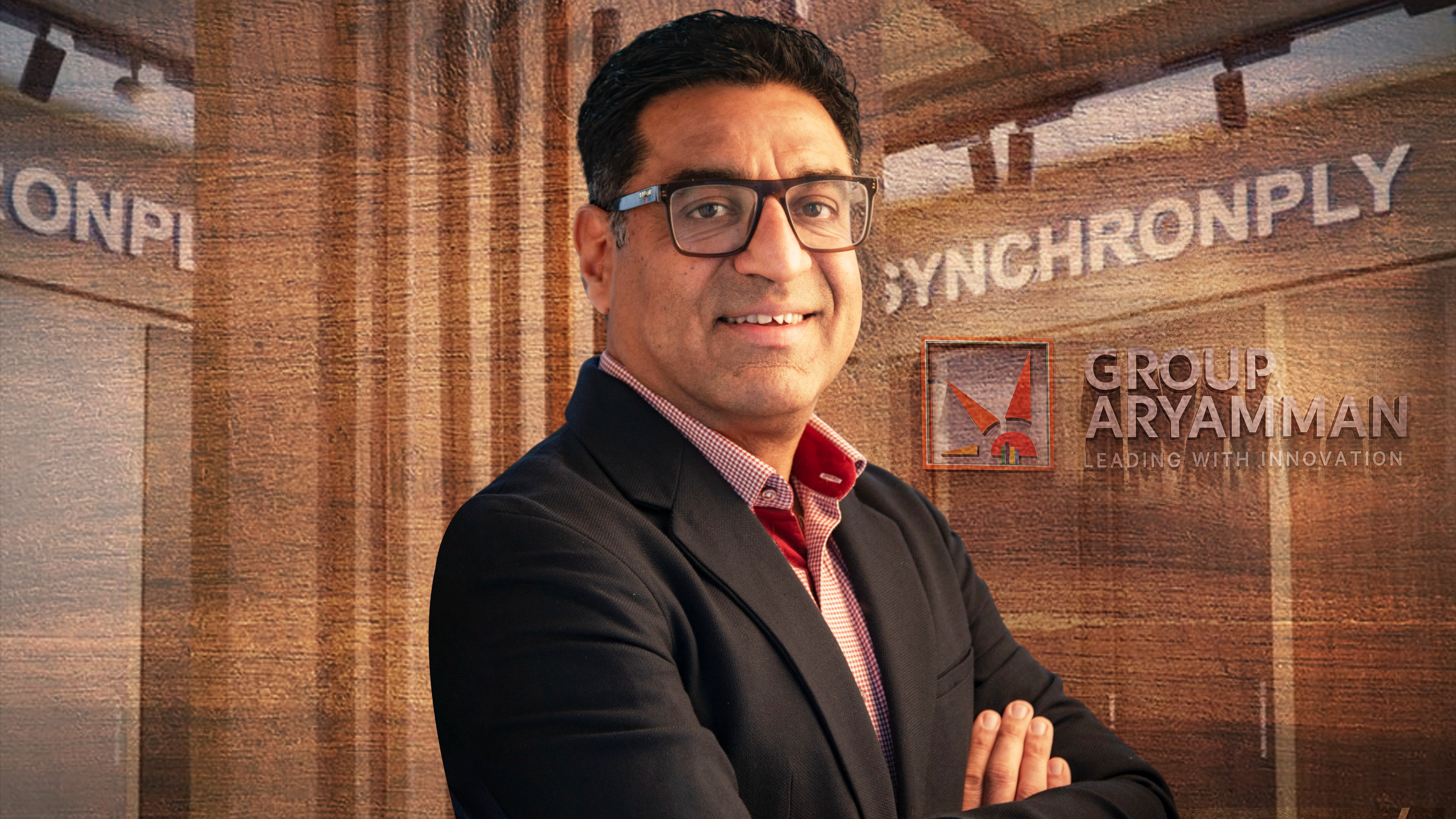
Group Aryamman Moves Beyond Surfaces for Furniture OEMs examines how integrated
material systems are shaping scalable modular furniture manufacturing in India.
As India’s modular furniture industry becomes more organised, mechanised, and design-conscious, the role of material suppliers is beginning to change in important ways. What was once a business of selling panels, finishes, or individual substrates is steadily becoming a business of enabling systems — helping furniture manufacturers produce more
sophisticated products, more consistently, and at scale.
For OEMs and furniture manufacturers, the question is no longer only about access to a
decorative surface or a board. It is increasingly about whether a supplier can help them
produce furniture that is globally relevant, visually refined, and operationally scalable.
That broader transition is visible in the journey of Group Aryamman, which has built its
business around decorative panels and engineered surfaces, and is now consciously
expanding toward becoming what managing director Dhanesh Bhatia calls a ‘solution
partner’ or ‘systems partner’ to the furniture industry.
“We want to shift from being more of a surface supplier to more like a solution partner, or a
systems partner,” Bhatia said in an interview with Sourcing Hardware. “What OEMs need
today is not just material. They need reliability, integration, and systems that simplify
production.” Group Aryamman’s moves beyond surfaces is as part of this broader transition
in the furniture materials ecosystem.

Beyond Panels: Toward Integrated Material Systems
Aryamman’s evolving portfolio reflects a larger change in how suppliers are positioning
themselves in the modular furniture ecosystem. The company, known for offerings such as
calibrated plywood, synchronised textured plywood, OneSkin lacquered boards, designer
acrylic surfaces, and imported premium sheet materials, is now extending its basket to
include integrated profiles, matching J-bars for handleless applications, fluted elements, and coordinated handles.
This is not merely a case of assortment expansion. The logic is more strategic. As furniture design moves toward softer edges, warmer forms, monochromatic looks, handleless shutters, fluting, and classical profile-based aesthetics, manufacturers need materials and components that work together seamlessly.
Recently Aryamman launched integrated profiles, J-bars, and handles within its
synchronised range to support exactly this shift. According to Bhatia, the idea is to help
Indian furniture producers create more international-style products without forcing them
into unnecessary process complexity.
“We are trying to give the whole ecosystem of products, and integrate them, and help the
furniture producer make international-style furniture,” he said.
A notable point here is that Aryamman is not pitching these as exotic or difficult-to-adopt
solutions. Bhatia argues that many of these profile-led and design-led developments can be
worked on existing machines, allowing OEMs to move toward newer looks without heavy
incremental capex.
For instance, Aryamman’s profile systems are intended to enable the making of classical
Italian five-piece shutters for kitchens and wardrobes, while its matching J-bars and
integrated handles support cleaner handleless and monochrome frontages. In other words,
the company is attempting to bridge a gap that often exists in Indian manufacturing: the gap between design aspiration and production practicality.
This reinforces how Group Aryamman is moving beyond surfaces to support production-
ready design evolution.
Why OEMs Are Looking for More Than a Vendor
The interview makes clear that Aryamman sees the future relationship with manufacturers
as deeper than a conventional vendor-customer model. For premium and design-led
furniture producers, managing separate suppliers for surface, substrate, profile, and
finishing element can create inconsistency and slow down production.
“I think customers would prefer to have a limited set of suppliers,” Bhatia said. “Otherwise
you are juggling and chasing different suppliers for different materials, different finishes,
different substrates.”
This is where the idea of a future-ready material partner becomes important. A supplier that can offer a wider but coordinated basket — and support it with warehousing, availability, and technical understanding of production realities — becomes more valuable in a factory-driven furniture environment.
Aryamman’s own operating model reflects that thinking. The company has expanded its
warehousing footprint to Mumbai, Delhi, Bengaluru, and Hyderabad, partly to make
premium materials available in a more just-in-time and just-in-quantity mode. That matters because high-value finishes are not always bought or consumed in bulk in the same way as commodity materials; they often need to be available quickly, in the right quantity, when a production line requires them.
Surfaces Are Getting Smarter — and More Demanding
Another insight from the interview is that the discussion around surfaces has clearly
evolved. Architects, OEMs, and end-consumers are no longer responding only to colour and
gloss. They are also looking at touch, authenticity, wear resistance, stain resistance, scratch performance, and compatibility with evolving interior design language.
“The Indian consumer today is well travelled, well aware, and exposed to global design
trends,” Bhatia said. “He has moved much beyond the traditional plywood-and-laminate
phase.”
Among Aryamman’s key innovations is its synchronised textured range, which Bhatia said
has gained strong traction because it offers a warmer, more authentic, more natural look
and feel. The emphasis here is on surfaces that are visually softer and tactilely more
convincing — a response to a market that increasingly values material character, not just
finish.
The company has also invested in advanced surface technologies. Its UV-cured acrylic
offering, marketed under its own brand, is positioned as a highly durable, ultra-matte,
scratch-resistant surface engineered for demanding Indian conditions. Aryamman has also
introduced newer premium finishes such as liquid metal-effect surfaces and deep open-
pore, ready-to-use veneers, both aimed at expanding the visual and performance
possibilities available to furniture producers.
Importantly, these launches suggest that Aryamman is not merely following imported trends for their own sake. It is trying to interpret which of those trends can be made relevant to Indian production, Indian use conditions, and the growing premiumisation of domestic furniture demand. In this sense, Group Aryamman is moving beyond surfaces and toward performance-led material innovation.
The Substrate Question: Why Better Surfaces Need Better Core Materials
One of the most valuable parts of the interview is Bhatia’s insistence that the future of
premium furniture in India cannot be built on surface innovation alone. As finishes become
more sophisticated, the limitations of the base panel become more visible.
“Calibration is not enough,” he argued. “It is not only important to have calibrated panels.
They must also be dimensionally stable with well-constructed cores.”
This is a critical point for the industry. In mechanised furniture production, consistency of
thickness matters, but so do dimensional stability, core quality, and flatness. When high-
gloss acrylics, premium veneers, or other reflective and performance-oriented surfaces are
pressed onto unstable or poorly constructed cores, defects such as ripples, undulations,
dimples, and orange-peel effects become far more pronounced.
In other words, the more advanced the visible surface becomes, the more demanding the
invisible substrate becomes.
Bhatia sees this as one of the major industry challenges India must solve if its furniture
manufacturers are to scale meaningfully. For Aryamman, offerings such as calibrated
plywood, including variants like Russian birch plywood, are part of that response. But the
larger point extends beyond one supplier: India’s furniture sector will need more reliable
access to high-flat, dimensionally stable, well-constructed panels if it wants to compete on
quality, speed, and repeatability.
QCOs, Opportunity, and the Next Phase of the Industry
On Quality Control Orders, Bhatia is broadly optimistic, though not uncritical. He sees QCOs
as an opportunity to push both the furniture and panel industries toward better quality,
better processes, and a more serious approach to competitiveness.
At the same time, he feels the sequencing could have been more effective. In his view,
implementation might have been smoother had finished furniture been addressed first,
followed by raw materials and panels. Even so, his larger point is that protection alone is not enough; the industry must use this moment to improve product performance, cost
structures, and scalability.
That argument ties into a wider opportunity he returns to several times in the interview:
India’s potential to become not just a large domestic furniture market, but a stronger
furniture manufacturing and export base. For that to happen, however, the full ecosystem
— panels, surfaces, hardware, logistics, clusters, and production systems — must evolve
together.
A More Holistic Conversation
That is also why Aryamman’s participation in platforms such as India Kitchen Congress
matters in the context of this story. Bhatia does not describe IKC merely as a venue to
display products, but as a space for exchange across the ecosystem.
“For us, IKC is not just about exhibiting,” he said. “It is about learning and collective growth.”
That may be the most useful way to read Aryamman’s current positioning. The company is
not simply broadening its catalogue; it is attempting to align itself with where organised
furniture manufacturing is headed — toward coordinated systems, better-performing
surfaces, stronger substrates, and more production-aware design solutions.
Ultimately, Group Aryamman’s moves reflect how the furniture industry is transitioning
toward an integrated material ecosystem.
ALSO READ