


IKC Awards 2026: What Makes a Winning Kitchen Design Entry — insights from jurors and past winners on design excellence, authenticity, and sustainability.
In an online session organised by the Association of Designers of India (ADI), discussions around the IKC Awards 2026 brought together two voices that see the awards from different sides: Anuj Prasad, co-founder of Desmania and a jury member for the IKC Awards 2026, and Ar. Shraddha Dhone, Creative Head – Kitchen & Wardrobe at Spacewood Furnitures, a multiple-time awardee who won three Golds at the IKC Awards 2025 — Kitchen Store Design Award (up to 1000 sft), Kitchen Store Design Award (above 1000 sft), and Kitchen Design Award – Completed (Modern).
The session was moderated by design consultant and educator Aditi Vitasta Dhar and focused on what truly defines excellence in kitchen and cabinetry design.
Why the IKC Awards Matter in a Changing Kitchen Landscape
From a jury perspective, Anuj Prasad emphasised that the relevance of the IKC Awards 2026 lies in the rapid changes shaping Indian homes. With shifting family structures, evolving food habits, and increasing expectations from living spaces, the kitchen today is both the heart of the home and a high-performance workstation. According to Prasad, the awards act as a benchmark for recognising innovation, creativity, sustainability, and deep user understanding in this dynamic environment.
Shraddha Dhone offered insights from the standpoint of a past winner. For Spacewood Furnishers, participation in the IKC Awards delivered value far beyond recognition. The platform enabled industry benchmarking and peer learning, and opened doors to new networking and business opportunities. She highlighted that winning also validates a company’s design thinking and manufacturing capabilities in the eyes of the wider ecosystem.

How to Build a Strong IKC Awards Entry
A key takeaway from the discussion was the importance of investing time and thought
into building a strong award entry. Dhone shared that Spacewood typically spends 15–20 days crafting each submission, aligning internal teams, developing a clear narrative, and supporting it with strong visual documentation. This emphasis on clarity and intent was a recurring theme throughout conversations around the IKC Awards 2026.
Dhone illustrated this approach through Spacewood’s award-winning Bengaluru phyigital store concept. Instead of overwhelming customers with multiple physical displays, the store was designed around user behaviour. Visitors move through clearly defined zones—first understanding functionality and ergonomics, then exploring aesthetics, and finally visualising their own kitchen digitally. The idea was to simplify decision-making while delivering a strong retail and brand experience.
What the Jury Looks for: Authenticity Over Gimmicks
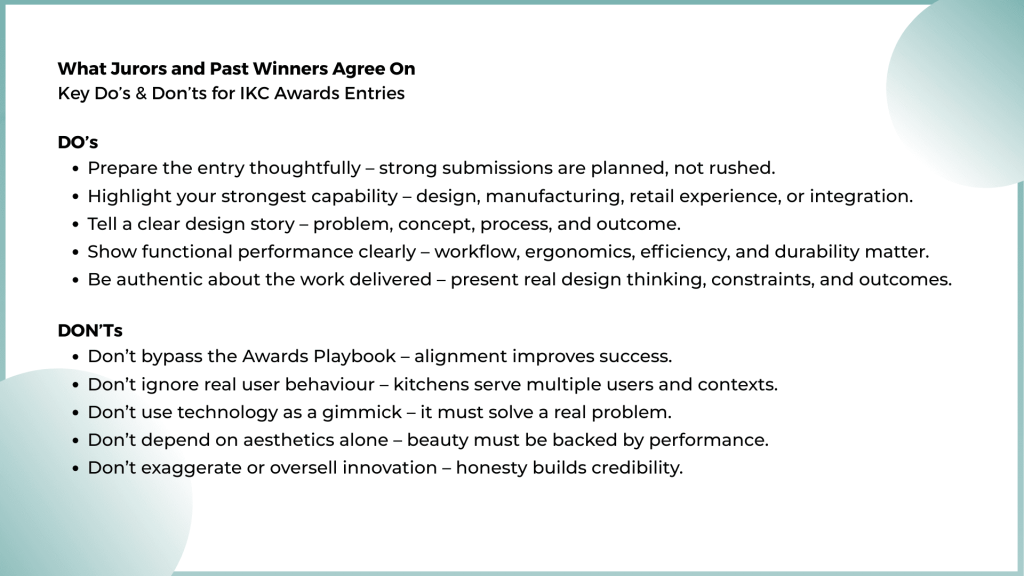
From the jury’s standpoint, Prasad explained that authenticity remains the first filter while evaluating entries for the IKC Awards 2026. While aesthetics play a role in creating perception, they must be supported by functionality, ergonomics, efficiency, and durability. Kitchens, he noted, are workspaces used by multiple family members, and good design must address real-life usage patterns rather than surface-level novelty.
The discussion also looked ahead at future-ready kitchens. Prasad encouraged designers
to think beyond visible technology and consider sustainability and circularity—addressing water usage, organic waste, and long-term environmental impact. He argued that speculative design should simplify life for users, not add complexity. Dhone echoed this view, stressing the need to balance technology with fundamentals such as workflow, smart storage, performance, and ease of maintenance.
Open Kitchens and Indian Realities
The webinar also touched upon the growing popularity of open kitchens in Indian homes. While open formats encourage social interaction and family participation, both speakers agreed that solutions must remain flexible, considering cooking habits, odours, space constraints, and user preferences. Hybrid and adaptable kitchen designs, they noted, may offer the most practical path forward.
The discussion also highlighted the importance of preparation. The IKC Awards 2026 Playbook offers comprehensive guidelines on categories, evaluation criteria, do’s and don’ts, and storytelling frameworks for crafting strong submissions. Participants were encouraged to study the Playbook carefully, as well-prepared entries consistently perform better during jury evaluation.
Why Preparation Matters for IKC Awards 2026
As the submission deadline approaches, conversations around the IKC Awards 2026 serve as a timely reminder that award-winning kitchens are not built on presentation alone. The strongest entries combine clear storytelling with deep, user-centric design thinking, sustainability, and execution excellence—qualities that ultimately push the entire kitchen and cabinetry ecosystem forward.
ALSO READ