

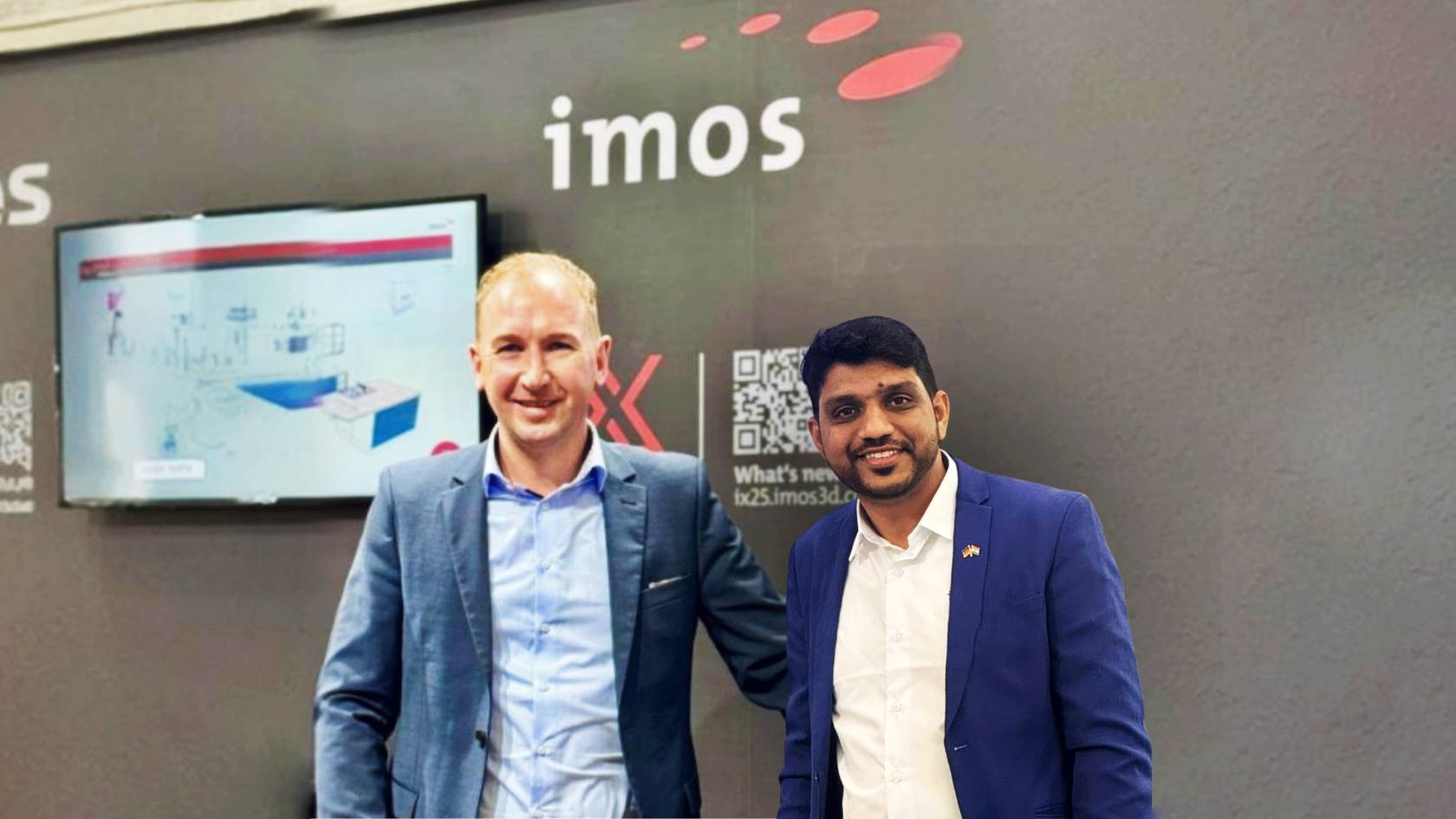
For India’s furniture and woodworking industry, the last decade has been a period of unusually fast structural change. Demand has expanded, the organised home interiors ecosystem has gained momentum, and manufacturers have learned—sometimes the hard way—that customisation is no longer a premium feature but the core operating condition of the market. IMOS on India’s furniture industry scaling moment captures why one phrase kept surfacing in different forms in a recent conversation with Ingo Bathe, international sales director at Germany-based imos AG, and Sumeet Ashtekar, who heads sales in India: time-to-market.
Bathe describes India as a “development-driven” market—not merely because it is growing,
but because customers push for new capabilities and expect suppliers to respond quickly. “A lot of our customers… are pushing us to step into new functions and features,” he says. That pressure is amplified by how rapidly Indian manufacturers are iterating on product lines and showroom offerings. The industry’s competitive rhythm—new finishes, new portfolios, new price points—demands tools that can compress decision-making from the showroom to the shopfloor.
To explain why India sits among IMOS’ top three markets globally, Bathe uses a consumer
spending lens. A decade ago, he says, average furniture consumption in India was around
US$5 per person, and is now closer to US$20—a jump he frames as a 300% expansion. Even if India’s per-capita number remains far below mature markets, the rate of growth changes the technology conversation. In mature markets, incremental gains in productivity can be pursued calmly. In India’s furniture industry, the pace of demand makes manual,
disconnected workflows break quickly.
Ashtekar notes that this transition is already visible in adoption patterns. IMOS today serves over 200 active customers in India, and onboarded more than 25 new clients during 2025 alone, many of them organised interior brands operating multi-city showroom networks seeking to standardise the flow from customer interaction to factory execution.

The Shift: From Machine Automation to End-to-end Digital Workflows
Ashtekar offers a useful India-specific chronology. About eight to nine years ago, he says,
the conversation was largely about machine automation—CAD/CAM integration and
generating CNC programs. That capability was typically confined to top-tier players who
could afford the investment and the change-management that came with it. After 2020, the emphasis widened: not just ‘design to production’ but ‘sales to manufacturing’, with the
showroom becoming the first node of a production workflow rather than a separate
commercial activity.
That shift maps neatly to what organised kitchen and wardrobe brands have been trying to
build: faster, higher-confidence customer interactions that translate cleanly into
manufacturable orders.
According to Ashtekar, many of these deployments involve companies operating 20–50 or more retail outlets, where consistency becomes as critical as speed. In such environments, catalogue logic is pre-defined by a central technical team, allowing showroom designers to configure products within approved manufacturing limits rather than designing from scratch—ensuring that what is sold remains buildable without downstream reinterpretation.
“Today you get a quotation, a floor plan and elevation, a VR picture, an AI-driven picture,”
Bathe notes—while also warning that the real challenge lies in ensuring that what is
promised at the customer end is the same “language” that arrives at the factory end.
This is where IMOS’ philosophy, as Ashtekar puts it, is “production to sales”—a
manufacturing-first logic where the catalogue and configuration rules are defined by what
the factory can reliably produce. The objective is not only speed, but fewer translation
steps. In a typical Indian workflow, a front-end design might be created in one tool and then re-created or “translated” into another tool for production detailing. That translation,
Ashtekar says, is where time is lost and errors are born—often leading to rework, missed
details, and site-level surprises. An integrated workflow reduces redesigning and
compresses the sales cycle because pricing and revisioning can happen quickly.
In practice, this allows designers to modify finishes, hardware or dimensions during live
customer discussions while instantly recalculating quotations. Once confirmed, orders move
through a light validation step before being pushed directly into production—removing the
redesign loops that traditionally slowed Indian workflows.
The economic impact is not abstract. In a market where a customer might give only a few
hours for a design conversation, a quotation that takes two to four days to generate is no
longer a benign internal delay—it becomes a conversion risk. Faster iteration of design,
finishes, hardware, and pricing is therefore a revenue lever as much as an operational lever
in India’s furniture industry.
Beyond Cutting and Drilling: Bringing Installation into the Digital Chain
If earlier waves of digitisation focused heavily on factory automation, IMOS is also pushing
into the area that Indian manufacturers often treat as the most chaotic: assembly, dispatch, and installation. Bathe describes a post-2021 development called iScout, designed to make each order more transparent from factory to site.
At a basic level, iScout generates packing lists for hardware, assembly drawings, and order documentation. But its logic is broader: barcode-driven tracking that functions like a light MES layer—scanning a job to see whether it has been cut, edged, drilled, picked, packed, or shipped. For installation teams, this becomes a browser-based, tablet-friendly interface that can show floor plans with position numbers, elevations, drawings, and even acceptance protocols.
In India, where flat-pack delivery and on-site assembly dominate, this matters more than it
might in some European workflows. Ashtekar describes a practical scenario: an installer
scans a barcode using a tablet camera and the system identifies which panel belongs to
which location in the project. For kitchens and wardrobes that may contain multiple
similarly sized cabinets with different internal configurations, that reduces confusion and
prevents mis-installs.
Perhaps the most operationally significant feature is what Bathe calls the “short time slot”
between identifying a damaged panel at site and getting it remade. If a broken part can be
flagged digitally and sent back for recut, re-edge and re-drill without ambiguity, the cycle
time between “problem identified” and “customer made whole” shrinks sharply. In a
service-heavy category like kitchens, where the brand is judged not only by product but by
installation experience, that feedback loop becomes a competitive differentiator.
AI Enters the Showroom—Carefully
For IMOS, AI is no longer a speculative buzzword. Bathe calls it “daily business,” and
describes how the company’s AI roadmap emerged from customer conversations—particularly at India Kitchen Congress—and was showcased at LIGNA before being embedded into the product stack. The first major visible outcome is AI rendering:
generating a high-quality image in roughly 15 seconds, compared to traditional rendering
workflows that required extensive development of visual logic and manual placement of
décor elements.
Ashtekar explains that the primary bottleneck AI addresses is not technical kitchen design
itself but presentation readiness. Designers often spend hours adding lighting effects, décor
artefacts or ambience elements required for customer visualisation. AI-assisted rendering
compresses this process dramatically—sometimes reducing rendering preparation from
several hours to under a minute—allowing designers to focus more on technical accuracy
and order closure.
But IMOS is also careful about a problem many design teams have begun to notice: AI can “improve” a picture by quietly changing what matters. Bathe explains that if AI-driven rendering alters cabinet configurations, handle positions, or layout logic, the image might no longer represent a manufacturable—and quote-accurate—kitchen. IMOS’ approach is to embed AI inside the system with guardrails: AI may change lighting, décor, or ambience, but it must not change the furniture configuration that is tied to a customer order.
Beyond rendering, Bathe points to AI-led tools that support catalogue configuration—automating catalogue data creation to speed up time-to-market. He also references an upcoming AI service tool (planned for March) designed to answer user questions in any language, reflecting an effort to reduce friction in adoption and support. On the horizon are “picture-to-configuration” concepts: photographing a room or kitchen and generating a configuration using the supplier’s defined portfolio, as well as tools that suggest styles—country, city-modern, etc.—based on a brand’s own door-and-handle pool and patterns in past orders.
The Export Question, and the Uber-like Design Hub Model
On exports, Bathe is cautious but directional. India remains largely domestic in furniture, he says, but global trade dynamics and shifting tax structures could make India a production hub over time. Ashtekar adds that some Indian customers are already shipping to the Middle East, the US, South Africa, and parts of Europe. In such cross-border models, the need for a shared digital “source of truth” becomes critical: designs, quotations, margins, and production data need to remain consistent across geographies and currencies.
Ashtekar notes that several Indian IMOS users have already begun supplying projects
beyond domestic markets—including the Middle East, the US, South Africa and parts of
Europe—making digitally consistent design and production data increasingly essential for
cross-border execution.
Bathe also describes an “Uber-like” business model that he says is emerging from India:
design hubs that do not manufacture themselves but connect customers to production hubs
across cities or countries to reduce shipping costs and avoid unnecessary travel. In that
frame, brands like Livspace and HomeLane—whom Bathe identifies as IMOS
customers—are examples of how India is experimenting with distributed production linked
by standardised digital workflows.
The Capability India Needs Next: Quality, IT Strategy, and Workflow Thinking
When asked what skills India must build to maximise digitisation, Bathe begins with an
unusual answer: motivation. India’s drive to be “better next day than the day before,” he
says, is a foundational advantage. But competitive advantage cannot be sustained on speed alone. As India looks outward, quality will become pivotal—not “10,000 cabinets a day” with rudimentary standards, but repeatable quality that strengthens branding and export readiness.
He also argues that IT strategy—minimising unnecessary human interactions, tightening
information flow from point of sale to factory, and automating reporting—will become
increasingly important. IMOS’ own tools such as iBots (workflow automation) sit within that
agenda.
A parallel constraint, Ashtekar adds, is talent availability. Because IMOS operates as a
technical design-to-manufacturing platform, designers typically require structured training
followed by one to two months of practical exposure before becoming fully productive. As
adoption expands, demand for IMOS-trained designers is rising sharply, prompting collaborations with around six training institutes across India, including industry and skilling
partners such as Furniture & Fittings Skill Council (FFSC), to widen the pipeline of industry-
ready professionals.
Finally, IMOS’ India strategy itself is framed in a single word: growth. Bathe says he has stepped back from the day-to-day India role, handing the reins to Ashtekar as sales director, backed by a young India team (including a hub in Hubli/Bengaluru) and education
partnerships through FFSC. One concrete move is pricing innovation: a more “industry-
friendly” subscription entry point for smaller businesses—starting at €375 per month—paired with training support. Bathe acknowledges that manufacturing software is “critical infrastructure,” which is why many factories still prefer perpetual ownership. But a lower-entry subscription model could widen the base of digital adoption among small and mid-sized shops now realising that machines alone are not enough.
Taken together, the picture is of an industry in transition—from the early thrill of
automation to the harder discipline of scale. India’s furniture industry is learning to
compress sales, design, costing, production, dispatch and installation into a single digital
thread.
If customisation was the first revolution, the next one is about something more difficult:
making customisation industrial-grade.
ALSO READ