

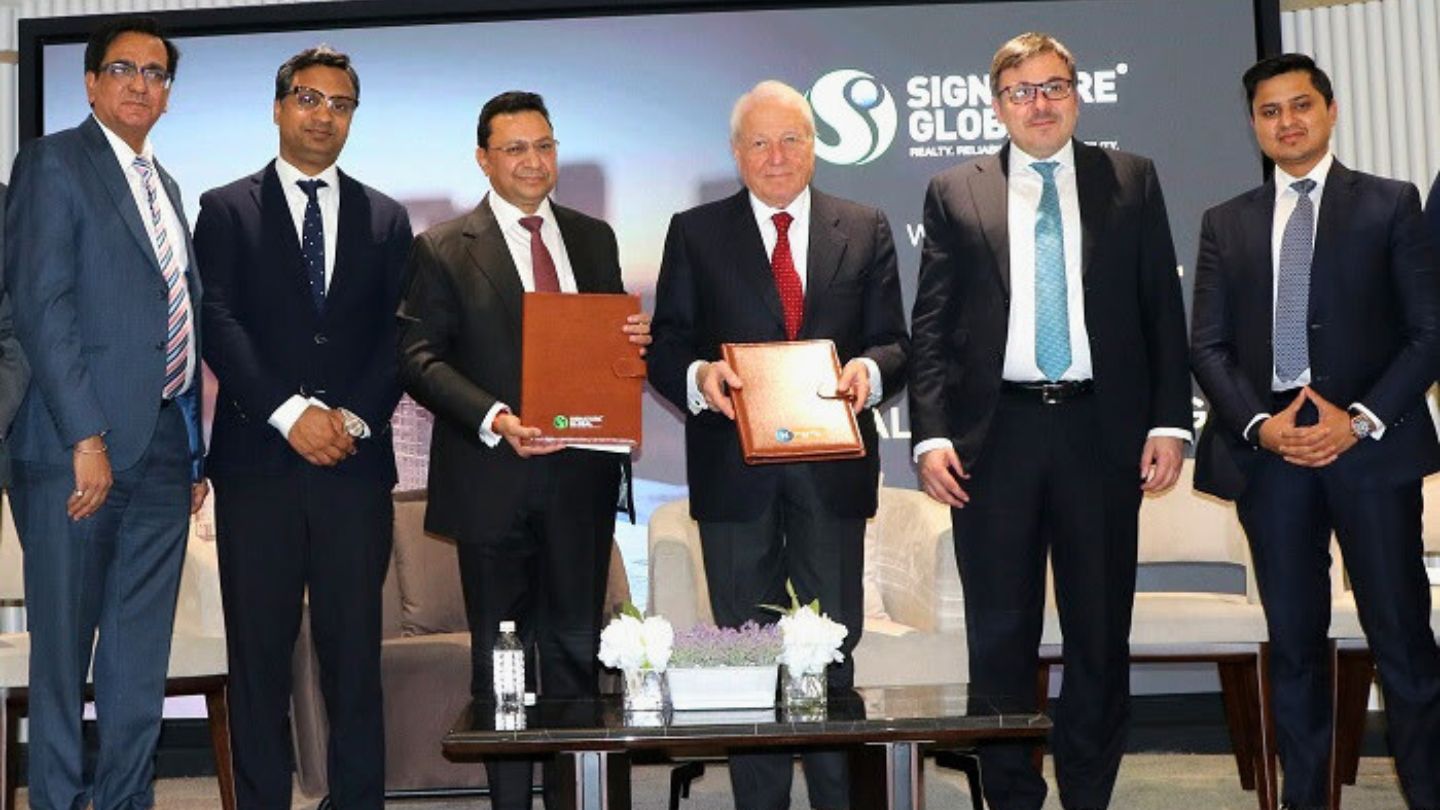
In a move that reflects the rising importance of resilience-led design in Indian real estate, Signature Global has signed a ₹380-crore memorandum of understanding (MoU) with Indo-Italian engineering firm CECO Hirun Pvt Ltd, in technical collaboration with HySAFE, to deploy advanced earthquake-resistant technology across its high-rise projects over the next 15 years.
The agreement centres on the adoption of Hysteretic Tuned Mass Dampers (HTMDs), a specialised vibration-control system designed to reduce building movement caused by wind and seismic activity. The earthquake-resistant technology will be integrated into Signature Global’s high-rise developments through a structured programme covering design evaluation, industrial manufacturing and on-site deployment in India.
High-rise Design Under new Pressures
As Indian cities densify and vertical development accelerates, high-rise buildings are increasingly exposed to dynamic forces such as strong winds, temperature variations and seismic events. While building codes address life safety requirements, developers are now looking beyond compliance towards solutions that improve structural performance, occupant comfort and long-term durability.

This shift is especially relevant in regions such as Delhi-NCR, which lies in Seismic Zone IV. In such geographies, the integration of earthquake-resistant technology at the design stage is becoming critical to manage building sway, protect structural and non-structural elements, and minimise post-event maintenance and downtime.
HTMDs work by absorbing and dissipating energy generated during wind or seismic activity. Unlike conventional tuned mass dampers, which perform optimally within a limited range, hysteretic systems remain effective under varying load conditions. This makes the technology particularly suited to tall residential towers where consistency of performance over decades is essential.
From Safety Compliance to Lifecycle Performance
By embedding earthquake-resistant technology into its design philosophy, Signature Global aims to enhance overall structural behaviour while safeguarding interior components such as partitions, façades, elevator systems and building services. Reduced vibration can help limit long-term wear and tear, lower repair costs and improve occupant comfort—factors that increasingly influence buyer perception in mid and premium housing segments.
Under the collaboration, CECO Hirun will design project-specific HTMD systems tailored to local construction practices, while leveraging global engineering expertise in vibration-control and anti-seismic solutions. Execution in India is expected to allow closer coordination with project teams and structural consultants.
Commenting on the MoU, Lalit Aggarwal, Vice Chairman and Co-founder of Signature Global, said the initiative aligns with the company’s focus on integrating safety, comfort and resilience as cities build taller. He noted that advanced earthquake-resistant technology allows developers to address both structural integrity and long-term livability within the same framework.
Dr Agostino Marioni, Chairman of CECO Hirun India, said the partnership brings together international engineering experience and Indian execution capability, with the shared objective of improving building performance and setting higher benchmarks for resilient urban infrastructure.
Implications for the Building-products Ecosystem
The deployment of advanced earthquake-resistant technology also has wider implications for the building-products and construction ecosystem. As developers increasingly adopt such systems, demand is expected to rise for precision-engineered components, specialised fabrication, testing facilities and skilled installation teams. For suppliers, this points to growing opportunities in high-performance, resilience-focused solutions aligned with India’s evolving urban landscape.
About the Partners
Signature Global’s expansion across NCR has been anchored in a focus on execution discipline, timing of launches and adherence to defined market segments, even as the company has broadened its portfolio beyond affordable housing into mid and premium residential developments.
“Over the years, we have tried to stay disciplined about how and when we launch projects, and about building scale through execution rather than land banking,” said Aggarwal. “That approach has helped us navigate different market cycles while maintaining delivery momentum.”
As of H1FY26, Signature Global has delivered 16 million sft of real estate. Its pipeline includes 17.1 million sft of recently launched projects, 24.3 million sft of forthcoming developments and 8.9 million sft under ongoing construction, scheduled for execution over the next two to three years. In FY25, the company reported sales bookings of ₹102.9 billion and recorded a CAGR of 58% between FY22 and FY25. The company is backed by institutional investors including Nomura, HDFC and IFC.
CECO Hirun is an Indo-Italian engineering joint venture specialising in advanced structural devices and anti-seismic systems. Working in technical collaboration with HySAFE, the company focuses on vibration-control solutions for complex building and infrastructure projects, supporting improved safety, performance and long-term resilience.
ALSO READ