


Tusker Steel Kitchens targets durable channel growth as SS and ACS cabinetry create long-
life opportunities for OEMs and channel partners.
India’s modular kitchen market has evolved largely around plywood and engineered panels, supported by advances in laminates, hardware and finishes. Yet, questions around long-term durability continue to surface, particularly in Indian conditions where kitchens are subject to intensive daily usage and high exposure to moisture. In this context Tusker is presenting stainless steel and ACS cabinetry as a long-life alternative for Indian homes.
Built Around Indian Kitchen Realities
“Our starting point was to understand how Indian kitchens are actually used,” says V V
Chatran, founder of Tusker Kitchens. “Data shows that an average household uses about
462 litres of water per day, and families spend nearly 7 hours 56 minutes daily in the kitchen. These usage conditions are very different from markets where modular kitchens
evolved earlier.”
Tusker’s core proposition is based on 304-grade stainless steel cabinet structures combined
with aluminium shutters. According to Chatran, the company’s effort has been to develop
cabinetry that remains stable despite prolonged exposure to water, heat and cleaning cycles.
“In many homes, kitchens are expected to last for decades. However, materials such as
plywood or particle board can deteriorate over time when exposed to moisture. We wanted
to explore whether metal structures could offer greater predictability in performance,” he
explains.
Engineering Longevity Into the Product
A distinctive feature of Tusker’s engineering approach is the use of threaded inserts
combined with crimping technology for cabinet assembly.
“When screws engage directly with sheet metal, repeated removal can weaken the
structure. Our threaded inserts are crimped into the metal, allowing shutters to be removed and refitted repeatedly without compromising structural integrity. Our internal testing indicates durability of up to 1.82 lakh shutter movement cycles,” says Chatran.
This structural approach allows shutters or finishes to be changed without replacing the
cabinet carcass, extending the usable life of the kitchen. The company is also developing
stainless steel countertop systems as part of its broader attempt to reduce dependence on
wood-based substrates in kitchen environments.
“Our effort is to see how far the idea of a long-life kitchen can be extended. Countertops are a natural extension of this thinking,” he notes.
Beyond Kitchens, Into a Wider Cabinetry Play
Beyond kitchens, the company has been extending its product portfolio into wardrobes,
vanities, TV units, crockery storage and utility modules, based on the view that durability
considerations extend to multiple storage applications within homes.
“If customers begin to appreciate durability advantages in kitchens, the same logic often
applies to wardrobes or utility areas exposed to moisture,” Chatran observes. The broader
intent behind Tusker steel kitchens is therefore to build acceptance for metal-based
cabinetry as a practical solution across residential storage categories.
Standardisation as a Growth Lever
At a manufacturing level, Tusker has attempted to apply standardisation principles to metal
cabinetry. The company has developed a library of 864 standard modules, enabling
components to be configured with relatively predictable delivery timelines.
“We are moving towards an inventory-led approach rather than purely project-based
fabrication. Standardisation helps improve consistency and installation efficiency,” he
explains.
Tusker indicates that typical delivery timelines are about 14 days from order confirmation,
with installation completed in approximately 14–21 hours, depending on project size.
This manufacturing logic is important to the company’s channel and OEM pitch. A
standardised product with coded modules, faster dispatch and quick installation is easier to
scale than a fully bespoke system.
An 18,000 sft Facility Built Around Inventory Logic
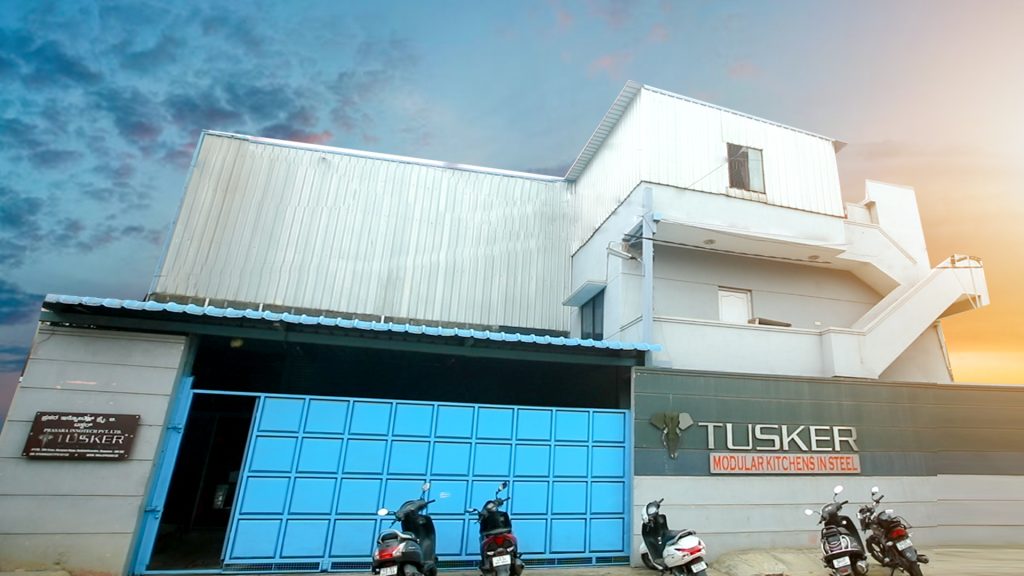
Tusker’s production infrastructure currently includes an 18,000 sq ft facility, but Chatran
describes the company as being driven as much by inventory discipline as by manufacturing capacity.
“We are not a manufacturing-centric organisation in the usual way. We are an inventory-
centric company,” he says. “Since the product is metal, it does not deteriorate in the way
other materials can. So we standardise, produce, code and keep inventory ready.”
Each cabinet module and component is coded, allowing most orders to be dispatched from
stocked inventory. Only non-standard items typically move into production.
Tusker uses software-driven optimisation to improve cutting patterns and reduce manual
intervention in the production process. According to the company, this approach supports
faster order processing and predictable execution timelines.
ACS Broadens the Market Opportunity
Recognising that stainless steel kitchens may be perceived as premium, the company has
introduced ACS (Alloy Coated Steel), positioned between galvanised iron and stainless steel
in price-performance terms.
“ACS allows us to address a wider segment of the market. The material retains corrosion
resistance characteristics while reducing overall system cost by approximately 25–28
percent,” Chatran says.
Tusker positions stainless steel kitchens with durability expectations of up to 25 years, while ACS kitchens are positioned with durability expectations of around 15 years. The tiered material approach is intended to expand the addressable market beyond premium kitchens into the mid-segment.
Tusker’s channel strategy has also evolved over time. The company earlier worked with a
large dealer network, but has since rationalised the number of partners to focus on those
aligned with its consultative sales approach.
“Steel kitchens require a different conversation with customers. The value proposition is
based on lifecycle performance rather than only visual appeal. We are therefore focusing on
partners who are comfortable positioning the product in this manner,” Chatran explains.
A COCO-led Expansion Model, With the Partner as Space Investor
Tusker’s showroom expansion model is also somewhat different from a conventional
franchise route. Chatran says the company is currently operating largely on a COCO —
company-owned, company-operated — model, even when it works with local partners.
“At the moment, it is largely a COCO model,” he explains. “Tusker is investing in the
showroom, the operations are ours, the team is ours, and the product investment is ours.”
The role of the local partner, in this structure, is primarily to provide the real estate.
According to Chatran, Tusker is looking for partners from the sanitaryware, building
materials or allied home improvement trade who can provide around 2,000 to 3,000 sq ft of space in their building.
“We are taking the area in the partner’s building — first floor, second floor, third floor, that
does not matter. The premises come from the local partner. The capex and opex for the
showroom are largely ours, except for the premises,” he says.
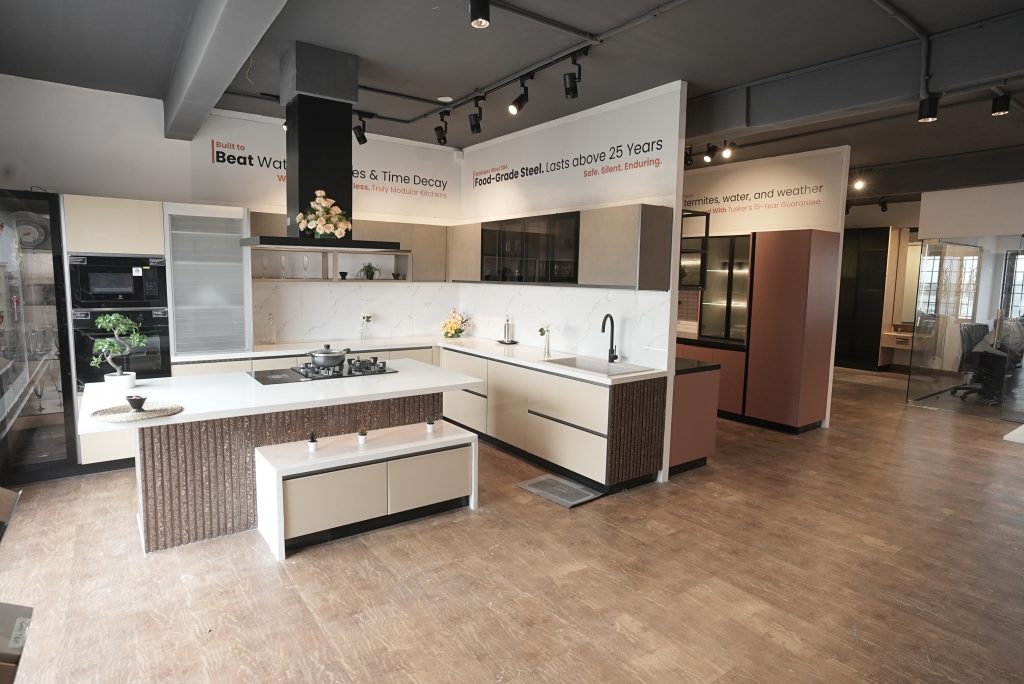
In effect, this makes the local associate less of an operating franchisee and more of an
investor-landlord partner, with Tusker retaining control of brand presentation, sales process
and execution. Chatran says the partner is not expected to run the store.
“He is not involved in the operations at all. He is mainly giving the premises. Instead of
earning rental income, he earns a commission from the business,” he explains.
That structure reflects Tusker’s learning from its earlier dealer-led phase. Since steel
kitchens require a more consultative pitch, the company appears keen to retain control over the customer conversation, product display and conversion process. For the local partner, meanwhile, the proposition is framed around monetising owned commercial space without taking on the complexities of retail operations.
OEMs Emerge as a Stronger Route to Scale
Tusker also sees OEM partnerships as an important growth avenue, particularly among
developers, contractors and design-build firms seeking standardised solutions.
“OEM customers value predictability. Standardised cabinet systems allow consistency across projects, which becomes important for scale,” he says. This is where Tusker steel kitchens align with broader industry efforts to build more reliable and repeatable interior solutions.
The company indicates that it has consistently invested in technology development, with
technology expenditure historically exceeding 10 percent of revenue.
“Technology helps us improve design precision and reduce installation complexity. Over
time, this supports scalability,” Chatran notes.
IKC as a Platform for Market Conversations
Tusker will be exhibiting at India Kitchen Congress (IKC), where Chatran expects to engage
with manufacturers, designers and channel partners evaluating alternative material
approaches in kitchens and cabinetry.
“We have attended IKC earlier as well. It is one of the few forums where serious
conversations take place about how the kitchen industry in India is evolving,” he says.
A Specialised Proposition, With Scale in Mind
While panel-based modular kitchens continue to dominate the market, alternative material
systems are gradually gaining interest among customers seeking longer lifecycle solutions.
Within this evolving landscape, Tusker steel kitchens represent an attempt to build a
specialised but scalable category around durability-led product propositions.
For channel partners and OEM firms looking to differentiate their offering through lifecycle
value, Tusker steel kitchens present a proposition that combines material innovation with
standardised manufacturing logic.
ALSO READ