
In Mumbai, the country’s largest metropolitan real estate market, residential demand is undergoing a steady but significant shift. According to Knight Frank, Mumbai’s residential market remained steady in H2 2025, with housing sales reaching 50,153 units, marking a 3% YoY increase, and momentum increasingly driven by mid-premium and mid-luxury housing. “Demand remained steady, supply was tightly managed, and prices continued to firm,” the report states, reflecting a consolidation rather than slowdown.
Within this environment, developers operating in this segment are finding opportunity not in excess, but in balance — between aspirational amenities, affordability, and functional design.
Premium, but Practical Spaces
Among developers catering to this evolving mid-luxury housing market is Alliance City
Developers, a Mumbai-based real estate firm with over a decade of operating experience. According to its co-founder and CEO, Ankita Luharuka, the convergence of thoughtful design, functionality, and material efficiency is reshaping both buyer expectations and supplier demand.
“Design is at the heart of everything we do,” Luharuka said. “But design cannot be only
about visual appeal. It has to be usable and emotionally engaging — especially in a city
like Mumbai, where space is limited and intelligent planning becomes critical.”
She noted that design choices today increasingly depend on material innovation, citing
the use of soundproof windows, sensor-based sanitaryware, video door phones and gas
sensors as examples of features that enhance both safety and everyday usability.
Equally important in mid-luxury housing, she said, is the focus on low-maintenance living. “Amenities need to be meaningful. For instance, many residential societies struggle with maintaining swimming pools that are rarely used. Similarly, we avoid hydraulic parking where possible and focus on simpler, more reliable systems,” Luharuka said, adding that timely delivery has become non-negotiable in a market where buyers have multiple choices.

Beyond execution timelines, trust and transparency remain central to Alliance City’s operating philosophy. “Real estate is as much about responsibility as it is about scale,”
she said, pointing out that sustainable growth depends on long-term relationships with
channel partners, contractors and suppliers.
This emphasis on process discipline is also visible in the developer’s regulatory approach. Recently, Alliance City received MahaRERA approvals for two residential projects in Vile Parle East — 22 Alliance House and Alliance Tanvi — despite neither project being mandatorily required to register under RERA. Voluntary registration, increasingly adopted by mid-luxury developers, is emerging as a confidence-building measure for buyers and stakeholders in mid-luxury housing, a segment where credibility and predictability matter as much as location.
Reframing what ‘Luxury’ Means
The definition of luxury housing itself is evolving. Rather than high-end facilities alone, buyers are increasingly seeking a balance between aspirational amenities, affordability
and a sense of human connection.
Alliance City has been focusing on inclusive design elements, particularly for senior citizens. In some of its projects, terrace gardens have been designed as social spaces for elderly residents, with elevators providing direct access and features such as handrails incorporated into lift design.
“Post-COVID, buyer behaviour has changed significantly,” Luharuka said. “There is renewed interest in larger homes and joint-family living. Proximity to railway and metro stations, access to workplaces, and usable amenities within the building have become decisive factors.”

She added that demand is strongest in established micro-markets where connectivity and social infrastructure are already in place. Neighbourhoods such as Vile Parle East, for instance, continue to attract buyers looking for compact, well-specified homes close to transport hubs, educational institutions and healthcare facilities. Projects offering 2 to 4 BHK configurations in the 700–1,800 sft range reflect how mid-luxury housing is being shaped by efficiency, execution certainty and material quality rather than sheer scale.
This shift has also influenced project planning. Alliance City is now targeting larger land parcels of over 2,000 sqm for future developments, compared to earlier projects built on 1,500 sqm plots. Design and material choices, Luharuka said, are increasingly guided by Mumbai’s mixed climatic conditions and long-term durability requirements.
Alliance City’s portfolio is concentrated in mature suburban neighbourhoods such as Mulund, Vile Parle, Malad and Borivali — markets where execution reliability and material quality matter more than speculative scale.
Procurement Trends: Opportunities for Suppliers
These changes at the project level mirror broader shifts in the building materials market. A Deloitte analysis estimates that India’s building materials industry will grow from around $105 billion in FY2025 to $166 billion by FY2030, driven in part by rising demand for sustainable and technology-enabled housing solutions.
For suppliers, this translates into growing demand for materials that are durable, low-
maintenance and consistent in quality. Luharuka pointed to increasing interest in readymade and precision slabs, which remain limited in availability in India. “If these solutions become more accessible, material wastage can be significantly reduced,” she
said.
Customised construction — particularly for senior-friendly housing — has also expanded demand for matte-finished and anti-skid tiles, elevators with stretcher access, bathroom
sensors, alarms and handrails. “The trend of making senior-citizen-friendly residential spaces has picked up post-COVID,” she said, adding that developers are investing more
time in research and design to address these needs.
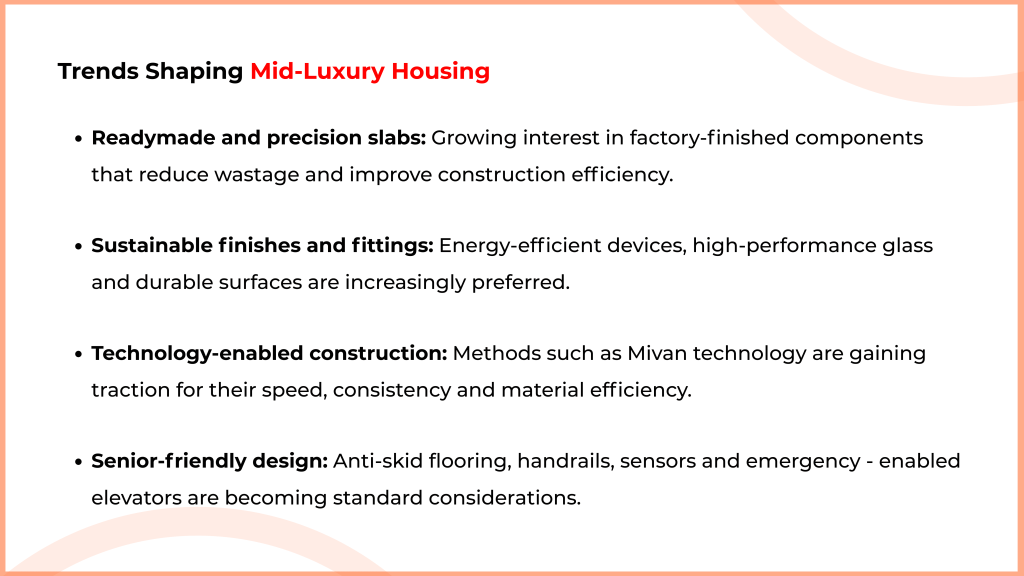
Alliance City has also adopted Mivan technology, a construction method that uses lightweight aluminium formwork to cast walls and floors. The approach has helped reduce material wastage, leakage issues, and dependency on multiple materials such as bricks, plaster and gypsum.
From a supplier’s perspective, the company’s development pipeline also points to sustained and predictable demand. With multiple residential projects across Malad, Vile Parle, Borivali and Mulund nearing possession in 2026, Alliance City represents the kind of mid-sized developer where material consistency, repeat sourcing and execution reliability matter more than one-off specifications.
For suppliers of formwork systems, interior finishes, fittings and smart-home components, such portfolios increasingly offer scale through repetition rather than volume through megaprojects.
For homebuyers, in turn, the shift reflects a preference for homes where functionality, efficiency and sustainable living take precedence over superficial luxury.
ALSO READ