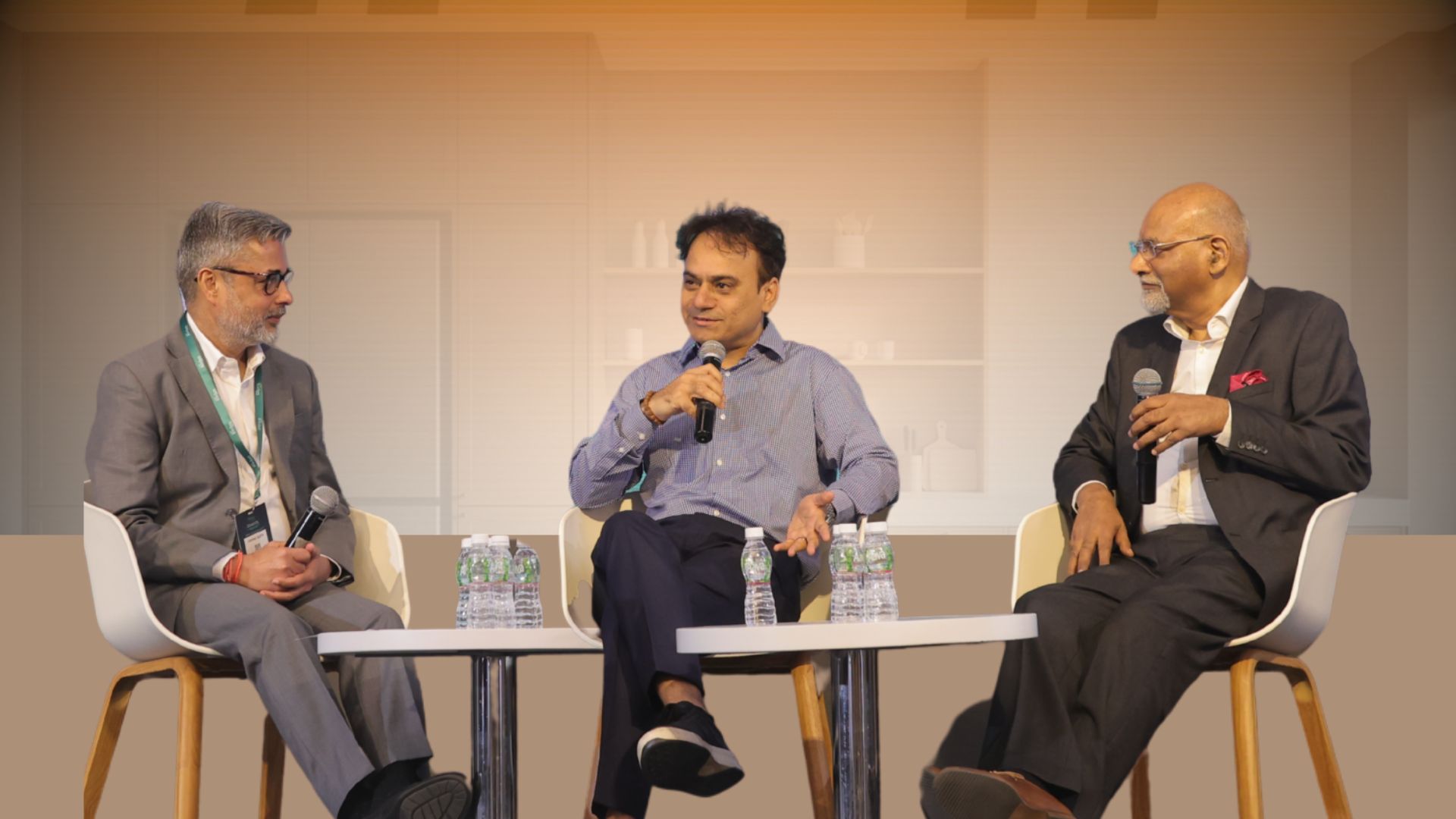
India’s furniture industry is attracting growing investor interest as scale, predictability and specialisation become critical drivers of growth. Livspace co-founder Ramakant Sharma and TPlusA founder A K Goel explain what manufacturers must do to attract capital, build scale and compete globally.
India’s furniture industry is entering a new phase of growth. Long characterised by fragmented manufacturing, localised retail networks and largely unorganised operations,
the sector is gradually evolving into a more structured and scalable industry. Rising incomes, changing lifestyles and growing consumer spending on home improvement are creating fresh opportunities, while investors are increasingly looking at furniture and interiors as a serious long-term growth category.
Few industry leaders have had a broader view of this transformation than Ramakant Sharma and A K Goel.
Sharma co-founded Livspace in 2014 and helped build it into one of India’s largest home
interiors platforms, attracting investments from global investors including IKEA, KKR and
Goldman Sachs. Goel spent decades shaping India’s furniture fittings ecosystem, worked
closely with furniture manufacturers across the country, and now leads TPlusA, a venture
backed by strategic investors including Livspace.
Speaking at India Kitchen Congress 2026, the two industry veterans shared their perspectives on why capital is beginning to flow into the furniture sector, what capabilities
investors are looking for, and what manufacturers must do to participate in the next phase
of growth.
Capital Follows Capability, Not Just Demand
According to Sharma, India’s furniture industry has reached a critical inflection point. While
furniture has traditionally been viewed as a discretionary purchase, rising per capita income
and changing lifestyle aspirations are transforming the category into a mainstream consumer priority. Consumers are increasingly investing in better kitchens, wardrobes, living spaces and home experiences.
However, demand alone does not attract capital. “Capital always finds its way where it gives the maximum ROI,” Sharma observed, arguing that investors ultimately seek scalable and predictable business models rather than demand in isolation.
For years, this was difficult in furniture. Manufacturing was fragmented, retail operations
were largely localised, and supply chains lacked consistency. Sharma described furniture as
one of the most primitive manufacturing sectors compared with industries such as
automobiles, electronics and textiles.
That, however, is changing. The emergence of organised players, improving supply chains,
growing consumer demand and increasing professionalism across the value chain are
creating conditions that allow investors to underwrite long-term growth.
Sharma believes the timing could not be better. “If I had to choose an industry today, after
11 years, I’ll choose home for sure.”
He pointed to global examples as well. According to Sharma, home remains one of the most significant and profitable categories at Amazon in the United States, demonstrating the long-term potential of the sector when scale, logistics and consumer demand align.
Policy Reforms Opened the Door
Goel believes the industry’s transformation has been aided by important policy changes. He
noted that until 2013, furniture manufacturing was largely reserved for the small-scale
sector, limiting the participation of large capital and professional talent. The sector’s
deregulation enabled larger investments and encouraged more organised business models.
A second shift came during the Covid period, when policymakers increasingly recognised
furniture manufacturing as a significant opportunity for import substitution and export
growth.
Goel pointed out that despite India’s large domestic market, the country remains a relatively small furniture exporter compared with global manufacturing leaders. While India exports roughly $1 billion worth of furniture annually, countries such as China have built furniture export industries many times larger. In his view, this gap highlights the scale of opportunity available if Indian manufacturers can improve productivity, specialisation and global competitiveness.
According to Goel, these developments helped attract both capital and talent into the
industry. “The moment capital comes, talent also comes.”
As a result, furniture companies today are attracting professionals from leading engineering, management and technology backgrounds, bringing new capabilities into a sector that was historically entrepreneur-driven.
According to Goel, this influx of professional talent is one of the clearest indicators of the
industry’s maturation. As capital enters the sector, it not only funds expansion but also
attracts the managerial and technical capabilities required to build larger and more
sophisticated businesses.
Scale Creates Reliability
Both speakers repeatedly returned to a common theme: scale.
Sharma argued that the industry’s biggest challenge historically was not demand but
scalability. Manufacturing processes were difficult to standardise, supply chains were
fragmented and retail models lacked consistency.
Goel approached the issue from a manufacturing perspective. “Reliability comes out of
volume and repetition.” In his view, scalability, reliability and capability are interconnected.
As companies expand production, define processes and improve operational discipline,
errors decline, costs reduce and consistency improves.
However, Goel also cautioned against excessive dependence on outsourced manufacturing.
As companies scale, they cannot outsource their core competencies indefinitely, he argued.
Many furniture businesses continue to rely heavily on contract manufacturing, which can
create challenges around consistency, quality control and reliability. “I believe that companies should have a strong ownership of the core competence which defines their
competitive advantage.”
He illustrated this with an example from Europe. Goel recalled a conversation with one of
the world’s largest kitchen manufacturers, producing 4,500–5,000 kitchens every day.
Despite operating in Europe, the company reportedly achieves production costs lower than
China because of its scale and process discipline.
For Indian manufacturers, the lesson is clear: scale is not merely an outcome of success; it is often the mechanism through which reliability, productivity and competitiveness are created.
Watch the 27-min discussion here.
Predictability Is Emerging as a Competitive Advantage
For investors, predictability is becoming as important as growth. Sharma noted that one of
the motivations behind Livspace’s investment in TPlusA was the need for greater supply
chain predictability. More importantly, he emphasised that predictability is not merely a
concern for Livspace; it is an industry-wide requirement.
He pointed to the furniture hardware segment, estimated at approximately $2.5–3 billion,
where a significant portion of the market remains fragmented and unorganised. The challenge is not simply product availability. Manufacturers increasingly need predictable
quality, predictable pricing, predictable delivery timelines and predictable supply chains.
Without these fundamentals, scaling furniture businesses becomes difficult.
According to Sharma, building large companies requires every element of the value chain to work together—from manufacturing and sourcing to logistics and customer fulfilment.
Specialisation Will Drive the Next Phase of Growth
Another recurring theme was specialisation. Goel believes Indian manufacturers often
attempt to participate in too many categories simultaneously, limiting their ability to build
scale and efficiency.
He contrasted this with countries such as Vietnam, where manufacturers often build scale
through deep specialisation. Some companies focus exclusively on outdoor furniture, others
on sofas, while others concentrate only on dining furniture. This category-focused approach
allows them to increase capacity, improve efficiency and become globally competitive.
Similarly, he cited Nobilia, one of the world’s largest kitchen manufacturers, as an example
of a company that has built scale through focus. Rather than diversifying across multiple
categories, the company concentrated on kitchens and developed the expertise, capacity
and process discipline required to become a global leader.
“Without specialisation, without increasing capacity and without cutting costs, it will be
difficult to achieve scale.” Goel also made a striking observation: on a like-for-like basis,
furniture produced in India can sometimes be more expensive than furniture produced in
Europe. The difference, he argued, lies not in labour costs but in the efficiencies created by
scale, process discipline and specialisation.
The message for Indian manufacturers is straightforward: future growth may come not from doing more things, but from doing fewer things exceptionally well.
Brands, Not Just Products
Beyond manufacturing capability, Goel stressed the importance of building strong brands.
He argued that furniture companies should be known for their own values, quality and
customer promise rather than the brands of the components they use.
“Everyone has to start building his own brand.” According to Goel, long-term value creation
requires businesses to define their own identity and invest in building customer trust. The
strongest furniture brands of the future will not simply assemble products; they will stand
for a distinct set of values in the minds of consumers.
Supporting this view, Sharma pointed out that categories such as laminates, MDF, hardware, tiles and paints have already demonstrated how scale, distribution and brand-
building can create large and sustainable businesses.
Capability Before Capital
Although Sharma and Goel approached the industry from different perspectives—one as a
platform founder and investor, the other as an ecosystem builder and entrepreneur—their
conclusions were remarkably similar.
India’s furniture industry has reached an inflection point. Demand is growing, capital is
available and talent is entering the sector. But long-term success will depend on a
company’s ability to build capability.
Scale, process discipline, predictability, specialisation and brand-building are no longer
optional. They are becoming prerequisites for growth.
In the years ahead, capital may continue to flow into the furniture sector. But as both
leaders suggested, it will increasingly flow toward businesses that demonstrate the
capability to scale.
Enjoyed this article?
Receive Kitchen & Cabinetry Intelligence directly in your inbox.
Subscribe to newsletter. Click.
–
ALSO READ