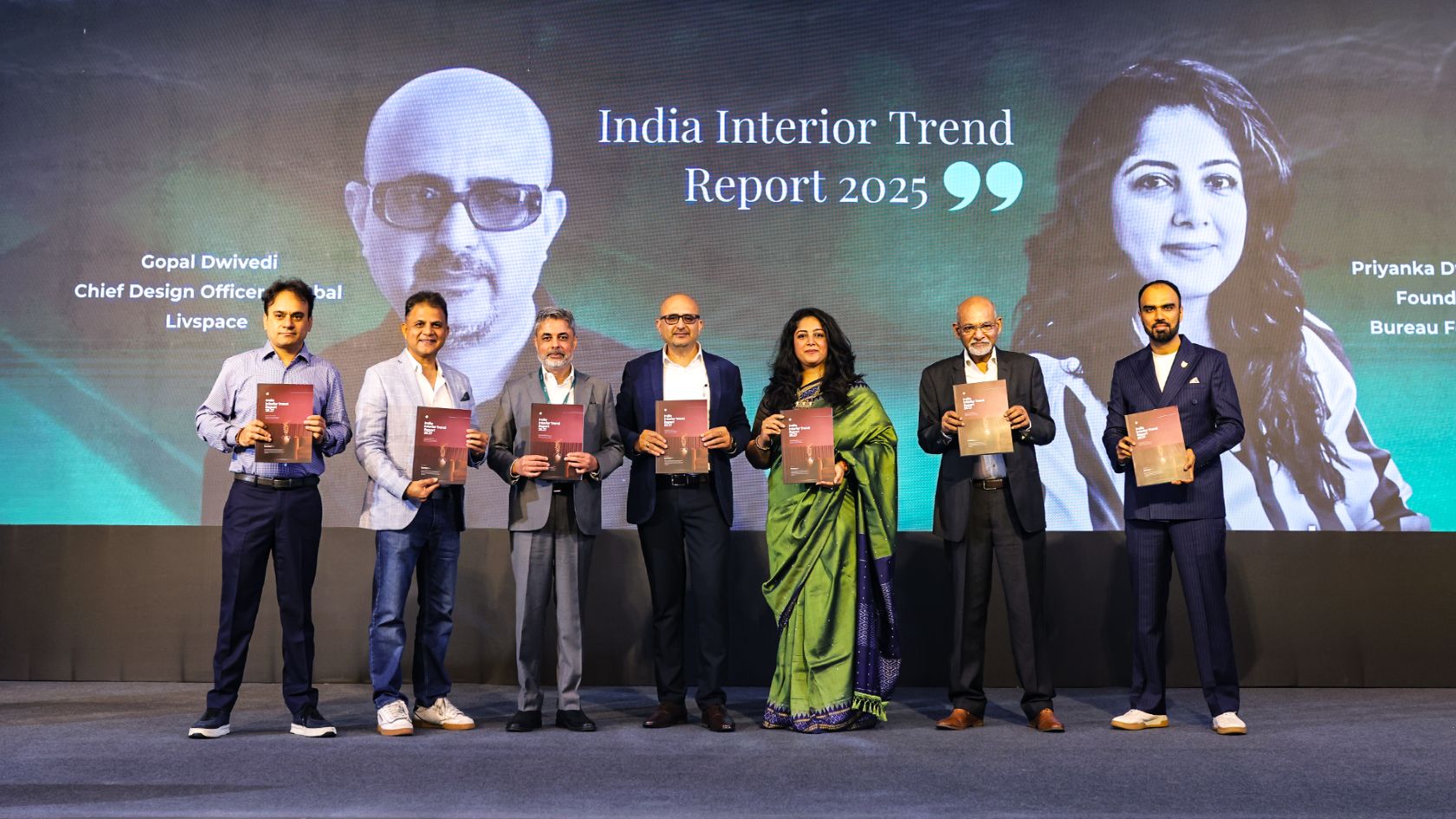
With the launch of Bureau Forma’s IITR 2026-27, India gets its own interior trend report. Until now, India’s interior industry did not have a comprehensive trend report built around its own consumers, homes and market realities. That changed in April, when Bureau Forma unveiled the India Interior Trend Report 2026-27 at the India Kitchen Congress 2026 (IKC).
IKC is an annual knowledge event for the modular kitchen, cabinetry and interior industry.
Launching the report at IKC placed it before manufacturers, designers, channel partners and suppliers—the stakeholders that are expected to apply its findings.
Priyanka Dwivedi, who founded Bureau Forma and edited the report, explained her
motivation. “For too long, our industry has borrowed references, benchmarks, and
assumptions while our homes, our families, our climate conditions, and our cultural patterns remain deeply unique.” She said her team spent months interviewing over 500 practitioners across nine cities, hosting six industry roundtables, and poring through 45+ project specifications to build something that actually reflects Indian homes.
The Problem with Borrowed Intelligence
Manish Anand, Managing Director of Kessebohmer Middle East & South Asia, also admitted
to the problem. His own company publishes trend reports every alternate year. “That report
is primarily for the European or US markets. India needs a separate trend report because
our colour choices are different, our food, our weather, climatic conditions vary.”
Swastik Ranka, founder of Paracasa Interior, said foreign reports rely on “very small
database analysis” that misses Indian traditions, culture, and habits.
The consequences of this gap can be expensive and frustrating. Standard MDF base units,
for instance, swell and warp within 18 to 24 months under Indian cooking conditions. The
report doesn’t just note this—it documents these failures with their real costs. It features a
‘failure gallery’ of nine common structural problems, hardware ratings tested in actual
Indian humidity, and a surface performance matrix scored against everyday enemies:
turmeric stains, pressure cooker heat, and relentless UV damage.
Deepak Gupta, Managing Editor of Sourcing Hardware and Conference Director at IKC,
summed up the stakes in his foreword, “The specification gap will determine who leads this
market in 2030, and who is still apologising to clients about swelling base units and drooping shelves.”
One Country, Many Worlds
If there’s one thing that seasoned marketers admit, it’s that India is not one homogeneous
market. Gopal Dwivedi, the report’s co-presenter at the launch, put it plainly: “India is not one market as we know—there are many countries in one country. What works for one
climate zone or one aspiration bracket may not work for another.”
The report treats this diversity as data, and not an obstacle. It maps nine cities across four
climate zones—coastal humid, dry-hot, humid-inland, and temperate—with substrate and
surface recommendations tailored to each. For manufacturers, this means developing
products for actual conditions rather than imported assumptions.
Vivek Modi, Director of Salice India, believes the zone-wise analysis will help hardware
makers “acknowledge the taste of the people and tune their working in that direction.”
Parth Parmar, Director of Pare Innovations, offered a concrete example, “Something that
may have worked well in the eastern market of India wouldn’t work well in the southern
market.”
For interior industry practitioners, “the interior trend report finally speaks their language
and sets out design directions, material selection and helps understand cultural nuances of
different markets within India,” said Sankari Radhakrishnan, Managing Director of NAADI.
Where the Money Is Heading
The report sizes India’s organised interior OEM market at ₹35,000 crore for FY2024-25 and projects it could reach ₹61,700 crore by 2030, assuming 12% annual growth. The housing pipeline supports this: 406,889 new homes were delivered in FY2025, up 33% from the previous year. India’s aspirational middle class is increasing too, from 432 million to a projected 580 million by 2030.
But the more telling shift is where value is concentrating. Projects in the ₹10-20 lakh band
currently make up 18-22% of organised projects in Tier 1 cities. This share is projected to
climb to 28-32% by 2030. In Tier 2 cities, where organised interior penetration is just 10-16% compared to 22-28% in metros, the share is expected to grow to 38-42% by 2030, according to IITR.
There’s also a renovation wave building up—kitchens installed between 2008 and 2016 are
reaching their replacement age, and renovation budgets typically run 20-35% higher than
for new-possession projects, states IITR.
It notes that material preferences are evolving too. Matte and suede surfaces now command 58.6% of India’s laminate market, up from roughly 35% in 2020. Soft-close hinges and tandem box drawers have become baseline expectations for projects above ₹5 lakh. And in a subtle but significant shift, motion quality—how smoothly a drawer glides, how quietly a door closes—has overtaken surface finish as the top quality signal for Indian
households.
Bureau Forma plans to make this report an annual series and Dwivedi confirms that India
Interior Trend Report operates under an Editorial Independence Charter. India’s interior
industry finally has its own trend report.
ALSO READ