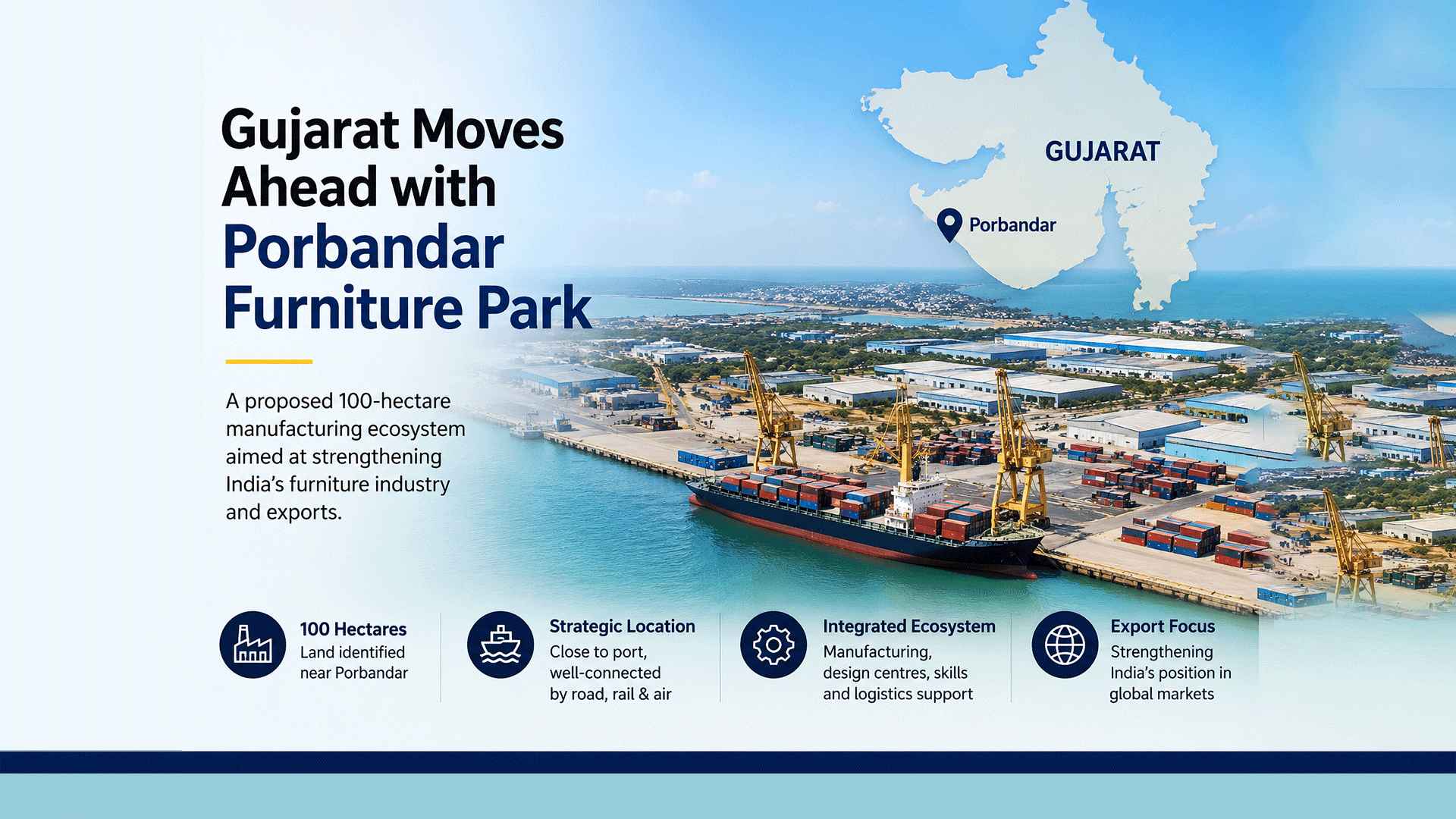
Gujarat has advanced plans for the Porbandar Furniture Park, a proposed 100-hectare
manufacturing ecosystem aimed at strengthening India’s furniture industry and exports.
The Gujarat Government has taken another step towards establishing a dedicated Furniture Park at Porbandar, bringing together industry leaders, policymakers and international stakeholders to discuss the framework for an integrated manufacturing ecosystem aimed at strengthening the state’s furniture manufacturing and export capabilities.
The two-day Viksit Porbandar Furniture Park Summit, held on 13–14 June, served as a
consultation platform to gather industry feedback on the proposed project. The summit was
chaired by Union Minister for Labour and Employment and Porbandar MP Dr. Mansukh
Mandaviya, and attended by Gujarat’s Minister for Forest, Environment and Science &
Technology Arjun Modhwadia, senior government officials, industry associations and
furniture manufacturers.
100-Hectare Site Identified
According to the Government of Gujarat, a 100-hectare site has been identified near
Porbandar for the proposed Furniture Park, with land acquisition currently underway in
coordination with the Central Government. Industrialists participating in the summit also
visited the proposed project site following the discussions.
The proposed Furniture Park forms part of a broader plan to develop Porbandar as a port-
based industrial hub. Alongside the furniture project, a Shipbuilding Cluster has also been
proposed near Kuchhdi, reflecting the state’s strategy of developing sector-focused
manufacturing ecosystems around coastal infrastructure.
Beyond an Industrial Estate
Rather than functioning as a conventional industrial estate, the Porbandar Furniture Park is
envisioned as an integrated manufacturing ecosystem.
According to officials, the development will include manufacturing units supported by
common infrastructure, design centres, skill development facilities and logistics support.
Beyond providing industrial land, the proposed ecosystem seeks to strengthen capabilities
across the furniture value chain—from product development and workforce training to
manufacturing efficiency and export readiness. Government representatives also indicated
that the project’s final framework would be shaped in consultation with industry.
Industry Participation
More than 50 entrepreneurs from the furniture industry participated in the summit, along
with exporters, trade bodies and representatives from national and international organisations. Companies including IKEA, Hettich and Merino were represented, while the
British Deputy High Commission also participated in the discussions.
The consultations focused on understanding industry expectations around infrastructure,
common facilities and the broader ecosystem required to support future investments.
Why Porbandar?
Officials highlighted Porbandar’s strategic advantages, including its coastal location, port
connectivity and availability of industrial land. Compared with Gujarat’s established Vapi–Ahmedabad industrial corridor, the region offers relatively lower land and labour costs, a factor the government believes could improve the economics of new manufacturing investments.
For the furniture industry, proximity to a seaport offers strategic advantages beyond exports. Many manufacturers rely on imported timber and wood-based raw materials, making coastal locations attractive for reducing inbound logistics costs while also providing
efficient access to overseas markets for finished furniture.
The region is connected through national highways, rail and port infrastructure, while air
connectivity is also being strengthened. According to the government, the runway at
Porbandar Airport is being extended from 1,300 metres to 3,000 metres, with new daily
flights to Ahmedabad and Mumbai expected to improve connectivity for businesses and
investors. The region’s growing renewable energy capacity, particularly wind and solar
power, is also expected to support future industrial development.
Industry Sees Value in Integrated Ecosystems
Commenting on the development, Linn Roslund, Managing Director, IKEA Supply Area South Asia, said globally competitive manufacturing ecosystems are built on strong integration across the value chain—from responsibly sourced raw materials and component
manufacturing to efficient finished-product production. She noted that manufacturing clusters become attractive for long-term sourcing when they combine infrastructure with
supplier capabilities and ecosystem partnerships, enabling companies and suppliers to grow
together while strengthening competitiveness, resilience and scalability.
Roslund added, “India already offers a strong material base, deep craftsmanship traditions
and a wide range of production capabilities. Continued investments in supplier capabilities,
reliable infrastructure, efficient logistics and integrated value chains would further
strengthen India’s position as a long-term global sourcing hub.”
Rakesh Agarwal, Managing Director of Gujarat-based panel and laminates maker Amulya
Mica, welcomed the government’s initiative, saying dedicated manufacturing clusters can
create significant value by bringing together manufacturers, component suppliers,
machinery providers, logistics partners, designers and ancillary industries within a single
ecosystem.
However, he emphasised that infrastructure alone would not determine success. “Sustained
growth will depend on creating a continuous pipeline of skilled technicians, machine
operators, designers, supervisors and production professionals through focused skill
development initiatives.”
Broader Policy Context
The Porbandar proposal comes at a time when dedicated manufacturing infrastructure is
receiving greater policy attention across India.
In May, the Andhra Pradesh Government announced plans for the Andhra Pradesh Furniture
Mega Cluster (APFMC) near Gudur in Nellore district. The proposed 1,000-acre project aims
to establish an integrated furniture manufacturing and export ecosystem through a public-
private partnership model, with an estimated investment of ₹3,500 crore.
More recently, the Department for Promotion of Industry and Internal Trade (DPIIT)
unveiled the BHAVYA (Bharat Audyogik Vikas Yojana) scheme, under which the Centre plans to support the development of 100 infrastructure-ready industrial parks across the country over the next six years. The scheme emphasises plug-and-play infrastructure, public-private partnerships, quality testing facilities and manufacturing ecosystems in Tier-2 and Tier-3 cities.
While the Porbandar Furniture Park has not been formally linked to BHAVYA, these developments collectively point to increasing policy attention towards strengthening India’s
manufacturing infrastructure.
From Vision to Execution
For the furniture industry, the significance of the Porbandar proposal will ultimately depend
on how the project progresses beyond the consultation stage. Land acquisition, infrastructure development, policy support, industry participation and workforce development will all be critical in determining whether the proposed Furniture Park evolves
into a globally competitive manufacturing ecosystem.
If implemented as envisaged, Porbandar Furniture Park has the potential to strengthen
Gujarat’s position as a furniture manufacturing and export hub while contributing to India’s
broader ambition of building integrated manufacturing ecosystems for the furniture
industry.
Enjoyed this article?
Receive Kitchen & Cabinetry Intelligence directly in your inbox.
Subscribe to newsletter. Click.
–
ALSO READ