

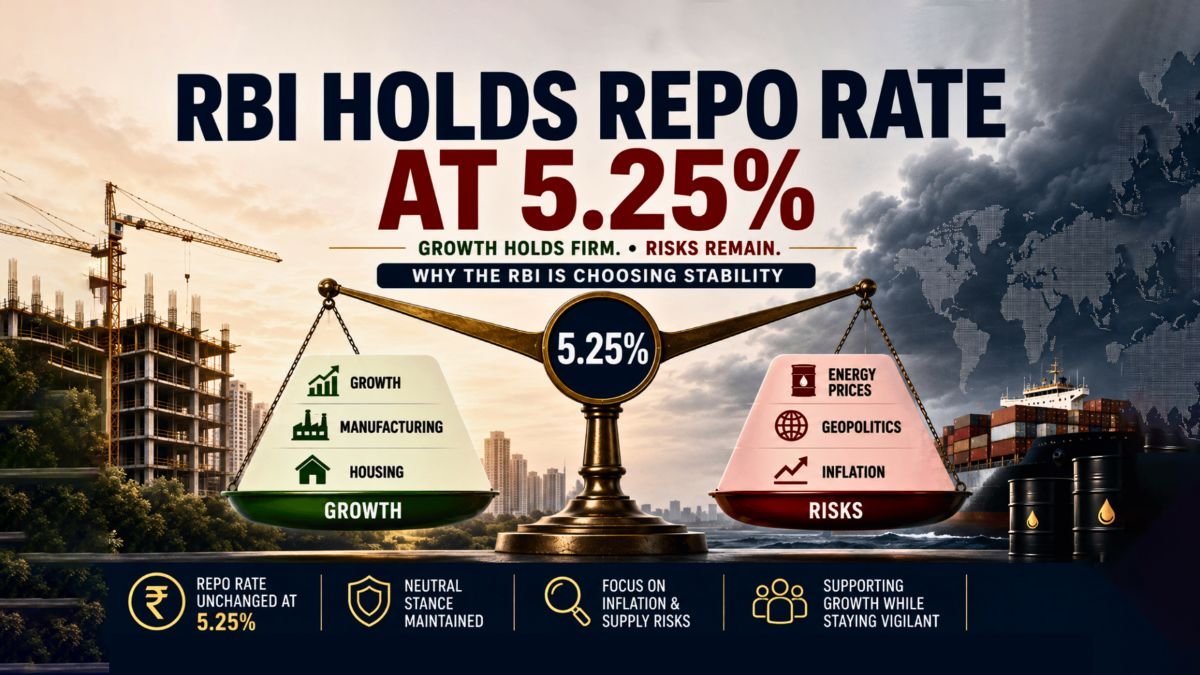
RBI Repo Rate August 2026: Industry leaders welcome the RBI’s decision to keep rates unchanged at 5.25%, while warning that rising costs and affordability remain key concerns.
The Reserve Bank of India’s Monetary Policy Committee (MPC) has kept the policy repo rate unchanged at 5.25% for the fourth consecutive meeting, retaining its neutral stance as geopolitical tensions, volatile energy prices and other external supply-side risks continue to shape the inflation outlook. The decision was unanimous, with the RBI reiterating its ‘wait-and-watch’ approach while maintaining confidence in the country’s underlying growth momentum.
The decision has been broadly welcomed by the real estate industry, with developers and property consultants viewing policy continuity as a positive signal for housing demand and investment. At the same time, most believe that stable interest rates alone will not resolve the affordability and cost pressures confronting the sector.
India’s economic fundamentals remain strong, but the RBI’s caution reflects concerns that lie largely outside the domestic economy. Elevated energy prices, geopolitical uncertainty and the possibility of a weaker monsoon continue to cloud the inflation outlook. Lata Pillai,
Senior Managing Director and Head – Capital Markets, India, JLL, believes these factors justify the central bank’s measured approach. While GDP growth has remained robust and inflation expectations have eased marginally, she expects the RBI to stay alert to evolving supply-side risks over the coming quarters.
Beyond the immediate policy decision, the RBI repo rate August 2026 announcement has once again drawn attention to the uneven recovery in the housing market. According to ANAROCK, residential sales across the top seven cities declined 6% year-on-year during Q2
2026 even as new launches increased by 7%. More significantly, affordable housing now accounts for just 6% of total launches, underscoring the growing imbalance between demand and supply in the mass-market segment. Anuj Puri, Chairman of ANAROCK Group,
argues that policy stability is welcome, but unchanged interest rates alone are unlikely to revive affordable housing while residential prices continue to rise.
Developers also acknowledge that stable borrowing costs solve only part of the problem. Anil Pharande, Founder and Chairman of Pharande Spaces, says the current rate environment should encourage homebuyers, particularly in the affordable and mid-income segments. However, he believes developers will need to absorb rising input costs rather than pass them entirely to buyers if affordability is to be preserved.
Aman Gupta, Director of RPS Group, adds that although luxury and commercial real estate remain relatively insulated from interest-rate movements, inflation trends will continue to influence future policy decisions and market sentiment.
Knight Frank India also believes the RBI has struck the right balance between supporting growth and containing inflationary risks. According to Shishir Baijal, International Partner, Chairman and Managing Director, policy continuity should reinforce buyer confidence, support investment across residential and commercial real estate, and provide businesses with greater certainty in an uncertain global environment.
The RBI repo rate August 2026 decision keeps financing conditions supportive across the construction value chain. The bigger challenge now is not access to capital, but managing rising input costs without placing additional pressure on affordability—particularly in the volume-driven housing segment.

ALSO READ