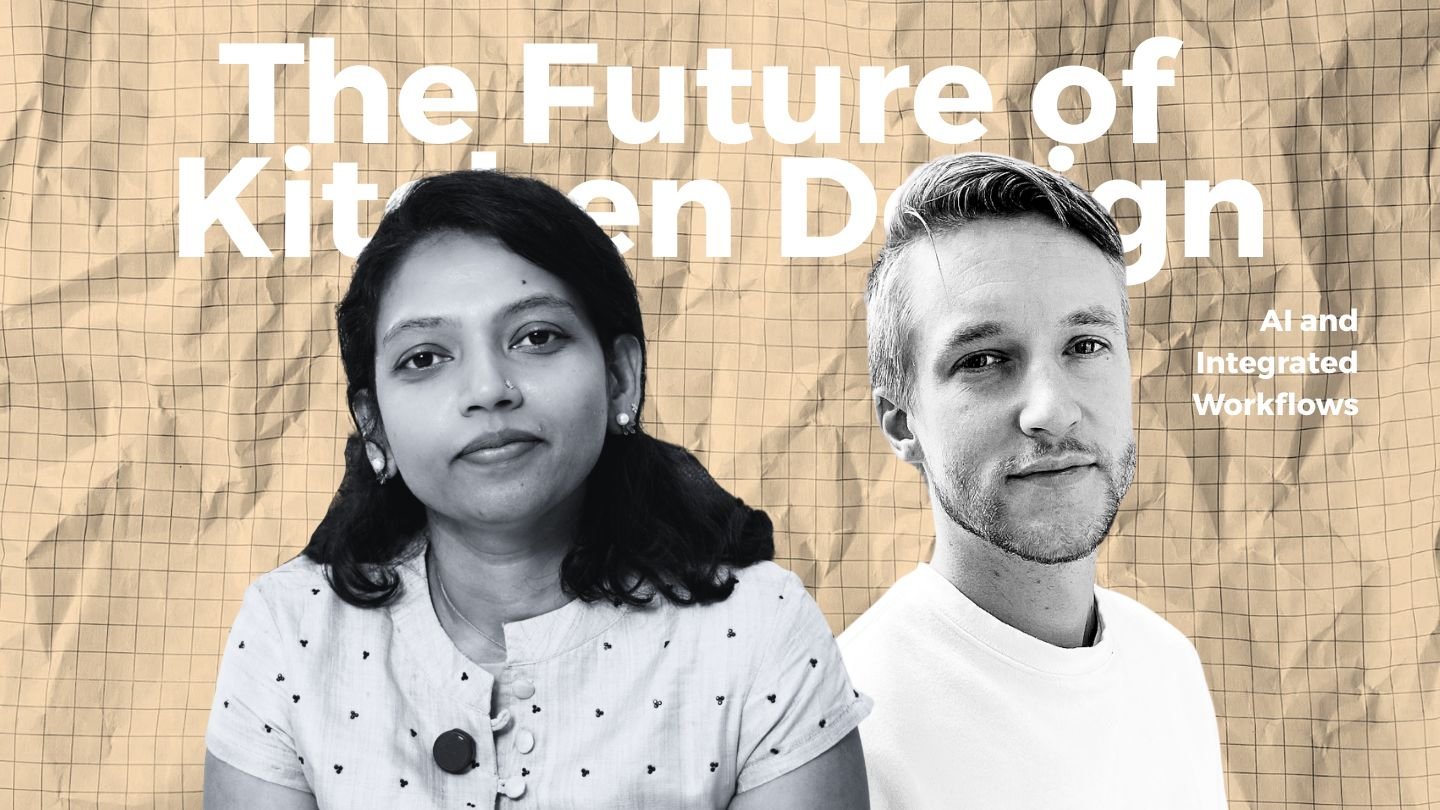
The Future of Kitchen Design: AI and Integrated Workflows explores how connected systems, AI and human expertise are improving design, execution and scale.
The future of kitchen design is no longer defined only by aesthetics. Designing a great kitchen is only one part of the process. Delivering the same design accurately, efficiently and consistently is becoming an equally important challenge for the industry.
What the future of kitchen design looks like was the focus of this conversation between Sankari Radhakrishnan, Co-founder of factory automation start-up NAADI, and Valentin Blanchard, Founder of New Delhi-based design consultancy Studio VB, recently at the India Kitchen Congress 2026.
While Sankari noted that intelligent workflows and integrated systems were helping businesses improve predictability and scale, Valentin warned that AI needs the right dose of human intervention for best outcomes. “The most important thing is to be human,” he said.
SANKARI: There’s a growing demand for better kitchen design. What is driving the shift from intuition-led design to a more system-based approach?
VALENTIN: The simple answer is – the market. The market itself is driving the need for more systemised design. We are moving away from a very artisanal, intuition-led way of designing and towards a more systematic approach. I see this happening both in architecture and furniture.
I think that India is a very good example. Demand has grown significantly, and more people now want customised kitchens with better finishes. When I first came to India about ten years ago, I remember asking a friend if I could go into the kitchen to get a glass of water. He looked at me and asked, ‘Why do you want to go there?’ The kitchen was seen as a functional space, not a part of the home that you would show your guests.
Today, with new residential developments, kitchens are becoming open or semi-open spaces. As a result, people want kitchens that not only function well but also look beautiful. That, more than anything else, is driving the shift towards more systemised design.
SANKARI: As the industry moves towards more systematic ways of working, concerns about preserving creativity in design remain. Are we compromising on creativity in this process?
VALENTIN: Not necessarily. It depends on where creativity adds the most value. A commercial kitchen has very different requirements from a highly customised kitchen in a holiday home, where the kitchen itself may become a design statement.
For the mass market, however, the priorities are different. Most customers simply want a kitchen that looks good, functions efficiently, and is easy to clean and maintain. So, we can have both. It depends on how the kitchen is going to be used.
SANKARI: Integrated workflows are bringing design, presentations, BOQs and manufacturing into a connected process. What changes in a fully integrated workflow where multiple systems are integrated seamlessly? Does it save time and effort?
VALENTIN: Definitely. It reduces a lot of the errors that occur during the creative process. It saves both time and effort because if you multiply the softwares, you multiply the people using them, the experts for each software, and the communication gaps and mistakes that
happen from one step to the other. With one system, everything is streamlined.
SANKARI: You’ve also worked on developing one such system. Could you tell us a little about that experience?
VALENTIN: Yes. In two of my previous startups in India, we developed a similar system for the office interiors industry. The objective was to automate the entire process, from layout planning and 3D design to procurement, BOQs and production. The idea was to make office
interiors as fast as possible, with fewer interactions and fewer mistakes. It worked more or less successfully, and it was a good learning.
SANKARI: Has it improved predictability? Has it saved time and reduced errors?
VALENTIN: Yeah, 100%. We conducted some pilot projects and while learning from those projects, we created a library database from where we could just pick and choose. That reduced a lot of time wasted in the full process.
SANKARI: One problem that we continue to see is the big gap between design intent and execution. Why do you think this is happening?
VALENTIN: I think there are two reasons for this. The first is the lack of good technology. The industry needs one platform that can streamline the entire process.
The second is the lack of versatile people. Beyond being a good salesperson, designer or architect, people also need to understand how the product is actually made. They should spend some time in the factory.
Especially in India, I see that work is much more divided as compared to in Europe. You have separate people handling sales, design, costing and production. If they don’t understand the constraints of the next step, those issues keep happening.
SANKARI: So, in Europe, do designers get involved in manufacturing as well?
VALENTIN: Good designers have to. We don’t have so much manpower, and every person is expensive. A product designer needs to understand, even while designing or speaking to the client, how the product is going to be manufactured and how much it will cost.
That is not really happening here in India. You have separate sales, design and costing teams. Everything is much more divided.

SANKARI: How can technology help bridge this gap?
VALENTIN: The gap can be bridged by having one platform where everything is connected. Even the sales team knows that if they oversell something, it comes at a cost.
SANKARI: Technology is becoming an important tool for improving design accuracy and reducing execution errors. Is it possible to set some rules for the design stage itself in order to flag impractical designs, so that they don’t move further?
VALENTIN: Yes indeed. By learning from previous projects, technology can give us some rules and alerts. It can tell us ‘be careful or else there will be an extra cost’.
The best technology is built on collective intelligence. It becomes more intelligent than an individual because it learns from multiple projects. It can also flag something that is not practical. For example, it can tell you that a particular design may not be able to support the weight of a marble slab, even though a designer may want to use marble everywhere.
SANKARI: Scaling across locations requires consistency in design and execution. How does modular thinking and a rule-based approach help businesses scale projects across different geographies?
VALENTIN: When we talk about scale, we are talking about different locations, different teams, different factories and different levels of knowledge.
If these systems are planned correctly, one team can design a project at one location, while another team can manufacture it somewhere else, with the same quality and the same standards. Technology allows you to separate design and manufacturing while keeping both
connected. That’s a big advantage when you’re scaling the operations.
SANKARI: What kind of infrastructure needs to be built to support that?
VALENTIN: Libraries and databases are the foundation. But before launching any collection, you need to do the groundwork. You have to design everything, analyse it with the factory, understand whether the collection is going to work, and identify the challenges. Once your
database is ready with the pricing integrated into the software, you can scale.
SANKARI: AI is increasingly being used to support decision-making during the design process. How do you think AI is contributing to design?
VALENTIN: AI is evolving so fast that the answer may be different tomorrow. But as of today, based on my experience and research, it is helping us a lot with sales presentations. It allows designers to quickly iterate designs, create more realistic renders and respond faster
to clients. It also helps in preparing BOQs and BOMs.
But as AI evolves by the day, it still has its flaws and needs to be trained properly. It needs to be fed with the right information to deliver good results. Today, it does a very impressive and fast job by taking away repetitive tasks. But, just like you would review a response
generated by ChatGPT, you still need to go back, check the output and correct mistakes when required.
SANKARI: As AI adoption grows, many designers are concerned that it could eventually replace them. The big question is ‘is AI going to replace designers or will it simply help them with repetitive tasks’?
VALENTIN: I think it will complement designers. Let’s see where AI goes over the next few months and years, but today you still need an operator behind it. You need to guide AI and make sure there are no hallucinations. AI can sometimes invent things that are not real, so
human supervision remains essential.
SANKARI: As a customer, one concern I have is that I don’t want the same kitchen as my neighbour. Is AI going to create sameness in design?
VALENTIN: That’s definitely a risk. See, AI is just a tool, it really depends on how you use it. Since AI is based on large language models, it learns from existing data. It doesn’t create by itself; rather, it reproduces what it has already seen. So, there is a risk of creating similar
designs. But at the end of the day, it’s still a tool. If you use it well, you can still create something that hasn’t been done before. That requires human intervention.
SANKARI: Designers are also rethinking the skills they will need in the future. What skills will they need to stay relevant as AI increasingly becomes a part of the design process?
VALENTIN: AI can sometimes be a bit scary, and many people ask, ‘will AI replace my job?’ The simple answer is – be human.
I believe what makes humans different from technology and machines is empathy. Design is still, at the end of the day, about empathy and understanding the client. From the sales perspective as well, no machine will go to the client and sell a kitchen, at least not in the
right way. The sales part is important. On the other side of the spectrum, machines are already automated. How much AI will automate in the future, we’ll have to wait and see.
SANKARI: So you’re saying human intent, empathy and context are still something AI cannot replace?
VALENTIN: Till today, yes. But you need to keep yourself updated. I prefer to look at the positive side. As long as you control the technology, you can still create beautiful results.
As this discussion suggests, the future of kitchen design will depend not just on AI, but on how intelligently businesses combine technology, integrated workflows and human creativity.
ALSO READ