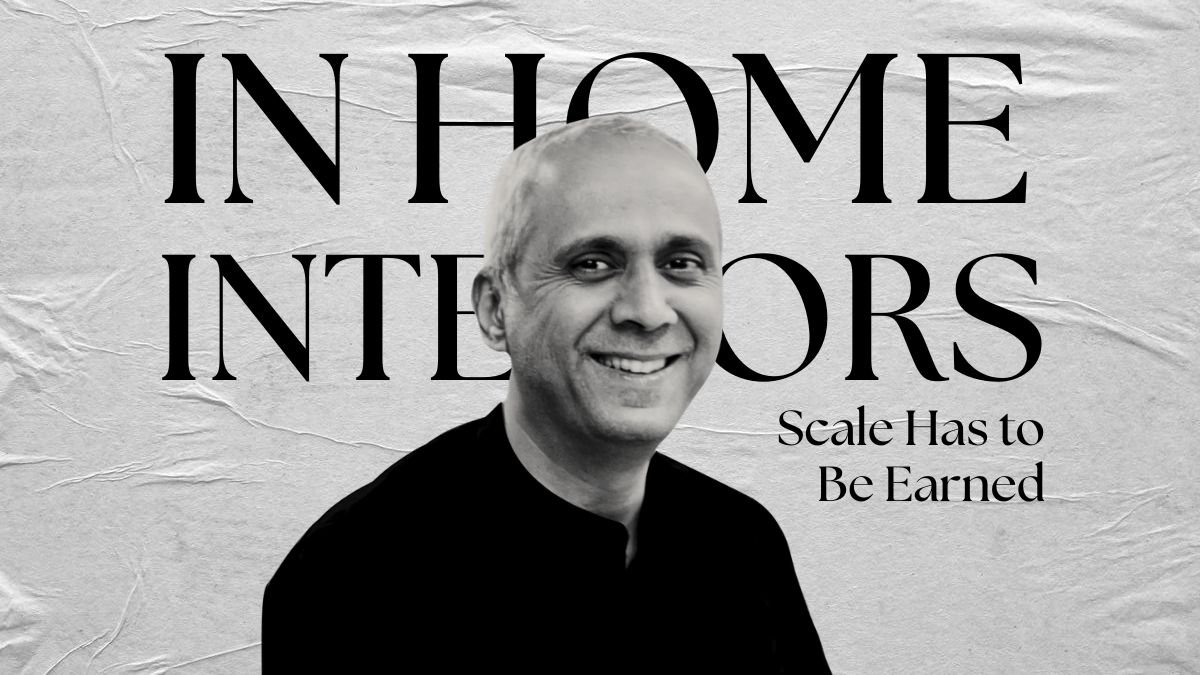
HomeLane CEO Srikanth Iyer explains key economics for scaling a home interiors business, covering unit metrics, CAC, FOFO models, and customer trust.
Scaling a home interiors business is not quite the same as scaling a furniture or consumer products business. There is usually no second purchase to recover the cost of acquiring a customer, the fulfilment cycle can run into months, and a single project involves thousands of decisions.
For Srikanth Iyer, Co-founder and CEO of HomeLane, that makes trust central to the economics of the business.
“Trust is the product,” he told delegates at India Kitchen Congress 2026, where he spoke on The Economics of Scale in Home Interiors: What It Really Takes to Build Trust, Predictability & Long-Term Value. Iyer drew on HomeLane’s 12-year journey, during which the company has expanded to 42 cities and delivered around 60,000 homes.
The Economics of Scaling a Home Interiors Business
The starting point, he said, is recognising that home interiors is not a normal consumer business. The product itself has enormous complexity, with customers choosing between thousands of possible combinations of materials, colours and finishes. The engagement can
stretch over 120 days and involve hours of interaction between customers, designers and project teams.
More importantly, there is little repeat business. “You have to make money off the first transaction,” Iyer said. That puts considerable pressure on customer acquisition cost (CAC). Iyer believes CAC needs to be around 5% for a sustainable business. HomeLane is currently at about 6.5%, he said.
One way of bringing this down is through referrals. Five years ago, only about 8% of HomeLane’s orders came through referrals. Today, the figure is 22%. The difference goes beyond the cost of acquiring the lead. A normal lead, according to Iyer, converts at around one in five or one in six. With a referral, the conversion can be as high as one in two.
For a business where the same customer is unlikely to buy another kitchen or home interior anytime soon, this matters. “If you can’t get repeat, get referrals,” he said.
Trust Has to Run Through the Project
Iyer sees Net Promoter Score (NPS) as one of the most important measures for a consumer-facing interiors company because it provides a proxy for trust. The customer, after all, is committing a substantial sum to something that does not yet exist. Iyer described this as buying an ‘invisible promise’.
That trust has to extend from the designer and project manager to the final delivery. HomeLane, for instance, promises to complete a home within 45 days and pays the customer ₹1,000 for every day of delay beyond the committed timeline.
Iyer also stressed the role of the designer in building this confidence. Understanding how the customer and family actually live — rather than simply responding to a list of requirements — is part of selling that trust.
Can Interiors Be Distributed Like FMCG?
Technology has been another part of HomeLane’s attempt to make a complex business more predictable. Finding no platform that could connect the journey from the first customer meeting through design and manufacturing, HomeLane built its own. The first version was released in 2018 after four years of development.
The next part of the equation is distribution. The question of how businesses can build repeatable systems and use franchising to expand nationally also came up in a separate IKC 2026 discussion on building a national kitchen retail network.
HomeLane’s first 100 stores were largely based on a franchisee-owned, company-operated (FOCO) model. Its more recent 20–30 stores have followed the franchisee-owned, franchisee-operated (FOFO) model, which Iyer said has worked better than he expected.
The reason is straightforward: the company carries less operating expenditure and customer acquisition cost. “If you have managed to get your SKUs under control, if you have managed to get tech to help you, then you should be able to distribute like FMCG. Why not?” he said.
Iyer expects the mix of HomeLane-owned and franchise stores to look very different five years from now.
He also pointed to the designer and OEM/vendor networks as important pieces of the model. HomeLane experimented early with an entirely success-fee-based network of independent designers, eventually building it to around 1,500 designers. The company later found that maintaining consistency required greater control over design, which remains a core part of the offering.
The Economics Still Have to Work
For investors, Iyer believes the expectations have become fairly clear: proven unit economics, scalable delivery, an asset-light model, technology and partner leverage.
The manufacturing side of the same scaling challenge was addressed at IKC 2026 by Spacewood’s Kirit Joshi, who outlined how standardisation, integrated manufacturing and multiple sales channels helped build a scalable furniture business.
Growth can justify cash burn for a period, but it cannot replace sound economics. And even with the right model, interiors remains unforgiving. Iyer estimated that every HomeLane project involves around 4,000 data points. “If we do 3,998 well and don’t do two very well, those 3,998 are never discussed or applauded. It’s only those two that are discussed.”
That perhaps explains his larger point better than any financial metric could. “Ultimately, scaling a home interiors business has to be earned,” and as Iyer emphasises, “the single biggest factor in earning that scale is trust.”
Enjoyed this article?
Receive Kitchen & Cabinetry Intelligence directly in your inbox.
Subscribe to newsletter. Click.
–
ALSO READ