
India’s building materials trade is being reshaped by three forces: expanding export opportunities, tighter quality regulations that are altering import flows, and geopolitical disruptions that have exposed the vulnerability of some export categories to freight costs and regional demand. Equirus Securities’ analysis of FY26 and 1QFY27 EXIM data shows that the impact is playing out very differently across laminates, wood panels, ceramic tiles, sanitaryware, quartz sinks and furniture.
The numbers do not point to a uniform export or import trend. Laminates and sanitaryware recorded strong export growth in FY26, quartz sinks continued to make progress internationally, while ready-made furniture exports declined. Ceramic tiles ended FY26 with modest growth but suffered a sharp reversal in the first quarter of FY27 as Middle East demand and freight conditions deteriorated.
On the import side, another structural change is becoming visible. Implementation of Bureau of Indian Standards (BIS) and Quality Control Order (QCO) requirements contributed to steep declines in imports of MDF, plywood and particle board during FY26. According to Equirus, this reduced import competition and created incremental opportunities for domestic manufacturers.
Taken together, the numbers suggest that India’s building materials trade is becoming less about a single export-growth narrative and increasingly about how individual industries respond to changing markets, trade regulations and supply-chain conditions.
Laminates Stand Out in the Export Story
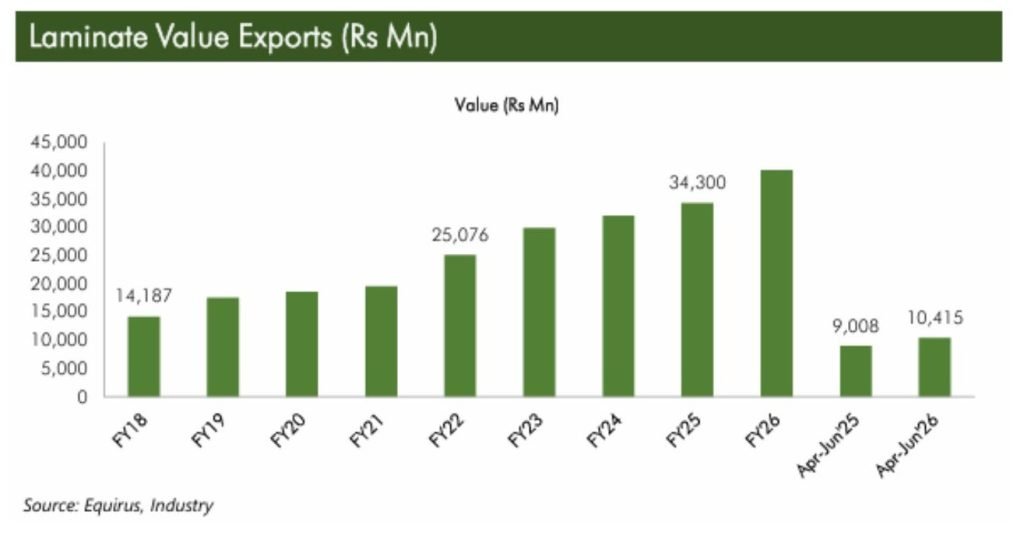
Among the categories tracked by Equirus, laminates present one of the clearest export growth stories.
India exported laminates worth approximately ₹40.1 billion in FY26, an increase of 17% year-on-year, while export volumes increased 11%. The longer-term numbers are also significant: export value has recorded a five-year CAGR of 15% and three-year CAGR of 10%.
Growth has also become geographically broad-based. Equirus identifies Egypt, Germany, Israel, the Netherlands, Poland, Singapore, Spain, the UK and the US among markets where Indian laminate exports have seen a strong uptick.
The first quarter of FY27 indicates that the momentum has continued despite the disruption affecting several other building-material categories. Laminate export value increased 16% year-on-year during 1QFY27, although volumes declined 5%. May 2026 recorded a historical monthly high in value exports at ₹3.8 billion.
The divergence between value and volume is noteworthy. It means the growth in export value during the quarter was achieved despite fewer sheets being exported, although the Equirus report does not attribute the difference to any particular cause.
Equirus expects Indian laminate exports to register an 11–12% value CAGR over the next three to four years as manufacturers expand into new markets and capture additional share in existing ones. It also identifies Greenlam and Stylam, alongside several unlisted manufacturers, as major beneficiaries of the longer-term export growth.
Sanitaryware and Quartz Sinks Expand Their International Footprint
Sanitaryware presents another positive longer-term export trend. Exports reached a historical high of ₹15.7 billion in FY26, increasing 13% year-on-year, while volumes grew 11%. Over five years, export value has grown at a CAGR of 9%.
But an important shift is occurring within the destination mix. The US remains the largest market for Indian sanitaryware exports, but its share fell from 23% in FY20 to 8% in FY26. At the same time, countries outside the top 10 export markets increased their contribution
from 38% to 53%.
That suggests Indian sanitaryware exporters are becoming less concentrated around a handful of destinations. Equirus expects exports to continue growing over the next three to four years as manufacturers penetrate new markets and increase their presence in existing
ones.
The immediate picture, however, is weaker. Sanitaryware exports fell 23% year-on-year to approximately ₹3 billion in 1QFY27.
Imports moved in the opposite direction during FY26. Sanitaryware imports increased 16% to ₹7.15 billion, with volumes rising 23%. China remained overwhelmingly dominant, accounting for 74% of India’s sanitaryware imports.
Quartz sinks have maintained a steadier trajectory. Exports increased 5% to ₹8.9 billion in FY26 and another 10% year-on-year to ₹2.5 billion in 1QFY27. The US accounts for 28% of Indian quartz sink exports and remains the category’s largest destination.
Equirus notes that Indian quartz sink exports continue to make inroads into the US and other international markets.
Middle East Disruption Hits Ceramic Tiles
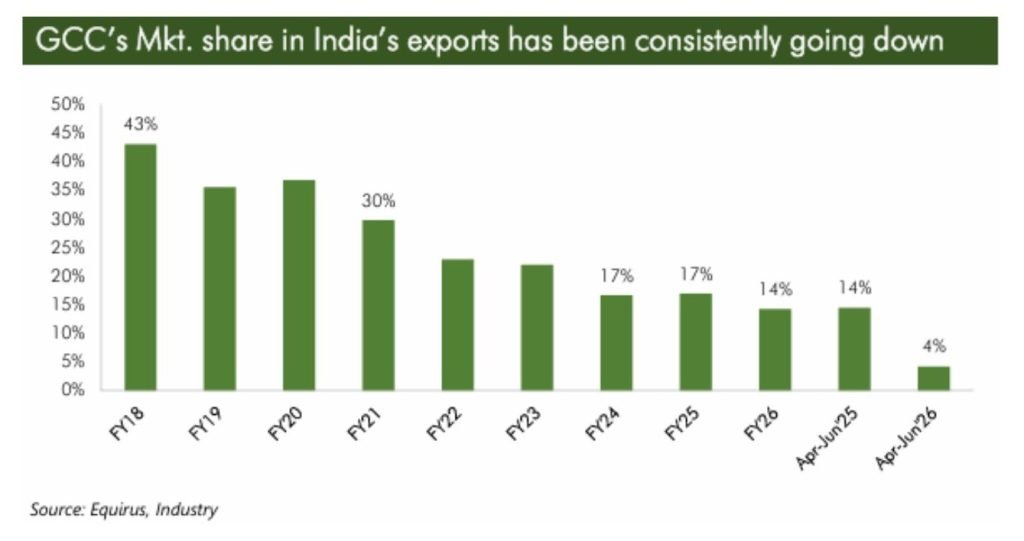
Ceramic tiles illustrate the other side of the export story. FY26 was still a growth year for the category. India exported ceramic tiles worth ₹187.3 billion, up 4%, while volumes increased 5% to 554 million sq m.
The longer-term expansion has been substantial. FY26 export value was 87% higher than FY20, although it remained below the FY24 peak.
Destination markets have also changed. Exports to the UK and EU improved in FY26, while the US, Mexico and GCC markets excluding Saudi Arabia recorded double-digit declines. EU exports reached ₹23.8 billion, up 11% year-on-year, while exports to the UK increased 22% to ₹9.8 billion.
The first quarter of FY27 then produced a dramatic reversal. Ceramic tile export value fell 39% year-on-year to ₹29.2 billion, while volumes declined 51% to 69 million sq m. Equirus attributes the weakness primarily to the geopolitical situation in the Middle East, weaker demand and higher freight rates.
The GCC was particularly affected. Its share of Indian ceramic tile export value fell from 14% in 1QFY26 to just 4% in 1QFY27, with export value to the region declining 82%.
There were signs of sequential recovery in exports to the US, Russia, UK, EU and other markets during May and June 2026. But Equirus estimates FY27 tile export value could still finish 10–15% below the previous year unless there is a sharp recovery during the second
half.
There are countervailing factors. Equirus points out that Chinese and European tile clusters are also facing high freight rates and describes Indian ceramic tiles as currently the cheapest available globally. Lower importer inventories could therefore create pent-up demand once
supply-chain conditions stabilise.
Longer term, however, Equirus expects the exceptional export-growth phase of recent years to moderate, forecasting a more rationalised high-single-digit CAGR over the next four to five years.
QCOs Change the Equation for Wood Panels
If freight and geopolitics dominate the export discussion, regulatory intervention is emerging as another consequential force shaping building materials trade in India.
The effect is particularly visible across MDF, plywood and particle board.
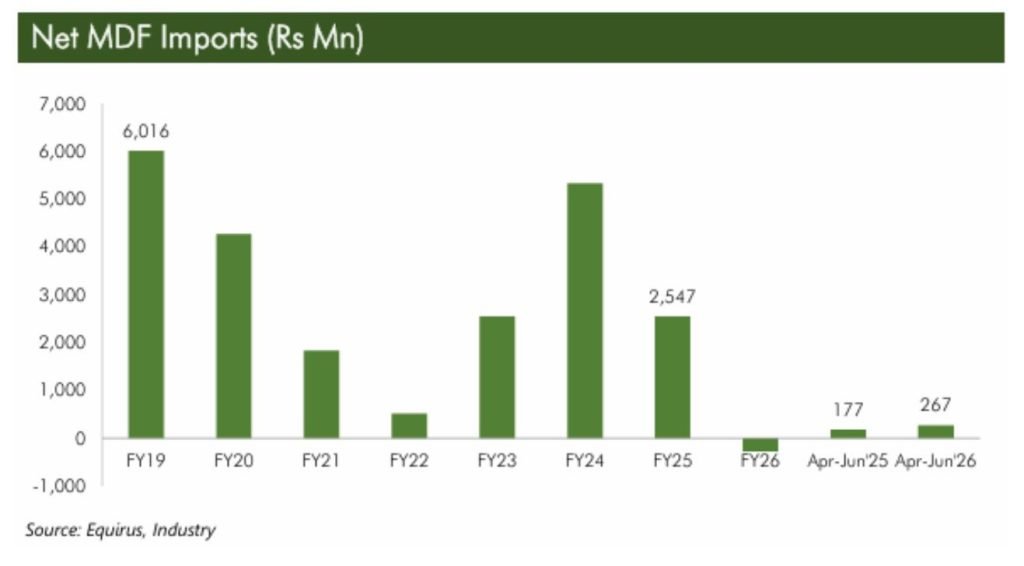
MDF imports fell 61% in value to ₹2.4 billion during FY26, while volumes declined 70%. Equirus attributes the substantial correction to implementation of BIS/QCO norms.
The decline was particularly sharp for the two largest sourcing countries. Imports from Thailand fell 58% in value, while those from Vietnam declined 96%.
For domestic MDF manufacturers, this altered the competitive environment. Equirus says the fall in imports enabled the domestic industry, including listed manufacturers, to capture incremental growth opportunities. Net MDF imports—imports minus exports—turned negative for the first time in FY26.
This changing import environment is also part of a broader shift in India’s wood-panel industry, where organised manufacturers are expanding capacity and gaining share.
Exports, however, were also weak. MDF exports declined 25% in value to ₹2.6 billion and 32% in volume during FY26. Equirus attributes part of this weakness to softer offtake from the GCC, an important export market for Indian MDF.
The early FY27 numbers also show why the import situation needs to be watched rather than treated as a permanent shift. MDF imports increased 82% year-on-year to ₹695 million during 1QFY27, with June alone recording a sharp recovery.
Plywood tells a similar story. Imports had reached a historical high of ₹24.9 billion in FY25 before falling 77% to ₹5.6 billion in FY26 following BIS/QCO implementation.
Equirus believes the reduction helped Indian plywood manufacturers recapture domestic market share. But here too imports began recovering in 1QFY27, increasing 25% to ₹1.8 billion. Nepal was the largest source, with imports from the country almost doubling year-
on-year to ₹1.1 billion.
Particle board imports followed the same broad pattern. Import value fell 72% in FY26 and volumes declined 79%. In 1QFY27, however, value imports grew 19% and volumes 31%.
The combination is important. QCO implementation has clearly changed import flows, but the first-quarter data indicates that compliant imports have not disappeared. The next few quarters should provide a clearer indication of the new equilibrium between domestic production and imports.
More Log Imports Ease a Raw-Material Pressure Point
Another development within the wood sector is occurring further upstream. Wooden log imports reached ₹23.7 billion in 1QFY27, an increase of 19% year-on-year. More significantly, volumes jumped 59%.
This follows FY26, when import value was broadly flat at ₹89.6 billion but volumes increased 46%. Equirus links the surge in log imports with an easing of inflationary pressure in domestic plantation timber prices, particularly for plywood manufacturers. Plantation timber prices had been on an upward trend for the preceding five years.
The development therefore creates an interesting two-sided effect for the domestic wood-panel industry: finished and semi-finished panel imports have been constrained by quality regulations, while greater availability of imported logs is helping moderate pressure on a key raw material.
Furniture Exports Show Resilience, While Imports Correct
Ready-made wooden furniture presents yet another pattern within India’s building materials trade. Exports declined 6% in FY26 to ₹63 billion. The US remained India’s largest export destination, but shipments to the market fell 16% to ₹26 billion.
Despite continuing trade and freight uncertainty, exports proved relatively resilient in the first quarter of FY27. At ₹15.8 billion, they were down only 2% year-on-year. US exports nevertheless remained under pressure, declining 16% to ₹6.2 billion.
The export opportunity also raises the manufacturing capability question, as Indian furniture producers look to automation and more consistent production processes to compete at scale.
The import trend moved sharply in the opposite direction between FY26 and the beginning of FY27. Furniture imports increased 23% to approximately ₹11.9 billion in FY26. In 1QFY27, however, they declined 28% year-on-year to ₹1.2 billion. Equirus notes that BIS/QCO
requirements for furniture imports were imposed from February 2026.
It is still too early to determine how much of the first-quarter decline represents a lasting regulatory impact, but the experience of MDF, plywood and particle board makes furniture imports an important number to watch over the coming quarters.
A More Complex Trade Landscape Is Emerging
The Equirus data ultimately shows why India’s building materials trade cannot be viewed through a single export or import trend, with different industries moving through very different stages of internationalisation.
Laminates have established a relatively broad export base and continue to add markets. Sanitaryware is becoming geographically more diversified. Quartz sinks continue to build overseas presence. Furniture exports remain substantial but are exposed to weakness in the
US. Ceramic tiles have built considerable global scale but demonstrated in 1QFY27 how rapidly freight and geopolitical disruption can affect a large export-oriented manufacturing cluster.
At the same time, BIS/QCO implementation is changing the competitive landscape at home. The dramatic FY26 reduction in MDF, plywood and particle board imports gave domestic manufacturers greater room in the Indian market, even as the first quarter of FY27 showed some recovery in imports.
Equirus expects free and bilateral trade agreements with the EU, UK and potentially the US to support recovery in categories including ceramic tiles, laminates, furniture and quartz sinks in the second half of FY27. It also cautions that anti-dumping and countervailing-duty
investigations, quota restrictions and continued freight volatility will need to be monitored.
The broader signal, therefore, is not simply that India’s building-material exports are growing or imports are declining. Trade is becoming a more important strategic variable for the industry itself. Export-market diversification, regulatory barriers, raw-material sourcing, freight economics and changing trade agreements are increasingly influencing where Indian manufacturers can grow—and the competitive conditions they face in their domestic market.
Enjoyed this article?
Receive Kitchen & Cabinetry Intelligence directly in your inbox.
Subscribe to newsletter. Click.
–
ALSO READ