Automation in furniture manufacturing is becoming an important part of the industry’s growth, but for many Indian manufacturers, the question is no longer simply whether to automate. It is where to start, what to automate, and whether the business is ready to make the investment work.
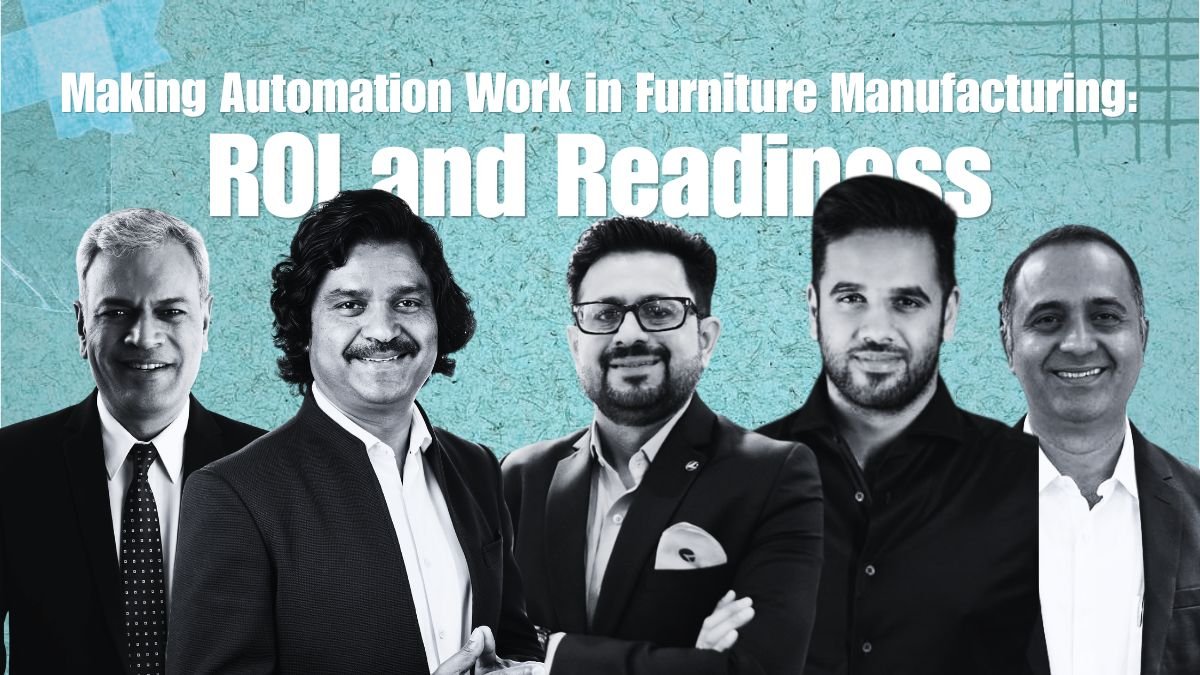
During a panel discussion at the India Kitchen Congress 2026, Venkataramana Gorti, Managing Director, Stanley Lifestyle; Gopi T, Managing Director, Woodtech Consultants; Kunal Roy, Director – India Sub Continent, SCM India Machinery Trade and Service Pvt Ltd; and Karan Raj Gopal, Founder & Director of Production, Fabience Living, along with anchor Raghavendra NK, CEO, IMA Schelling, discussed where Indian furniture manufacturing stands today, how manufacturers should assess the ROI of automation, and what needs to be in place before investing in machines and technology.
Where Does Indian Furniture Stand on Automation?
RAGHAVENDRA: From your experience across industries, where does the Indian furniture industry stand today in terms of automation maturity?
Venkat: Automotive is the leader in automation, with robotics already accounting for around 35–40% of operations. Electronics is a close second because of its repetitive manufacturing processes.
If you come to the Indian furniture industry, I think automation is currently at a low-to-mid level, and that too is largely limited to the large players. We have thousands of MSMEs, job-work organisations and a high level of customisation, which are some of the reasons for this situation.
The industry has already started using beam saws, CNCs and finishing machines, but these are largely individual machines or islands of automation rather than fully automated production lines.
As the industry moves towards greater automation, it is unlikely to start directly with robotics. We’ll have to first get into process standardisation, the modular way of working and digitalisation before we get into robotics.
RAGHAVENDRA: Is the Indian furniture industry buying automation with a clear plan, or are manufacturers buying machinery first and then figuring out the rest?
Gopi: In the olden days, people used to buy machines left, right and centre and then think about automation, and later realise the limitations. But in the current context, people are much clearer about what they need in terms of automation.
I think the reason people are looking at automation in India today is largely because they want to reduce the manpower working in the factory, which is one of the biggest headaches for manufacturers.
Some handholding is, of course, required. Many people think automation in furniture manufacturing can do everything for them, which is not possible in our industry. In automobile manufacturing, the processes are clearly defined. But in furniture, every factory has its own customised processes, so the processes are not always clearly defined.
That is where handholding becomes very important.
From Machines to Integrated Systems
RAGHAVENDRA: As manufacturers become more serious about automation, what according to you, Kunal, is the bigger gap today — the lack of automation itself, or the lack of integration between machines and systems?
Kunal: I think the gap is on both sides. The major objectives of automation are to reduce manpower, improve repeatability and improve plant efficiency. But the challenge is the cost and the heavy capex. Most SMEs and MSMEs are still struggling to decide whether they should go for automation, while for bigger corporations, automation is typically not a challenge.
But the deeper gap is integration. You may have standalone islands of automation — a CNC machine for cutting, another for drilling, automated edge banders — but if the machines are not talking to or interacting with each other, you don’t have line balancing or the right
output and efficiency from the factory.
If an SME is starting a factory, the software part is also very important, especially at the CAD-CAM level. When the design is done manually and then transferred manually to the machine, that is where a lot of errors happen. A simple implementation of CAD-CAM can drastically reduce these errors. That is the first level of automation — not the machine, but the software part.
Without software, the machines can’t do magic. Even if I don’t have the money to buy automated machines, I can at least start with basic machines and CAD-CAM to minimise manual errors. Then, of course, it goes to machines and subsequently to the integration of machines using software automation such as MES and MOM, which can interact with the ERP and ensure that efficiency is maintained across the various levels of the factory.
RAGHAVENDRA: Karan, you have implemented automation across your factory. When you started implementing these systems at Fabience, what was the biggest reality shock?
Karan: We have three to four different types of automation, including material handling, mechanical, digital and packing automation. Coming to mechanical automation, we have two key machines — a robotic pickup and return for edge banding and a seven-axis paint
machine.
One of the biggest challenges was that we initially thought it was a good machine to have, so we would just buy it and start painting panels. But it took almost a year of my hands-on experience to get it right.
There are a lot of iterations required to get a system right, particularly when you are dealing with a highly complex automated paint line. I feel we are in an industry where companies are not manager-driven but owner-driven. Our involvement had to be there right from the beginning to the end.
Coming to digital automation, we have automated the digital aspects right from the start to the end. In India, where people are used to writing things on paper and using Google Excel and similar tools, it was quite a challenge for them to get used to the ERP software we
implemented.
We also had to check at every stage whether it was being used consistently, whether the software had any bugs and whether there were any issues. If there is a small problem and we don’t follow up with the staff, five or six months later we may have to go back right from day one to find out what went wrong.
The involvement has to be there, and that was one of the biggest challenges I encountered.
What Does Automation Really Deliver?
RAGHAVENDRA: In the premium furniture business, where does automation in furniture manufacturing really deliver ROI — cost, quality or delivery?
Venkat: I would say you get an advantage in quality, delivery and cost. When anyone purchases premium furniture, functionality is a given. They are not looking only for functionality. They are looking for the premium feel, precision and consistency. That is what you can achieve when you use the right automated machinery.
For example, if you use a CNC, you can have very tight tolerances and repeatability. If you use the right finishing machines, you get the finish you need consistently.
Another very important factor is that automation starts reducing rework, which itself is an ROI. But most importantly, if you have one defect in a premium product, your brand is lost. It is not just about the quality it delivers; it also helps you grow revenue and generate repeat business.
The other big advantage is delivery. It is very important that your turnaround time is shorter, and automated solutions help reduce the time. If you have digitised your processes, the information flow is faster and your ability to stay connected with customers in real time is better. That gives you better customer satisfaction, which is very important for any customer and even more so for a premium brand.
Automation also helps in the scalability of the business, which a manual operation will never give.
RAGHAVENDRA: Automation can improve quality, delivery and productivity, but the investment involved can be significant. When manufacturers invest in automation, what are the biggest financial mistakes they make?
Gopi: The biggest financial mistake is looking at the direct ROI from automation. Every automation has a cost and needs to have an ROI, but you cannot expect a direct ROI immediately.
Automation can give you consistent quality, which is very important. The second thing is reducing manpower, which is one of the norms of automation.
The third thing is turnaround time. In a shorter span of time, you can turn around more products, which has a large impact on the business. If you can deliver faster, finish a project faster and take up more projects, that contributes to the ROI.
According to me, direct ROI may not be visible in the immediate context, but in the longer run, automation definitely pays off.
RAGHAVENDRA: How should manufacturers actually calculate the ROI when investing in automation?
Kunal: I agree that capital investment cannot be directly linked with direct ROI. If you are doing automation in furniture manufacturing, you cannot simply take the increase in production as the ROI.
When you buy an automated machine, it is a heavy capex. But you are also reducing manpower, improving repeatability, bringing down rejection ratios and increasing the efficiency of the plant. You should look at the total cost of ownership of the machine and spread it across the life of the machine.
Typically, a good high-end industrial-range machine can last at least 10 to 15 years if it is maintained well. You have to look at the kind of value you can generate from the machine over that period. It cannot be looked at only as: I am investing this much, how much production can I increase, and can I get my money back in two or three years?
Buying the machine is one part, but maintaining the machine is another. You have to look at how many times the machine goes down in a year and whether, after three or five years of service, you are able to run it with minimum downtime.
We cannot isolate ROI as only the machine cost. It has to be looked at as the total cost of ownership.
RAGHAVENDRA: Karan, you have already invested in automation. Where has it delivered the biggest ROI for your business?
Karan: People usually talk about marketing and sales because that directly reflects the revenue of a company. But honestly, to actually drive the turnover of a company, especially a manufacturing unit, the operations have to be on point and the systems have to be in
place.
In India, there is a lot of customisation in kitchens and wardrobes. If you look at Italian or German manufacturers, there is not as much customisation. They have fixed laminates, fixed edge bands, fixed module sizes and so on. So large factories can produce 500 kitchens a day. Here, there is a lot more procurement involved because of the customisation.
That brings me to the whole digital automation that we have implemented. We have set up systems where, right from design to installation, everything is automated through our ERP software. For example, when the procurement process happens, the system tells us what materials have arrived and what is yet to arrive. That makes the purchase process much easier and, in turn, increases efficiency.
We also have a panel tracking system. At any given time, we can have around 100 to 120 projects in our factory, with each project having around 300 to 400 panels. We can track the progress of each project and communicate with our clients to make sure the projects are dispatched on time. Delivery is very important.
I can also track how much time each of our designers has spent on a particular project and how much time each project spends on every machine, such as a beam saw. This gives us a clear idea of where we can improve as a system and helps reduce leakage, which is also very important. All of these things contribute to increasing revenue and cutting costs.
On the mechanical automation side, we have a robotic edge-band return and pickup system. In some good months, we can do around 40 kilometres of edge banding in a month on some major projects, particularly where the projects are standardised, such as 100 or 120 apartments.
We also have a seven-axis robotic spray system that can cover around 1,500 sq ft per day. While I still need manpower to run the machines, there has been a visible reduction. These are some of the notable areas where I am able to extract ROI, both directly and indirectly.
Is Your Business Ready for Automation?
RAGHAVENDRA: What should a company, according to you, Venkat, fix first before moving towards automation — the product, the process or the mindset?
Venkat: I think without doubt, mindset comes first, then the process, then the product, and finally automation.
Many times, companies think, we have the money, we have a problem, let’s automate. I would actually say that automation will not fix the problems. You need to fix your problems so that the automation works.
Why does mindset come first? At the leadership and team level, unless you have standardisation, proper measurements and discipline, it is not going to work.
From the leadership side, the first thing is that you need to be ready to document your processes and have SOPs in place, with the discipline to adhere to them. The second is that decisions have to be taken based on data, not intuition and so-called experience. Otherwise, automation won’t work.
In terms of process, if a manual process cannot be repeated, how do you automate it? Automation will essentially lock a process so that you can repeat and reproduce it. It is very important that the process is in place.
The third one, especially for our industry, is product design. Design will enable and dictate how much you can automate a process. Are you working on reducing the SKUs? Are you looking at having fewer material palettes? Are you working towards standard dimensions? There is something in Six Sigma called DFM, or design for manufacturing, and that is very important. Are your designs modular? These are all paramount.
It is not that you do anything upstream and automation will take care of everything. Once you have fixed these three, that is when you should start looking at automation. Otherwise, you have a frustrated leadership team, frustrated teams down the line and no ROI.
We need to follow this chronology to be successful. Do not automate to fix problems. Fix your problems so that automation works.
RAGHAVENDRA: Gopi, what are the clear signs that a factory is ready for automation?
Gopi: People might have the money to invest, but are they capable of running automation? That is the most important factor in deciding whether to go for automation.
Capability means having the right people to run the automation. Many people come to me for automation, but when I look at their background, I look at whether they have a capable team to run the automation and whether they have capable software, which is also very
important. This capability is very important before deciding on any automation.
RAGHAVENDRA: Kunal, if somebody is building a new factory today, where should they start from day one?
Kunal: If you are starting small, say as an SME, you can pick up some manual machines to start with. But the important part is to start integrating at the design level, at least with the software, so that you can reduce errors. Then you can gradually start upgrading the machines and moving towards automation.
I think one of the easiest processes to automate is edge banding. If you look at panel processing, you get paid on the quality of edge banding and the quality of surface finish. So, if you want to make money, the quality of edge banding is very important.
If I have less money, on the machine front I would first automate the edge bander, then move to the cutting section and then the other processes.
It all depends on the vision of the entrepreneur. Based on that, he has to take a call. But the starting point should be CAD-CAM — the least investment, but a very productive one.
RAGHAVENDRA: You have already built and are running a highly automated factory, Karan. Having learned from the experience, if you had to rebuild it today, what is the first thing you would do differently?
Karan: We started in 2019 in a much smaller unit, and in 2023 we moved to a much larger manufacturing unit. We never wanted to automate 100% of everything in the current manufacturing unit outright. So, we went step by step.
For instance, we have about 70% automation, if you want to measure it quantitatively, and then slowly we started piecing everything together. Recently, for example, we got an automated packing machine, and the next move will probably follow.
It really depends on whether you are ready for the market and what products you are actually manufacturing, which ones you want to make in-house and which ones you want to outsource.
To answer your question very honestly, I feel like I would do the same thing again and again — slowly, step by step, and piece everything together. There is a long way to go.
Customisation With Automation in Furniture Manufacturing
RAGHAVENDRA: Can automation help manufacturers manage customisation while still maintaining efficiency and repeatability in the factory?
Gopi: There is often confusion between customisation and choice. In the kitchen industry, customisation is a norm because every house is different. Cabinets and shutters have to be customised. But when you give customers a choice of different colours or finishes, that is a choice, not customisation.
We recently worked on an automation project where the client wanted to offer 72 colours to customers. The cabinetry sizes were customised, but the customer could choose from 72 colours. In a pan-India business, this kind of choice is important because preferences can vary across regions. Of the 72 colours, perhaps 24–25 could be fast-moving, but the entire range can still be managed through automation.
When an order comes in, the automation can automatically pick the colour selected for that particular project, run it and finish it. So customisation with different choices is possible using automation.
RAGHAVENDRA: I call this mass customisation, mass batch size one. Furniture manufacturing is also logistics. When we are talking about automation, we should not be creative inside the factory. We have to be more creative at the sales front and in other areas, but inside the factory we have to be boring because it has to be about repeatability and doing the same thing consistently.
Venkat: While there can be choices at the front end, the trick is how we are able to standardise manufacturing at the back end.
If you look at the auto or electronics industries, customers are given choices at the front end, but the manufacturing process behind those choices is standardised. It is like ice cream — the base is still vanilla, and then you have different things coming on it. That is the approach we need to look at in furniture manufacturing as well.
Enjoyed this article?
Receive Kitchen & Cabinetry Intelligence directly in your inbox.
Subscribe to newsletter. Click.
–
ALSO READ