
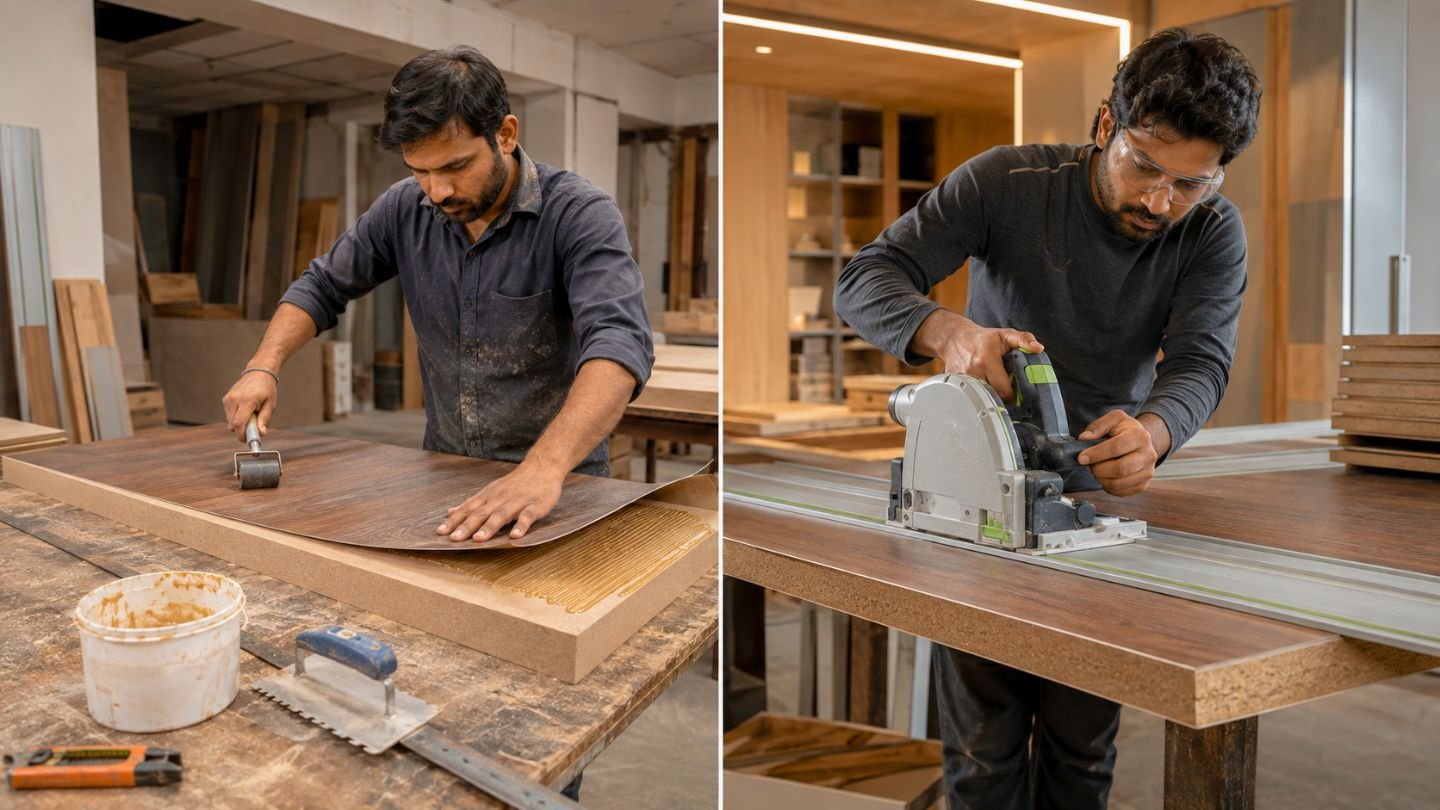
India’s panel furniture industry is entering an interesting manufacturing phase. For decades, one of the simplest decisions in cabinet making was whether to begin with a ready decorative board or with a raw substrate and apply the final surface later. The first route offered speed and repeatability. The second offered flexibility.
Today, surface technology is making that choice far more strategic. Laminate manufacturers are producing synchronised woodgrains, stone structures, textile effects, metallics, ultra-matt finishes and increasingly sophisticated digital prints. Indian companies such as Heritage Laminates and Sequence Surfaces are good examples of how decorative laminates are moving into more differentiated, design-led and digitally printed surface languages.
PET is introducing exceptionally smooth matt surfaces and fine textures. Acrylic continues to deliver optical depth and high-gloss clarity. Membrane wraps routed profiles. Thermoformable films can follow three-dimensional geometry. Veneer and PU remain important where individuality and finishing depth matter.
As this material vocabulary expands, the question facing furniture manufacturers is no longer simply prelaminated board or post-laminated board.
It is becoming: at what stage of the value chain should the finished surface be created?
The Observation
The India Interior Trend Report 2026–27 identifies rising demand for factory-finished components as one of the clearest structural shifts in organised interiors. Designers, traders and manufacturers surveyed for IITR consistently associated factory finishing with better consistency, fewer site errors, cleaner installation, improved surface performance and more predictable project timelines.
This direction is particularly relevant to kitchens and wardrobes, where mechanical hardware, surface durability and installation tolerances make factory precision more valuable than in conventional loose furniture. IITR consequently finds kitchens and wardrobes leading organised-system adoption before the same manufacturing logic spreads into TV units, study furniture and storage walls.
There is a useful manufacturing reason behind this shift. When a factory receives a finished decorative board, one complete production stage has already been performed upstream. The furniture manufacturer can move more directly into cutting, edge banding, drilling,
routing, assembly preparation and packing.
Gopal Dwivedi’s Modular Wardrobe Planning & Designing Guide describes exactly this distinction: when prelaminated boards are used, board preparation can be eliminated, whereas laminates, acrylic, veneer and similar surfaces applied onto a core introduce a separate board-preparation process before the panel enters downstream manufacturing.
That one eliminated step becomes increasingly important as furniture manufacturing scales.
Europe Offers one Useful Manufacturing Reference
The European panel industry has built a mature ecosystem around decorative boards that arrive at furniture factories already surfaced. Brands such as EGGER, ALVIC, Niemann and Kronospan illustrate a broader manufacturing philosophy in which a highly developed
decorative panel often becomes the starting material for furniture production rather than something created inside the furniture factory.
India now has its own increasingly relevant examples in this direction. Lamàni, formerly Asian Prelam Industries, is positioned around melamine-faced MDF and chipboard solutions, bringing factory-finished board systems closer to the Indian furniture manufacturer’s
starting point. Its current portfolio focuses on pre-finished melamine-faced panels for furniture and interior applications.

This changes the role of the factory. The panel producer specialises in creating the board and decorative surface under controlled industrial conditions. The furniture manufacturer specialises in converting that finished board into accurately machined components. Edge suppliers, hardware companies and machine manufacturers then specialise in their own parts of the system.
It is a highly distributed manufacturing model. The cabinet factory does not necessarily need to become simultaneously a board laminator, coating line, decorative-surface processor and furniture producer.
That division of expertise has obvious advantages: fewer processes inside the furniture plant, easier quality standardisation, lower work-in-progress, faster throughput and a clearer relationship between material specification and manufacturing.
India Followed a Different Path
India’s furniture manufacturing structure evolved differently. Plywood has historically played a much larger role, while the decorative laminate industry developed enormous variety in independent sheets. That combination made it natural to select the core first and
the decorative surface separately.
The system offered tremendous flexibility. A fabricator could buy plywood, MDF or particleboard from one supplier and select from hundreds of laminate designs from another. The same core inventory could therefore service many customer preferences.
That flexibility remains one of post-applied surfacing’s greatest commercial strengths. It also helps explain why the Indian laminate industry continues to innovate so aggressively.
IITR places laminate at approximately 53% of the organised modular surface market, making it by far the largest surface family. Matte and suede finishes alone represent 58.6% of the decorative-laminate texture market referenced in the report, while synchronised surfaces and deeper tactile structures continue to grow.
The more sophisticated laminate becomes, the stronger the case for retaining the ability to combine specialised sheets with the right core. So the future is unlikely to be a simple migration away from this model.
Surface Innovation is Simultaneously Pushing in The Opposite Direction
An interesting contradiction is now appearing. While laminate innovation makes secondary surfacing easier and more desirable, many of the fastest-growing premium surfaces actually demand more controlled board preparation, not less.
Consider acrylic. The optical quality of the finished shutter depends heavily on substrate flatness, bonding consistency and lamination quality. Indian companies such as Praveedh Décor and Decora show how this category is increasingly moving toward engineered,
factory-laminated finished-panel solutions rather than expecting every furniture factory to perfect acrylic lamination independently.
PET has similar requirements. IITR specifically recommends PUR-based edge bonding for PET applications because poor bonding can create edge-lifting failures.
Membrane moves the process further downstream again. The panel first needs to be cut and routed, after which the decorative film is vacuum-formed around the three-dimensional face and edges. Indian suppliers such as Shreepal represent this growing membrane
ecosystem. The wardrobe manufacturing guide describes membrane pressing as occurring after routing, removing the conventional visible-edge requirement because the film wraps the profile.
Thermoformable surfaces follow a similar design logic: the final material is determined not only by colour but by the geometry of the panel underneath it. PU, veneer and other speciality surfaces introduce their own finishing sequences.
In other words, the more expressive furniture becomes, the less likely one single board technology can satisfy every application.
The Real Shift May Therefore be Toward Specialised Board Manufacturing
This is where the conversation becomes more interesting for Indian manufacturers. A typical furniture factory trying to accommodate every premium surface internally may need flat lamination, cold or hot pressing, PUR systems, membrane pressing, spray finishing, sanding, curing and multiple quality-control processes before the panel even reaches conventional cutting and machining. Each process requires different knowledge.
The Wardrobe Planning Guide notes that lamination quality depends heavily on glue quantity, bonding conditions and processing method, and that machine lamination generally produces superior results for thinner and more sensitive materials such as acrylic, veneer and sub-1 mm laminates.
This raises an important business question. Does every kitchen and wardrobe factory need to own every finishing process?
Or will India increasingly develop specialist converters that supply ready-to-process acrylic boards, PET boards, synchronised decorative boards, veneer panels, thermoformed fronts and other technically optimised components to furniture manufacturers?
We can already see elements of this model emerging. Aryamman’s Synchronply is an interesting example of how the pre-finished board proposition itself is evolving. A synchronised, veneer-feel decorative surface is built into a ready panel, allowing a furniture factory to begin with a richer visual and tactile board rather than create that finish in-house after purchasing the substrate.
This is structurally closer to the European specialisation model, even though the Indian material mix remains very different.
Why Prelam Will Continue to Gain Importance
For carcasses, shelves, partitions and high-volume standard components, factory-finished decorative boards offer a compelling manufacturing argument.
Consistency is created upstream. Board preparation disappears from the furniture factory. Procurement becomes easier to standardise. The number of production variables falls. The furniture plant can focus its capital and management attention on machining, edge quality, hardware integration, assembly and logistics.
This becomes particularly valuable as organised manufacturers expand volume. A factory producing thousands of similar panels every day benefits differently from a custom workshop producing ten unique wardrobes. The former gains enormous value from eliminating processes; the latter may gain more from retaining flexibility.
Prelaminated boards therefore become increasingly powerful wherever volume, repeatability and production speed matter most.
Importantly, the category itself is also changing. The idea of prelam is gradually moving beyond basic economical melamine boards toward deeper textures, richer wood interpretations, improved surface performance and better edge coordination.
Why Post-applied Surfaces will Remain Strategically Important
At the same time, Indian design is moving toward greater surface differentiation.
Digital laminates allow relatively small quantities of unique patterns. Synchronised laminates reproduce increasingly sophisticated wood and stone structures. Acrylic and PET create optical and tactile qualities that conventional melamine-faced boards may not provide at every price point. Membrane and thermoformable materials enable routed and curved geometry. Veneer allows natural variation. PU creates almost unrestricted colour and finish freedom.
IITR describes synchronised laminate, fabric-feel PET, fluted membrane profiles and brushed aluminium as part of the same broader movement toward texture, depth and tactile richness.
That direction favours specialised finishing. The premium shutter may therefore increasingly separate from the carcass in manufacturing logic. The carcass can become highly industrialised and standardised around finished boards, while visible fronts become more sophisticated, more customised and potentially sourced from specialist surface processors.
That may ultimately prove to be the more important shift than prelam versus postlam itself.
Why it Matters
Factory efficiency will increasingly influence material choice. As organised furniture volumes rise, eliminating an entire board-preparation stage can improve throughput, consistency and production economics.
Premium fronts are becoming more specialised. PET, acrylic, membrane, thermoformed films, veneer and PU require different processing capabilities that may be difficult for every furniture factory to optimise equally well.
The carcass and shutter may follow different manufacturing paths. Standardised finished boards are naturally suited to structural components, while customer-facing fronts can support greater surface experimentation.
Surface brands are moving closer to furniture manufacturing. The future opportunity is increasingly in supplying complete board-and-edge or finished-front systems rather than selling decorative sheets alone.
Specialisation can improve quality. A factory dedicated to one surface technology can potentially optimise bonding, finishing and processing more deeply than a general furniture factory attempting to run every technology internally.
Business Truth: “The future factory may create less of the surface—and considerably more of the furniture.”
The Business Implication
For board manufacturers, this shift creates an opportunity to move further downstream. The market will increasingly value ready decorative boards with stronger texture, improved cores, coordinated backs and precisely matched edges rather than treating prelamination merely as an economical carcass solution.
For laminate companies, the opportunity is equally significant. The growth of factory-finished boards does not weaken laminate innovation; it creates another route to market. Successful laminate brands may increasingly work with panel converters and OEMs to offer finished-board programmes, allowing sophisticated laminate designs to enter industrial furniture manufacturing without requiring every factory to laminate them itself.
For PET, acrylic and thermoformable-surface companies, the logical evolution is toward approved processing partners, controlled bonding specifications and ready-to-machine panel solutions.
Edge-banding companies become even more important because a coordinated board system is only convincing when the edge belongs to the same visual language. As surface realism improves, a poor edge becomes more visible rather than less.
And for furniture manufacturers, the strategic question becomes one of make versus source. Which processes genuinely create competitive advantage inside the factory? Which can be executed more consistently by a specialist supplier? Where does customisation create customer value, and where does it simply create manufacturing complexity?
The answer will vary by manufacturer, product category and price segment. That is why the next phase should not be framed as a contest between prelam and postlam.
India’s furniture industry is likely moving toward a hybrid manufacturing architecture: factory-finished decorative boards for efficiency and standardisation; specialised surfaced panels for premium applications; and highly customised finishing where design genuinely justifies the additional process.
[Explore more IITR INSIGHTS: Browse our growing collection of research-backed articles interpreting key findings from the ‘India Interior Trend Report‘.]
The surface industry will continue innovating. The board industry will continue industrialising.
And the most efficient furniture factories may increasingly become the businesses that understand which part of the surface journey they should own—and which part they should allow a specialist to perfect.
–
Enjoyed this article?
Receive Kitchen & Cabinetry Intelligence directly in your inbox.
Subscribe to newsletter. Click.
–