
India’s wood panel sector reported a healthy Q4FY26, with organised plywood and MDF manufacturers posting strong volume growth during the quarter. However, domestic laminate demand remained subdued, although exports continued to perform well.
The Equirus Securities‘ Building Materials Q4FY26 Results Review reveals that organised players continued to strengthen their position despite rising raw material costs. Industry-wide price hikes have already been implemented across plywood, laminates and MDF to offset higher resin and chemical prices, while margin performance remained mixed across segments.
Key Trends
#1 Players Maintain Healthy Volume Growth
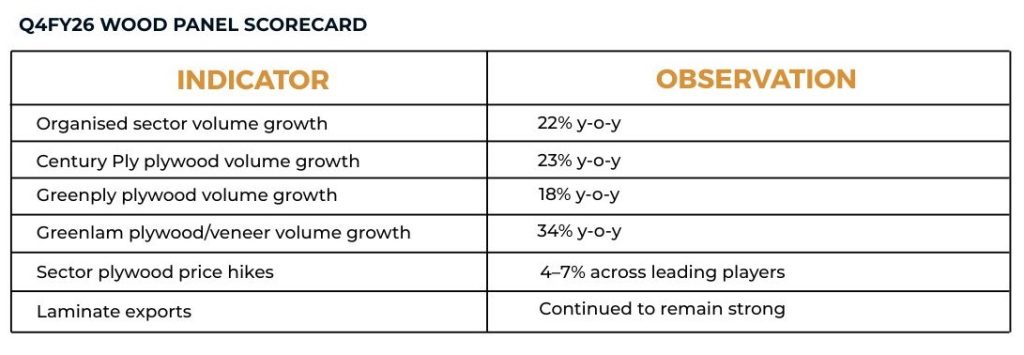
Manufacturers of India’s wood panel sector continued to report healthy volume growth during the quarter, particularly in the plywood segment. According to the report, listed companies’ average sector volume grew 22% year-on-year, with Century Ply, Greenply and
Greenlam all reporting volume growth. This indicates that demand remained healthy during the quarter.
The report also highlights that individual companies achieved growth through initiatives such as distribution expansion, advanced production technology and stronger product acceptance.
#2 Rising Input Costs Keep Margins Under Pressure
The report highlighted that margin performance remained mixed across plywood, laminates and MDF as higher resin and chemical costs continued to impact profitability. To offset rising input costs, leading manufacturers announced plywood price hikes ranging from 4% to 7%, with Century Ply increasing prices by 7% and Greenply by 6%.
#3 Exports Continue to Support Growth
Laminate exports continued to perform well during the quarter and the momentum is expected to continue. The report estimates that laminate exports from India will grow at an 11–12% value CAGR over the next three to four years, supported by manufacturers expanding into new markets and increasing their share in existing ones.
#4 Capacity Expansion and Product Mix to Support Margins
According to the report, India’s wood panel sector expects margins to benefit from the rapid ramp-up of newly commissioned and upcoming capacities. It also highlights that value-added products, favourable product mix changes and a growing international presence are expected to support profitability over the coming years.
These sector trends become more evident when we look at the performance of India’s leading wood panel manufacturers.
“Indian Wood Panel industry should see improved traction over the FY27-29 period, as we believe that Housing projects launched between FY22-26 should start reaching delivery phase over the next 2-3 yrs. Organised players with disciplined execution, differentiated go-to-market strategies, product SKUs + innovation and balance sheet strength will be the key beneficiaries of this growth.”
— Pranav Mehta, Associate Director, Equirus Securities
What Plywood Annual Charts Reveal
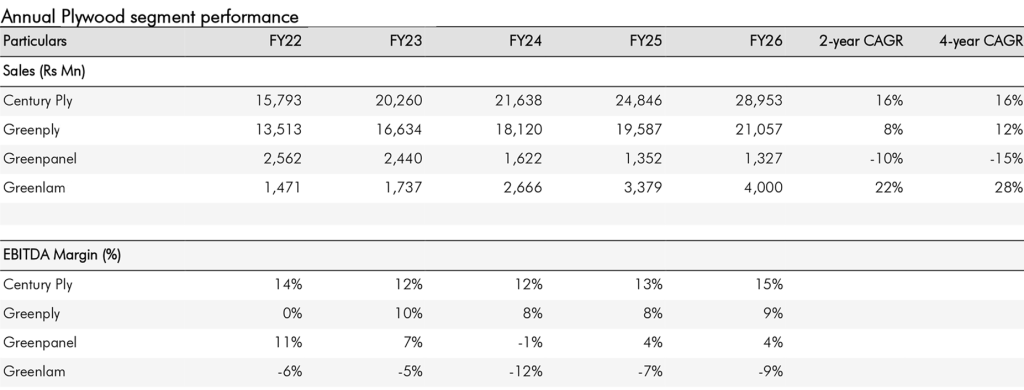
Viewed together, the charts point to these emerging realities:
- Market Leaders Continue to Pull Ahead
Sales have grown steadily across the organised plywood sector, with Century Ply and Greenlam recording the strongest growth over the last four years.
- Volume Growth Remains Healthy
Plywood volumes have increased across most leading manufacturers, indicating sustained demand in the organised market.
- Profitability Has Been Mixed
EBITDA margin trends varied across companies, with some players improving profitability while others continued to face pressure.
What Laminates Annual Charts Reveal
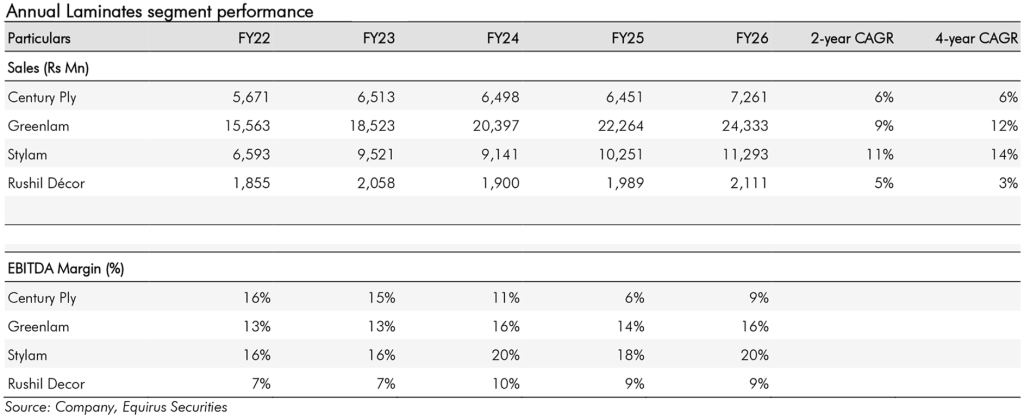
Viewed together, the charts point to these emerging realities:
- Exports Continue to Support Growth
The charts indicate that companies with a stronger international presence have consistently expanded both sales and profitability over the last four years. This highlights the growing role of exports in supporting long-term growth in the laminates segment.
- Volume Growth Has Been Gradual
Laminate volumes increased steadily, reflecting consistent demand rather than rapid market expansion.
- Margins Show Signs of Stability
EBITDA margins remained stable or improved for most leading players, indicating better profitability across the segment.
What the MDF Annual Charts Reveal
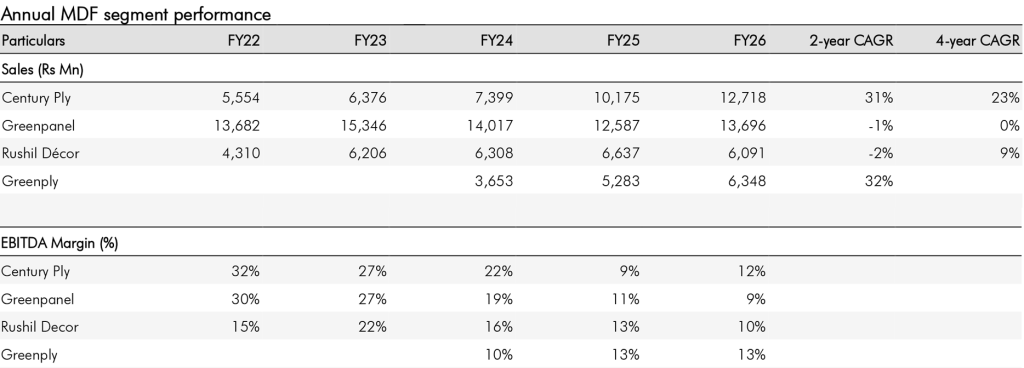
Viewed together, the charts point to these emerging realities:
- Volume Growth Continues Across the MDF Segment
The MDF segment recorded healthy volume growth over the last four years. Century Ply emerged as the fastest-growing player, while Greenply also expanded its MDF business steadily.
- Sales Growth Reflects Industry Expansion
Sales increased across most organised MDF manufacturers over the last four years, reflecting the segment’s steady expansion.
- Margin Performance Has Been Uneven
EBITDA margin trends differed across manufacturers. While some players improved profitability, others continued to face margin pressure.
“Organised larger plywood companies will continue to gain volume market share in the mid-segment plywood category, while organised laminate players will benefit from improved offtake, both in the domestic as well as the export markets.”
— Pranav Mehta, Associate Director, Equirus Securities
Company Strategies: How Market leaders are Preparing for FY27
Century Ply: Expanding Capacity While Strengthening Product Portfolio
Century Ply’s management highlighted that April 2026 was the company’s best month till date, with growth momentum expected to continue. During the quarter, the company reported 23% year-on-year growth in plywood volumes, supported by healthy demand, strong brand positioning and continued distribution expansion.
The company also reported healthy demand across its product portfolio, with improved contribution from recently expanded capacities. The laminate business witnessed a visible turnaround, driven by a better product mix, while the MDF business recorded improved utilisation levels and sustained demand. The particle board business also benefited from new capacity additions and higher utilisation.
The company reported an improvement in EBITDA margins, supported by better operating leverage, higher capacity utilisation, an improved product mix, continued cost optimisation and operational efficiencies. To offset rising resin and chemical costs, Century Ply announced price hikes across its portfolio, including 7% for plywood, over 10% for laminates, more than 15% for MDF and over 10%for particle board.
Looking ahead, Century Ply is expanding its manufacturing footprint across key product categories. Plywood capacity utilisation stood at 99% during the quarter, and the company plans to increase capacity by 30% this year through enhancement at existing facilities and the addition at its Hoshiarpur plant. It has also announced new plywood and particle board facilities in Odisha, while work on a new plant in Uttar Pradesh is expected to begin in FY27. FY27 Focus: Capacity expansion, higher utilisation, product portfolio expansion and margin improvement.
Greenpanel: Focusing on Utilisation, Premium Products and Operational Efficiency
Greenpanel’s management said industry volumes remained flat during the quarter due to pre-channel stocking but expects the wood panel sector to grow in the mid- to high-teens in FY27. The company expects demand to improve as new capacities are absorbed by the market.
The company continues to strengthen its manufacturing capabilities and product portfolio. It is adding a new production line using 100% European technology and expects value-added products to remain a key growth driver. Currently, value-added products account for 43% of volumes and 55% of value, while premium products continue to contribute a significant share of MDF sales. The company also said that most of its business comes from the retail segment, with 15-20% contributed by large OEMs.
Greenpanel is also focusing on improving operational efficiency. The company is undertaking raw material optimisation by replacing eucalyptus with other timber species, as eucalyptus prices in South India remain significantly higher than other options. To offset rising raw material costs, it implemented a 6% plywood price hike from the beginning of FY27.
Looking ahead, the company plans to focus on improving utilisation of its existing capacities rather than undertaking major capital expenditure. Management expects utilisation to increase from the current 55-60%, while FY27 will be focused on debt reduction. It also expects two new industry capacities coming up during FY27 to contribute meaningfully over the medium term.
FY27 Focus: Increase capacity utilisation, expand value-added products, improve operational efficiency and reduce debt.
Greenlam: Strengthening Global Presence Through Exports and Capacity Expansion
Greenlam’s management said the company’s position in Europe remains strong, while exports continued to grow across all key regions. The company also highlighted that the premium plywood market has started stabilising, with demand improving across regions such as North and Western India.
The company said its pre-lam board business is gradually recovering, while its market share has remained stable. Management also noted that India contributes only a small share of the global laminate market, with international markets continuing to drive both volume and value growth.
From April 2026 onwards, Greenlam implemented price increases to offset higher chemical costs. The company said it was able to pass on the increase in raw material costs in the domestic market and recovered around 45% of the higher costs in export markets.
Looking ahead, Greenlam expects 18% revenue growth in FY27 and laminate volume growth of 10-12%, with margins expected to remain in the 16-17% range. The company also expects its chipboard business to move towards profitability from FY28. Management said FY27 will remain focused on executing ongoing capacity expansion projects and converting these investments into revenue growth.
FY27 Focus: Expand global business, execute capacity expansion, improve profitability and strengthen growth across product segments.
Greenply: Investing in Technology and Capacity to Drive the Next Phase of Growth
Greenply’s management said the company has started FY27 on a strong note and is targeting 10% growth in its plywood business during the year. It also expects 25-30% volume growth in MDF, supported by improving demand and operating leverage. While plywood demand is growing at 3-4%, the MDF sector continues to expand at 15-20% annually.
To protect margins, the company implemented a 4-5% price increase in plywood and a 5% price hike in MDF from April 2026. Management said current margins remain sustainable and does not expect raw material prices to rise further. The company is also working to source chemicals domestically to reduce its dependence on imports.
Greenply is strengthening its manufacturing capabilities through technology upgrades and new capacity additions. The company has introduced new European ContiRoll technology for plywood manufacturing, which is expected to improve product quality, support higher-margin products and cater to the growing demand from OEM customers. It has also commissioned its PVC/WPC Boards facility and expects both its PVC Boards and Flooring businesses to become meaningful revenue contributors over the coming years.
The company has lined up significant investments to support future growth. Along with technology upgrades at existing plywood facilities, Greenply is developing its Odisha plywood plant, with the project remaining on track. Management has planned around Rs 4.8 billion of capital expenditure in FY27 across capacity expansion and technology upgrades. It also expects the Samet JV to improve its margins and move towards breakeven next year as demand continues to improve.
FY27 Focus: Technology upgrades, capacity expansion, stronger MDF growth, domestic sourcing and margin improvement.
Stylam Industries: Strengthening Exports and Expanding Manufacturing Capabilities
Stylam Industries expects its growth strategy to continue, with a stronger focus on domestic and international markets. Management said the company is investing in global technology, product innovation and better manufacturing practices to support future expansion.
The company reported healthy export demand, with exports contributing around 75% of revenue. It also said it was able to pass on part of the increase in raw material costs through price hikes, while continuing to monitor higher input costs. From April 2026, the company implemented another round of price increases to protect margins.
Looking ahead, Stylam plans to strengthen its manufacturing footprint. The company expects to expand its laminate capacity after receiving the necessary environmental approvals and aims to achieve Rs 3.4 billion in revenue over the next three to four years. Management also expects 20-25% revenue growth in FY27, supported by expanding capacity and increasing market presence.
FY27 Focus: Expand manufacturing capacity, strengthen exports, drive product innovation and accelerate revenue growth.
Rushil Decor: Expanding Premium Product Portfolio and Global Market Presence
Rushil Decor continued to strengthen its laminates and MDF businesses despite higher raw material costs during the quarter. The company implemented price hikes of around 15% in MDF and 10% in laminates from April 2026 to offset rising resin and chemical costs.
A key focus for the company is increasing the share of value-added products (VAP) in its MDF portfolio. VAP currently contributes 54% of MDF value, and the company aims to increase this to 50% of MDF volumes and 60% of MDF revenue by FY27. Management believes this will support higher-margin growth and improve profitability over the long term.
Rushil Decor is also strengthening its position in the laminates business through exports and product development. The company continues to expand its international presence, with growing demand for Jumbo Laminates in markets including Russia, Portugal, Slovakia, Romania, Israel, Central America, Latin America and several other regions. It also remains focused on product innovation, certifications and expanding the Jumbo Laminates portfolio to support future growth.
Alongside exports, the company is expanding its domestic reach. During the year, it added 67 new direct distributors and over 131 retailers, improving customer accessibility across key markets. Management also plans to improve capacity utilisation, increase the share of premium products and continue operational efficiency initiatives to support margins.
FY27 Focus: Expand value-added products, strengthen laminate exports, improve capacity utilisation and grow domestic distribution.
“MDF will continue to remain the fastest growing segment within the Wood Panel category, but we expect competitive intensity to remain at least for the next 2 quarters with improvement happening only from 4Q27/FY28. The Chipboard segment will see a steady move from unorganised to organised market, with the aggressive entry and capacity addition by large organised players in the last 2.5 years.”
— Pranav Mehta, Associate Director, Equirus Securities
SH Takeaways
For Furniture OEMs
Manufacturers are expanding their range of value-added wood panel products while improving capacity utilisation and manufacturing efficiency. This means furniture manufacturers are likely to have access to a wider choice of engineered wood products, better finishes and more consistent quality. The focus is shifting from adding capacity to delivering higher-value products and improving profitability.
FY27 is likely to be less about adding capacity and more about making existing investments deliver returns.
For Channel Partners
Pricing is likely to remain dynamic as manufacturers continue to respond to changes in raw material costs.
Most leading companies have already announced price hikes across plywood, MDF and laminates. Dealers may need to focus more on inventory planning, premium products and organised brands as the market continues to evolve.
For the Interior Ecosystem
The industry is offering more choices beyond standard wood panels.
Manufacturers are investing in premium laminates, value-added MDF, decorative surfaces and better manufacturing technologies. This gives architects, interior designers, modular kitchen companies and furniture manufacturers more options to create differentiated products while meeting the growing demand for quality interiors.
ALSO READ