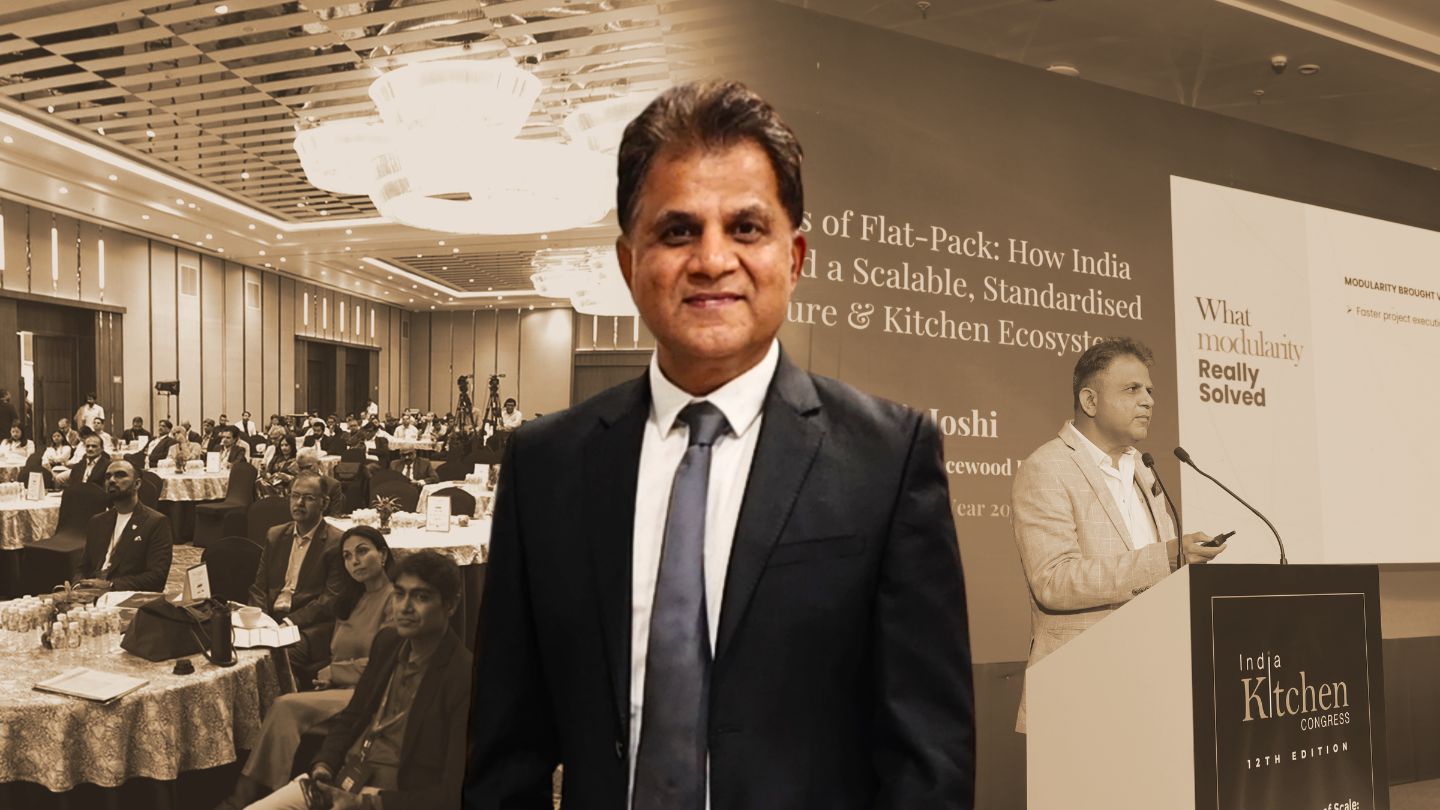
Building India’s Standardised Furniture Ecosystem explores Kirit Joshi’s roadmap for scaling the modular furniture industry through standardisation and technology.
India’s modular furniture industry has come a long way, but according to Kirit Joshi, Founder and Managing Director of Spacewood Furnishers and IKC Person of the Year 2025, the journey has only just begun. Speaking at India Kitchen Congress 2026, he observed that despite the industry’s progress, India’s largest manufacturers remain significantly smaller than their global counterparts, reflecting the fragmented nature of the market.
At the same time, he believes the organised industry is still at an early stage of its growth, creating significant opportunities for businesses that build scalable systems and disciplined manufacturing.
Joshi entered the furniture industry in 1994 with a small manufacturing unit and a team of just 10 people. Drawing on more than three decades of building Spacewood, he said the business decisions that helped the company scale included standardisation, technology adoption, backward integration, a multi-channel growth strategy and long-term partnerships. Together, these lessons offer a practical roadmap for modular furniture manufacturers looking to build profitable and scalable businesses.
Systems Before Capital
For modular furniture manufacturers looking to grow, scaling is not just about investing more capital. Joshi highlighted that while funding may be required to support expansion, businesses cannot depend on external funding indefinitely. “You can’t inject external capital every day.”
According to him, long-term growth depends on generating consistent profits through better planning, product mix optimisation, material utilisation and efficient manufacturing processes, rather than simply increasing prices.
Recalling a lesson that stayed with him throughout his career, Joshi shared advice from a former Godrej executive, “Even if you make one rupee, please make one rupee. If you make one rupee, this company can run for a hundred years.”
He highlighted that profitability is a critical component of long-term growth, and businesses should focus on improving manufacturing efficiency without relying on repeated capital infusions.
Joshi emphasised that scaling begins with a change in mindset. Businesses must first think like manufacturers, with repeatable systems and disciplined processes, before investments in technology or capital can deliver meaningful results.
Standardisation is The Foundation
Looking ahead, Joshi believes the industry’s next phase of growth depends on reducing complexity through standardisation. “If businesses in India want to become more sustainable, we need to move from fragmentation to standardisation — if not size, definitely in materials.”
This requires a shift from “project to a product mindset,” he said. Rather than creating a new solution for every order, modular furniture manufacturers should build standardised product catalogues that reduce unnecessary variations while still offering customers enough flexibility. This, he believes, can simplify manufacturing, lower costs, and help businesses scale without compromising quality.
He also stressed the importance of standardising design logic, so that products follow consistent engineering principles even when customers choose different finishes or configurations.
According to Joshi, manufacturers should also design products in such a way that all the complexities are addressed during the production phase, making installation faster and simpler, “Today, the front-end cost of installation is far higher than the cost of manufacturing. The cost of installing a kitchen or a wardrobe is higher than the manufacturing cost right now, and that is where the challenge is.”
Comparing Indian manufacturers with their counterparts in Europe, he said manufacturers there improve efficiency by working with standard materials while continuing to offer customised products. He highlighted how Indian companies often produce the same kitchen using dozens of different particle board colours and material combinations. “In the same particle board, we are making 10,000 kitchens in at least 50 colours and 25 materials. How will manufacturing become efficient!” he exclaimed.
According to him, standardising materials allows manufacturers to buy in larger volumes, reduce costs, improve supply chain planning and simplify installation by resolving complexity during design and production. These principles, he argued, are what made modular furniture successful in the first place—delivering faster execution, predictable timelines, consistent quality and easier scalability than traditional on-site carpentry.
Why À La Carte Doesn’t Scale
For many manufacturers, offering greater customer choice means offering more materials, finishes and hardware options. Joshi argued that this creates unnecessary manufacturing complexity without adding proportional value.
He illustrated this with an example of the automobile industry, stating that customers buying a car choose the model and colour, not the steel grade, engine components or every part used in its manufacturing. Similarly, he suggested that modular furniture makers should standardise components such as carcasses, cabinet bottoms and internal hardware, while allowing customers to customise shutters, drawer fronts, finishes, colours and other visible design elements.
According to him, global players like Oppein and Nobilia follow this approach by working with a standard set of materials and default hardware, while giving customers flexibility only in the visible elements of the product. The quality standards, core materials and hardware
specifications are non-negotiable and remain with the manufacturer to select, not the customer.
Technology as Continuous Investment
Technology has remained a constant investment throughout Spacewood’s journey. According to Joshi, connecting design, planning and manufacturing through digital systems has been one of the company’s biggest competitive advantages as it scaled.
One of Spacewood’s major investments was backward integration. Instead of sourcing laminated boards, the company set up its own lamination lines, becoming one of the first furniture makers in India to integrate the process in-house. The company was among the
early investors in CNC tech and bringing edge banding and membrane pressing in-house. “We were the first in post-forming. We did a backward integration of lamination of the board. We were the first to integrate right from lamination lines to the front end,” Joshi said.
Spacewood has also executed end-to-end IT integration, focusing on connecting design, quotation and manufacturing through CAD-CAM integration and an ERP backbone. Their front end to the factory is fully connected, enabling information to flow seamlessly across departments and reducing manual intervention. It also allows the company to deliver mass customisation without disrupting manufacturing.
According to him, end-to-end integration became one of Spacewood’s key drivers of scale. It strengthened manufacturing control, enabled mass customisation and continues to improve productivity, with AI expected to further enhance planning and decision-making.
Build a Multi-Channel Growth Strategy
As businesses grow, relying on a single sales channel can also mean relying on a single source of demand. Spacewood has instead built a multi-channel business.
Its retail stores help build brand visibility and strengthen its consumer presence. Institutional projects, including commercial and large-scale developments, provide business volumes. OEM partnerships with leading brands such as Godrej, NeoSpace and HomeLane create a steady stream of business, while exports expand the company’s international footprint. Spacewood has also partnered with online platforms such as Pepperfry, making its products accessible to customers through digital channels.
Reflecting on this approach, Joshi described it as a “first principle strategy” that helped the company spread risk across multiple channels instead of depending on one. “Somebody buying home furniture online, we are with Pepperfry. Somebody buying from retail stores, we are there. We have reduced our risk.”
Additionally, the company entered into a strategic partnership with Sumitomo Forestry of Japan, which brought it both capital and technical collaboration. Reflecting on the partnership, Joshi said it not only added credibility to Spacewood but also strengthened its manufacturing systems and standards. “Obviously, a very large partner like Sumitomo adds credibility. A Japanese company would build very strong systems into you,” he remarked.
Recently, private equity firm A91 Partners invested in Spacewood to support its next phase of growth. Joshi noted that external capital became important when the focus shifted to scaling faster. Beyond funding, the partnership also helped strengthen governance and institutionalise the business.
Today, Spacewood operates nearly one million sft of manufacturing space, employs over 2,000 people, generates more than Rs 700 crore in annual revenue while maintaining double-digit EBITDA margins.
Long-Term Partnerships
Beyond manufacturing and technology, Joshi believes long-term growth depends on building lasting relationships across the business ecosystem. Reflecting on Spacewood’s supply chain, he said many of the company’s suppliers have remained with it for over 25 years. Rather than constantly looking for new vendors, Spacewood has focused on building partnerships with suppliers who have grown alongside the company and actively contributed to its journey.
“They were into the thick and thin of our lives. We treated them as a good partner and a team,” he said, adding that suppliers should be seen as long-term partners rather than transactional vendors.
Extending the same philosophy to people, he highlighted that most employees at Spacewood have been hired as freshers and trained internally, with the company preferring to build capabilities over time rather than relying heavily on experienced hires. This approach has resulted in low attrition, with many employees spending their entire careers at the company. “People grow with you, and they build the company with you,” he remarked.
Building an Organised Industry Ecosystem
Joshi noted that while manufacturing capabilities had improved over the years, the organised sector in India remains highly fragmented, making it difficult for manufacturers to achieve the scale seen in global markets. “A standardised furniture ecosystem will allow manufacturers to simplify production, improve profitability and compete globally.”
Drawing a comparison with China, he remarked that India’s top ten companies remain smaller than China’s largest player. Yet he believes this also represents the industry’s biggest opportunity, as stronger national brands and greater standardisation gradually reshape the market.
For Joshi, a standardised furniture ecosystem is the foundation on which India’s next generation of furniture manufacturers will be built. He said that the challenge is no longer about building larger factories or increasing production capacity. Instead, it lies in how quickly modular furniture manufacturers embrace standardisation, technology and product thinking to build more efficient and scalable businesses.
From product standardisation and technology integration to multi-channel growth strategies and long-term partnerships, Joshi’s keynote reinforced a simple idea: scale is built through systems, not size alone.
Joshi believes that the future of India’s furniture industry depends on three fundamental shifts—from fragmentation to standardisation, from craft to manufacturing discipline, and from a project mindset to a product mindset.
For manufacturers, these shifts could become the foundation for building profitable businesses capable of competing at scale.
Enjoyed this article?
Receive Kitchen & Cabinetry Intelligence directly in your inbox.
Subscribe to newsletter. Click.
–
ALSO READ