As India’s furniture industry enters a new phase of growth, the ESG leadership prism challenges enterprises to rethink not just how they scale, but the models on which they build.
Drawing insights from Nyrika Holkar’s thought leadership and Godrej’s sustainability journey, this article explores five strategic shifts that are redefining how businesses compete, create value and prepare for the future. From the convergence of competitiveness and responsibility to the growing importance of circularity, trust and resilient supply chains, these shifts are gradually reshaping the industry’s growth story.
At the centre of this transformation is ESG (Environmental, Social and Governance) in India’s furniture industry. What was once viewed largely as a reporting or compliance requirement is increasingly becoming an important business consideration. As customer expectations evolve and businesses face growing pressure to operate responsibly, ESG is influencing decisions around sourcing, manufacturing, supply chains and long-term value creation.
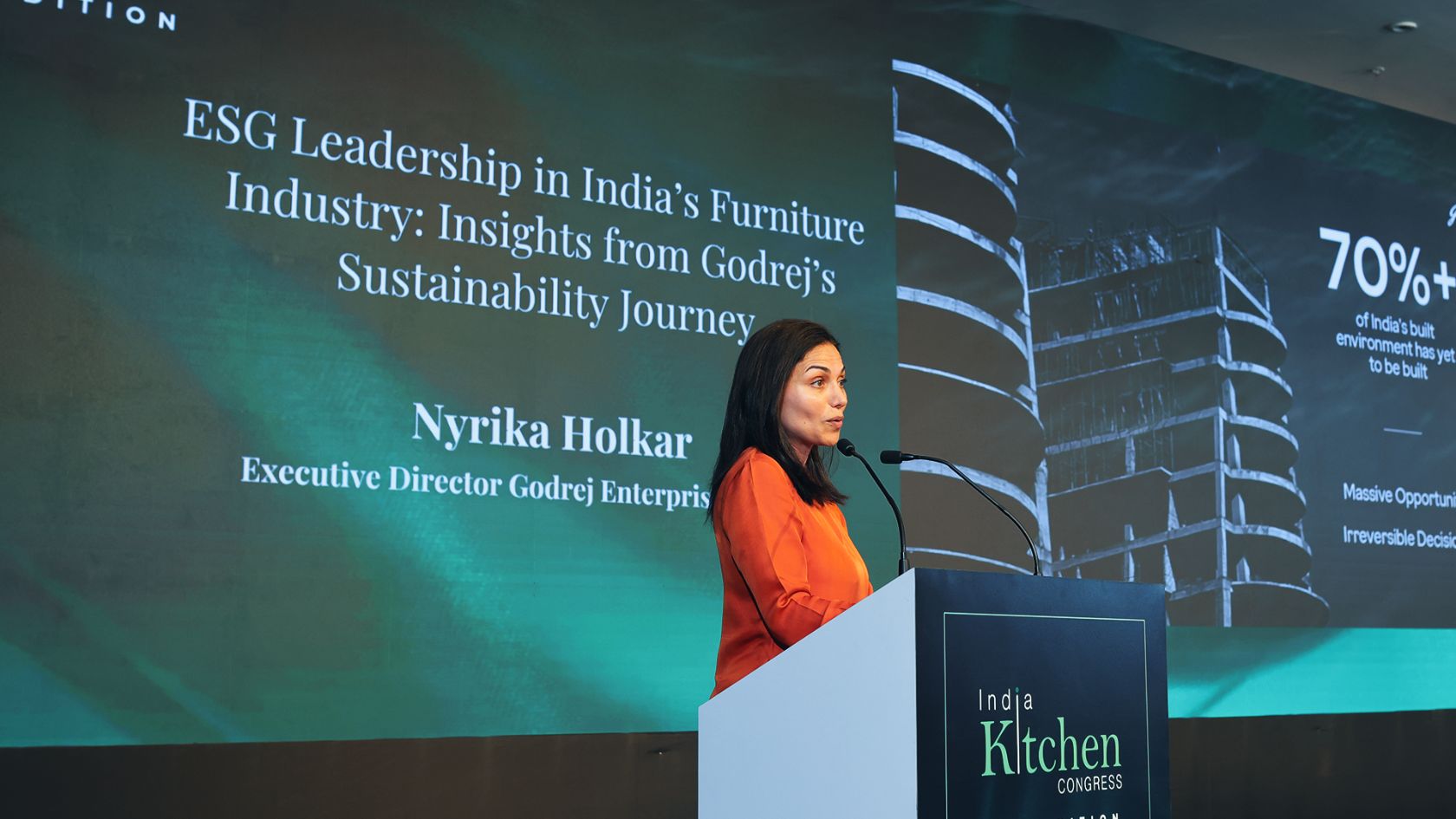
Speaking at India Kitchen Congress 2026, Nyrika Holkar, Executive Director of Godrej
Enterprises Group and an ardent ESG advocate, challenged the industry to rethink not just how it scales, but what exactly it is scaling.
According to Holkar, the challenge industry face today is not the ability to grow but the model on which that growth is built. The Indian furniture market, which is expected to grow from $31.51 billion in 2026 to $45.52 billion by 2031, is entering a period of rapid expansion. As expectations from customers, regulators, investors and institutional buyers continue to evolve, businesses are being encouraged to think beyond short-term growth and ask a more fundamental question: Can India build a furniture industry that is not only larger, but also more responsible, resilient and regenerative.
As Holkar observed, many industries continue to rely on models driven by resource extraction, linear consumption and short product life cycles. The concern, she argued, is that scale amplifies whatever model lies under it. And if the model is broken, scale only perpetuates the issue and makes it harder to fix.
Competitiveness and Responsibility Are Converging
For a long time, growth in India’s furniture industry has been measured through production
capacity, scale and expansion. Today, the definition has evolved as priorities have changed.
Consumer expectations have changed. Customers are increasingly interested in knowing where the products come from and how they are manufactured. At the same time, global markets, investors and institutional buyers are asking a different question altogether: Can growing companies be trusted? As a result, competitiveness and responsibility are no longer separate conversations. They are increasingly becoming part of the same business equation.
According to Holkar, long term sustainable growth requires models that not only prioritise
growth but also ‘do good’. In the years ahead, industry’s winners will not be those who scale the fastest, but those who scale the smartest.
Beyond Scale: What Model is India Building?
One of Holkar’s most significant observations was that India’s opportunity is fundamentally
different from that of many developed economies. She highlighted that in the developed world, 80% of the built environment has already been built. However, over 70% of the built
environment that India will require by 2050 is yet to be built. For the furniture and interiors
industry, this represents not only a massive growth opportunity but also an opportunity to
influence how that growth takes shape.
Watch Nyrika Holkar’s 14-minute talk here:
Challenging the industry to think beyond conventional growth models, she remarked that if we are not inheriting a system but scripting it, “Why can’t we script it differently?”
She questioned whether India’s furniture industry should continue to follow Western
prototypes or use this opportunity to create a unique, future-ready model of its own. In fact, she noted that the decisions being made today will ultimately determine whether future generations inherit problems to solve or foundations they can build upon.
As businesses rethink the systems that support growth, the industry has an opportunity to
prioritise durability, resource efficiency and longer product life cycles. The choices made today will shape both the industry’s future and its legacy.
From Extractive to Regenerative
The furniture industry carries a significant responsibility when it comes to protecting the
environment. For decades, it has largely operated a linear model in which raw materials are
extracted, transformed into products and eventually discarded. While this has supported
growth, it has also increased pressure on natural resources and generated substantial waste.
Businesses today, therefore, need to rethink this model. Holkar believes that India has a rare opportunity to build a regenerative furniture industry, one that creates value without depleting the resources, communities and ecosystems on which it depends.
“The industry must accelerate its shift from an extractive to a regenerative model. It must
adopt a ‘cultivate, create and circulate’ mindset and focus on doing more good than doing less harm.”
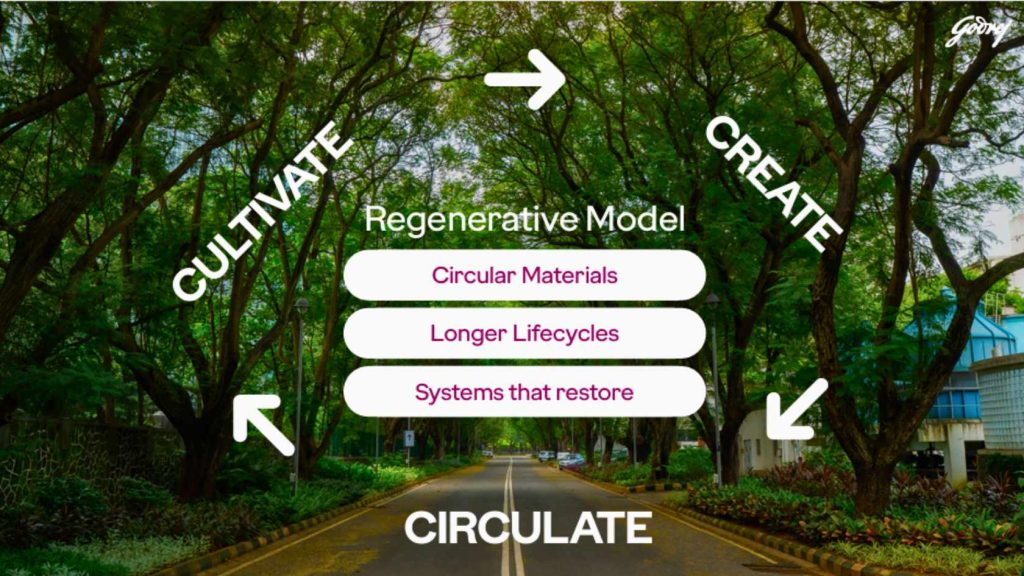
As such, a regenerative approach focuses on creating products that last longer, use resources more efficiently and generate less waste. It encourages businesses to think beyond production volumes and ask deeper questions: How do we really design for circularity? And how do we ensure that systems are built to replenish rather than deplete?
Holkar emphasised that the transition requires a fundamental mindset shift. Too often
sustainability is viewed through a lens of scarcity, with ESG seen as an additional cost. However, she argued that a regenerative approach requires an ‘abundance mindset’ that focuses on creating ecological, social and financial value over time.
With this approach, the focus shifts from pursuing short-term gains to building systems that are efficient, resilient and capable of creating long-term value for businesses, communities and the environment. “Abundance thinking looks on waste as a design failure, looks on longevity as a value.”
This transition in India’s furniture industry is also being reinforced by evolving regulations,
government initiatives and industry sustainability standards. The Business Responsibility and Sustainability Reporting (BRSR) framework, introduced by the Indian regulator Securities and Exchange Board of India (SEBI), in 2021, has made ESG disclosures for the country’s top 1,000 listed companies mandatory. The framework was further expanded to include value-chain disclosures, suggesting that the companies ensure their suppliers, partners and distributors are also operating ethically and sustainably.
Furthermore, the Furniture (Quality Control) Amendment Order, 2026, that came into effect
this February, has mandated manufacturers to align with higher quality and certification
standards.
Trust as a Business Asset
Holkar believes that trust is one of the most valuable assets a business can build over time. As customers become more aware and global markets demand greater transparency, businesses are increasingly being evaluated not just on the products they sell, but on how those products are made. Questions around sourcing, certifications and environmental impact are increasingly influencing their decisions.
As a result, large developers, institutional buyers and investors are placing greater emphasis on traceability, responsible sourcing and verified sustainability practices. This is reflected in the growing relevance of sustainability criteria embedded in the Indian Green Building Council (IGBC) guidelines and Forest Stewardship Council (FSC) chain-of-custody certifications. The industry is also witnessing increased adoption of engineered wood, low-volatile organic compound (VOC) finishes, certified raw materials and other environmentally conscious alternatives, particularly across premium residential, commercial and institutional projects. Thus, whether it is responsible sourcing, ethical supply chains, product quality or sustainability commitments, businesses that can demonstrate accountability are likely to be better positioned for long term growth.
“In an increasingly competitive market, trust is no longer just a brand value, it is becoming a business advantage.”
Principle to Practice: Godrej’s Sustainability Journey
Holkar described supply chain as the crux of building a more responsible industry ecosystem, and emphasised that sustainable growth depends on strengthening the broader value chain. Highlighting Godrej’s approach, Holkar noted that the company has spent the last 17 years developing a Green Cluster Programme that works closely with MSMEs to improve not only their manufacturing standards, engineering capabilities and product quality, but also their green credentials.
“By building for efficiency and sustainability, today, nearly 81% of Godrej’s sourcing is
indigenous, while 34% is classified as green sourcing.”
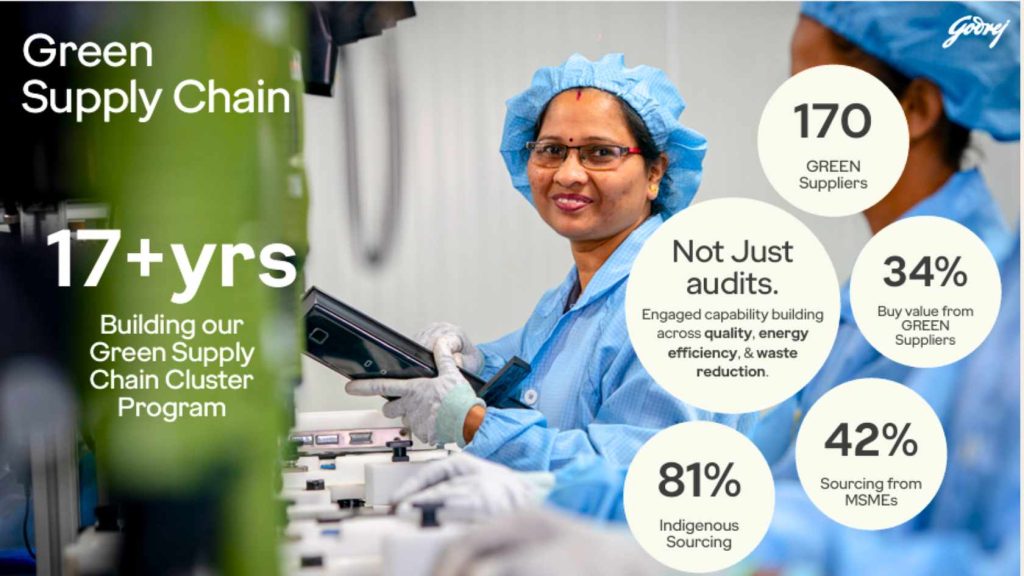
The initiative also highlights how MSMEs that invest in quality, sustainability and responsible manufacturing can strengthen their position in future-ready supply chains. “If the ecosystem does not evolve, the industry cannot evolve.”
She also highlighted the importance of making material choices that are both practical and
sustainable. Referring to steel as one of Godrej’s key materials, she noted that its durability, recyclability and suitability for Indian climatic conditions make it an important component of responsible manufacturing.
Looking ahead to 2032, Godrej aims:
- 50% of revenues from green products
- Increase use of renewable energy by 40%, improve carbon productivity by 60%
- Scale domestic green procurement to 80%
Therefore, as India’s furniture industry enters a period of significant transformation, businesses must rethink what growth should look like in the years ahead. As demand continues to rise, success will not be defined by scale alone, but by the ability to build operations that are resilient, future-ready and capable of creating long-term value.
“Our industry may be judged on the products that it makes, but more importantly, it will be
judged on how it made those products.”
Enjoyed this article?
Receive Kitchen & Cabinetry Intelligence directly in your inbox.
Subscribe to newsletter. Click.
–
ALSO READ