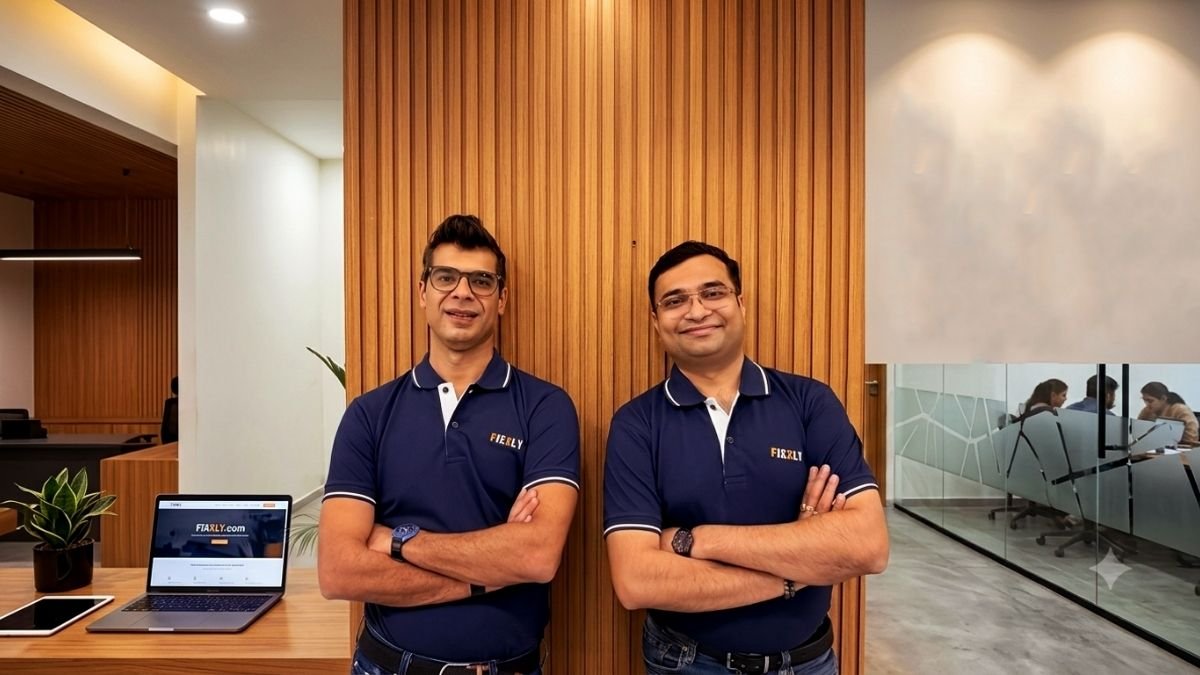
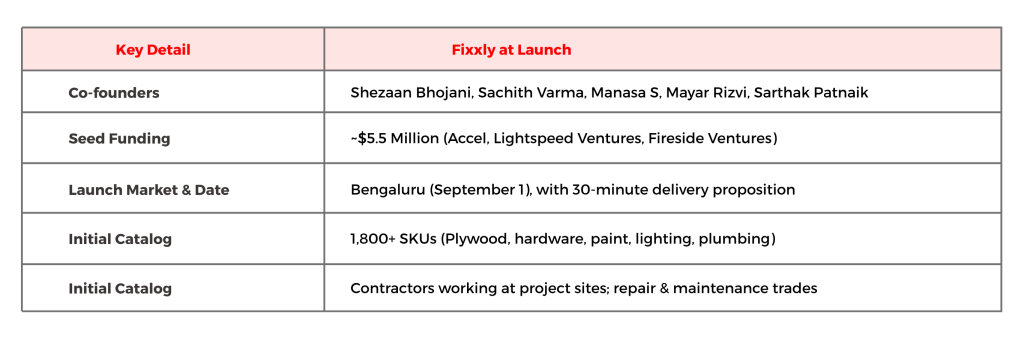
Shezaan Bhojani, co-founder of DesignCafe, has launched Fixxly for building materials, a quick-commerce platform that enables contractors working at ongoing project sites to order materials and have them delivered directly to the location. The platform launches in Bengaluru on September 1 with a 30-minute delivery proposition.
Fixxly is launching with 1,800+ SKUs across categories including paint, plywood, hardware, hinges, cables, switch boxes, lighting, fans, pipes and CP fittings. Hyderabad is expected to follow, before the company moves into other markets.
The proposition is also designed for small, immediate requirements: Fixxly says there is no minimum order, allowing contractors to buy only what they need for a job. On its website, Fixxly describes the proposition as “quick commerce for repair & maintenance”.
The venture is backed by about $5.5 million in seed funding from Accel, Lightspeed Ventures and Fireside Ventures. But Bhojani is betting on more than speed. Speaking to Sourcing Hardware ahead of the launch, he said the larger opportunity is to make building-material procurement more predictable — through better product availability, transparent pricing, authenticity and dependable delivery.
“30 minutes is a table stake,” Bhojani said. “The core proposition is quick delivery when you need it, but the right product at the right price also.”
India’s building-material market is still largely driven by fragmented distribution, local suppliers and relationships. For contractors working at an ongoing site, a missing fitting, sheet, cable or plumbing component can mean calling multiple suppliers, sending someone to a nearby market or store, and holding up work until the material arrives.
Fixxly wants to change that experience. “The whole idea is to make the contractor’s life easier. You get the material when you need it, you know the price upfront and you know the product is genuine,” Bhojani said.
Building for Scale
Bhojani comes to Fixxly after having co-founded home interiors company DesignCafe with Gita Ramanan, a business that was subsequently acquired by HomeLane. That experience gave him a close view of the challenges involved in managing materials, supply chains and execution across interior project sites — and of what it takes to scale a consumer-facing business.
Earlier this year, Bhojani had spoken to Sourcing Hardware about the economics of scaling DesignCafe through a store-led channel strategy and tighter operating discipline.
As he builds Fixxly for building materials, Bhojani is drawing on a five-member founding team with experience spanning supply chain, retail, brands, logistics and technology.
Alongside Bhojani, the team includes Sachith Varma, who previously headed supply chain at Zepto; Manasa S, who headed brand and loyalty at Asian Paints; Mayar Rizvi, who has worked with Walmart and Hippo Stores; and Sarthak Patnaik, who previously headed product at Shadowfax.
For Bhojani, that experience matters because identifying a customer problem and building a business capable of solving it at scale are two different challenges. “There are two parts to building any business. One is understanding the customer pain point and understanding the problem and creating a solution. The other thing is scaling the solution,” he said.
“All five of us have seen and built scale.” The experience, he added, goes beyond understanding the customer problem to the architecture of building the business itself — how supply chain, technology, assortment and fulfillment come together as the company grows.
Bhojani sees Fixxly’s investors playing a similar role. Their value, he said, extends beyond the capital they provide to the insights and longer-term perspective they bring to the business. “The vision we have is not for six months, or three months, or one year,” he said. “We are thinking, okay, what’s in 10 years, what will be the shape of business, and how do we get to that shape?”
Making Building-material Buying More Predictable
The market Bhojani is targeting with Fixxly for building materials presents a different challenge from consumer quick commerce.
Contractors do not simply need products quickly. They need the right material to be available when required, at a price they understand, with confidence over its quality and authenticity. Much of that buying today remains dependent on local suppliers, dealer networks and individual relationships.
Bhojani points to the large unorganised component of the market as part of the opportunity. Except for categories such as cement, steel, paint and adhesives, he said the unorganised segment accounts for more than 50% of India’s building-material ecosystem.
For brands, he believes this creates a distribution gap, particularly when it comes to reaching smaller contractors. “Which means that the brand is not able to go to the smallest contractor,” Bhojani said, pointing to limitations in distribution and dealer reach. “So we will offer brands a path to increase their distribution.”
Importantly, Fixxly does not necessarily need to bypass the existing distribution structure to do this. The company can procure directly from brands or work through their existing distributors, effectively creating an additional digital route through which products can reach contractors.
That could also create opportunities for challenger brands that do not have the distribution depth of larger players. Bhojani believes Fixxly can give both established and emerging brands another way to reach contractors, while giving contractors access to a wider assortment of branded products.
For the contractor, the proposition is also about creating greater consistency between large and small buyers. Bhojani describes the objective as “levelling the playing field”. Fixxly says there is no minimum order, and Bhojani adds that the price displayed on the platform would remain the same whether a contractor buys five sheets of plywood or 500.
“Our goal is to give the best product to the customer at the best price,” he said. “The need we are solving for is bringing the same reliability and transparency to building material that exists in FMCG.”
Building the Infrastructure Behind Quick Delivery
Making Fixxly for building materials work at scale requires more than putting products on an app. Fixxly is building a network of dark stores, with multiple stores planned within a city so that inventory can be positioned closer to contractors and delivery distances can be reduced.
The company will also use a dedicated fulfillment fleet through a fulfillment partner, with the initial fleet expected to comprise more than 20 vehicles.
The assortment is intended to address another limitation of neighbourhood procurement: the number of products immediately available to a contractor. By bringing together products across multiple building-material categories within its fulfillment network, Fixxly is betting that availability and assortment can become as important as delivery speed.
Technology will sit behind much of this infrastructure. Bhojani describes Fixxly as “AI native on day one”, with artificial intelligence being used in areas including inventory planning, demand planning and customer cohort analysis.
The objective is to understand what contractors are likely to need, where that demand is likely to emerge and consequently what products should be stocked closer to them.
A New Route for Brands — Not Necessarily a Replacement for Distribution
Fixxly is not alone in seeing an opportunity in quick commerce for building materials. Digital procurement of building materials is already drawing startup activity and strategic capital. In 2025, Somany Impresa Group invested ₹6 crore in Mad Over Buildings, a B2B e-commerce platform combining building-material procurement with financing and same-day delivery.
Bhojani acknowledges that other players are experimenting with similar models, but views competition as validation rather than a threat to the category. His argument is that the opportunity need not come entirely from shifting existing business from distributors or retailers to digital platforms.
If platforms such as Fixxly can give contractors easier access to branded products that they might otherwise have bought from the unorganised market, he believes they can also help expand the market available to brands.
He draws a parallel with consumer quick commerce, where digital platforms have enabled brands to reach consumers and buying occasions that traditional retail may not always capture. Building materials, he believes, could see a similar shift.
That makes the proposition broader than simply delivering the same material faster. For brands, Fixxly wants to become another route to contractors. For contractors, it wants to reduce some of the uncertainty around availability, pricing, authenticity and delivery that remains part of everyday procurement.
And that is also why Bhojani does not ultimately define success around whether every order arrives in exactly 30 minutes. When asked what would constitute Fixxly’s biggest failure, his answer was straightforward. “If I am disappointing my customer, that is my biggest failure.”
Whether that disappointment comes from delivery time, the wrong assortment, price or the product itself makes little difference, he said. “If my customer NPS is not very high, and if the customer is not ordering from me again, that’s a failure.”
For Fixxly, therefore, the 30-minute promise may be what first gets attention. The larger bet is that contractors will return because buying building materials from an ongoing project site has become more dependable.
Enjoyed this article?
Receive Kitchen & Cabinetry Intelligence directly in your inbox.
Subscribe to newsletter. Click.
–
ALSO READ