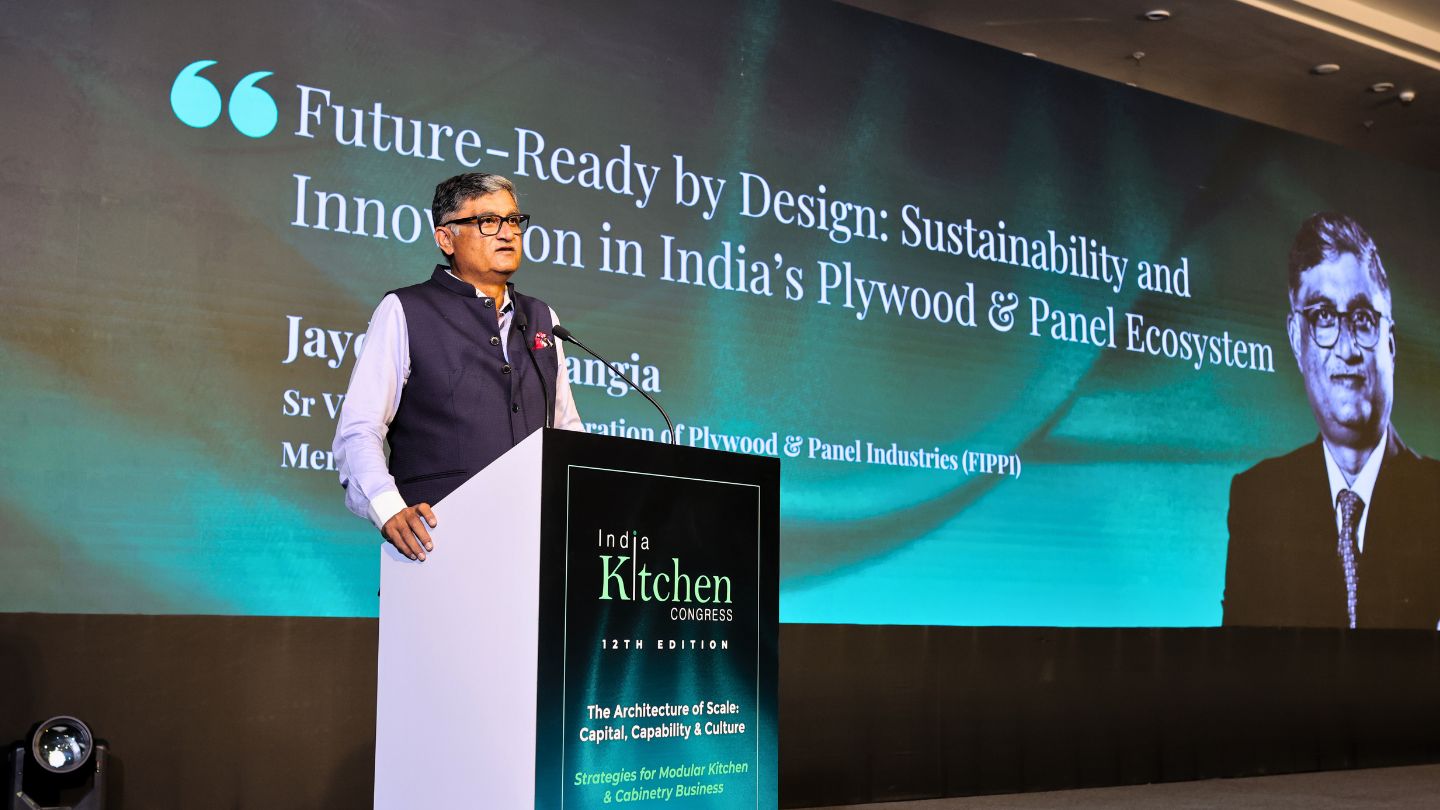
FIPPI has a vision for the Indian panel industry, which Jaydeep Chitlangia says calls for innovation, precision manufacturing and sustainability-led growth.
At a time when India’s plywood and panel ecosystem is navigating regulatory shifts, rapid market expansion and rising consumer expectations, Federation of Indian Plywood & Panel Industry (FIPPI) presented a strong vision for the Indian panel industry at the 12th edition of India Kitchen Congress, held in New Delhi. The annual conference brings together stakeholders from the modular kitchen, cabinetry and interiors industry to discuss emerging business, manufacturing and design trends shaping the sector.
Speaking on the theme ‘Future-Ready by Design: Sustainability and Innovation in India’s Plywood & Panel Ecosystem’, FIPPI’s Senior Vice President and Duroply Industries mentor Jaydeep Chitlangia urged the industry to look beyond short-term uncertainties and focus instead on innovation, design capability, manufacturing excellence and sustainability.
“The uncertainties of geopolitics, raw material availability, chemical prices and consumer buying behaviour are outside our control,” he said. “What we do have in our control is innovation, design and our ability to manufacture products that meet the evolving expectations of the consumer.”
India’s Growth Story is Driving a Future Ready Panel Industry
Setting the context for his address, Chitlangia described India as an aspirational society undergoing rapid transformation, where technological shifts and changing consumer behaviour are compressing traditional business cycles. “I used to think a generation gap was ten years,” he remarked. “A few years ago I redefined it as five years. Today, I believe it is closer to three years.”
He pointed to the rapid adoption of AI, the digital fluency of younger consumers and the accelerating pace of lifestyle change as indicators that the industry must evolve faster than ever before.
According to Chitlangia, the furniture and interior segment is growing at approximately 12–14 percent annually, while the modular kitchen category is expanding at close to 20 percent year on year. “But these are not just numbers on a slide,” he said. “They are the echo of a young, ambitious India — one that is building homes with intent, furnishing spaces with aspiration, and demanding quality that matches its rising expectations.”
For him, this growth trajectory creates both an opportunity and an obligation to make the Indian panel industry capable of delivering quality, consistency and sustainability at scale.
The Material Question Behind Kitchen Failures
A significant portion of the keynote focused on a challenge often overlooked in the interiors conversation: material performance.
Chitlangia recalled an early-career interaction with a Mumbai family whose newly renovated kitchen began deteriorating within just a few monsoon cycles. “The design was good. The workmanship was skilled. But the material had simply not been engineered for the environment it was placed in,” he said.
According to him, nearly one-third of customer complaints in modular kitchens today are linked not to design or installation, but to the behaviour of materials under real-world conditions. “That one fact should give every person in this room space to pause with a purpose,” he remarked.
The message was clear: aesthetics alone cannot define the Indian panel industry. Materials must also be engineered for climate resilience, durability, precision and long-term consistency.
Sustainability Can no Longer Remain Optional
Chitlangia positioned sustainability not as a branding exercise, but as an operational and ethical imperative. “Sustainability is not an aspiration. It is an imperative,” he said.
He argued that responsibility must begin at the source — through ethical sourcing practices, agroforestry-based raw material systems and environmentally sound manufacturing — but ultimately extend into the homes where these materials are used.
Citing studies on indoor air quality, he noted that indoor environments can often be significantly more polluted than outdoor spaces, making material choices central to healthier living environments. “The materials we produce either contribute to healthier living or quietly undermine it,” he observed. “As an industry, we can no longer remain neutral on this.”
He also pointed out that the sector has already moved substantially away from dependence on natural forests toward agroforestry-based sourcing systems — a shift he believes must continue alongside investments in cleaner manufacturing and higher technical standards.
From Output-driven Manufacturing to Capability-driven Excellence
For Chitlangia, the future of modular interiors will be defined by manufacturing precision. Modern CNC machining, long-span shelving systems, premium hardware integration and factory-built interiors leave little room for inconsistency, he noted. Even minor calibration
deviations can compromise functionality and finish quality.
“A variance of even 2–3 millimetres can misalign hardware, jam drawers or ruin a premium finish,” he said. He called on manufacturers to move beyond output-focused production models and embrace what he termed “capability-driven excellence.”
“This means understanding that every stakeholder — from the designer conceptualising the space, to the craftsman building the components, to the family ultimately living within those walls — depends on the silent, unglamorous performance of the materials we create,” he said.
According to Chitlangia, the country’s panel industry will ultimately be defined not by production volume alone, but by technical capability, process discipline and long-term trust.
A Call for Leadership, Not Just Compliance
Closing his address, Chitlangia urged the industry to treat quality, sustainability and technical capability as long-term strategic commitments rather than compliance obligations or marketing narratives.
“The future will belong to those who invest in it today,” he said. “Those who innovate responsibly, elevate technical capability consistently, and treat sustainability not as a marketing badge but as a foundational value.”
He concluded with a broader vision for the Indian panel industry and the ecosystem — one rooted not merely in catching up with global standards, but in defining them.
“If we align ourselves with this vision, we will not merely follow global trends,” he said. “We will set them.”
ALSO READ