The proposed NCR Regional Plan 2041 (RP-2041) is being viewed as one of the most significant urban planning initiatives for North India in recent decades. While the real estate industry sees the Plan as a catalyst for new housing and commercial development, its implications extend much further. For companies in building materials, furniture, modular kitchens, architectural hardware and home improvement, the Plan offers an early glimpse into where tomorrow’s markets could emerge.
A Plan That Looks Beyond Delhi
Cities are often remembered for their skylines, but they are shaped by infrastructure long before buildings appear. That is why the proposed NCR Regional Plan 2041 deserves attention beyond urban planners and real estate developers. If implemented as envisaged, it could influence where millions of people live, where businesses invest, and where the next wave of demand for construction and home improvement products takes shape over the next fifteen years.
The National Capital Region has expanded dramatically over the past three decades. Yet much of this growth has remained concentrated around Delhi and a handful of established centres such as Gurugram, Noida and Ghaziabad. The resulting pressure on infrastructure,
housing and mobility has highlighted the limitations of a development model centred on a few dominant cities.
The Regional Plan 2041 attempts to change that equation.
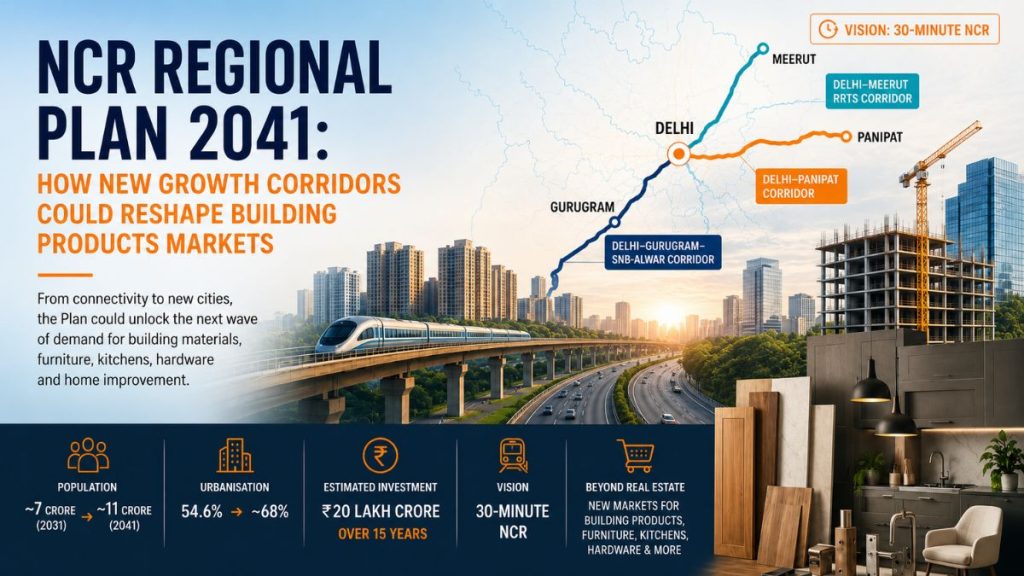
Its vision is to transform the NCR into a more balanced, multi-nodal urban region where economic activity is distributed across several interconnected cities rather than concentrated around Delhi. Better regional mobility through the Namo Bharat Regional Rapid Transit System (RRTS), new greenfield urban centres, transit-oriented development and improved road connectivity are intended to make emerging locations more attractive for both residents and businesses.
The scale of the opportunity is considerable. The NCR’s population is projected to grow from around seven crore by 2031 to nearly eleven crore by 2041, while urbanisation is expected to rise from 54.6 per cent to nearly 68 per cent. Accommodating this growth will require massive investment in housing, transport and civic infrastructure, with estimates suggesting cumulative investment of over ₹20 lakh crore over the next fifteen years.
For the real estate sector, these projections point towards sustained long-term demand. For the building products and home improvement industry, however, the more important question is different.
Where will this demand emerge? That question matters because companies manufacturing plywood, laminates, furniture, modular kitchens, lighting, sanitaryware, architectural hardware, appliances and other building products often need to identify growth markets years before they fully mature. Distribution networks, project partnerships and manufacturing investments are built over long time horizons. In that context, regional planning documents such as RP-2041 serve not merely as policy statements, but as early indicators of future market direction.
The industry’s initial response suggests that the Regional Plan has the potential to reshape the geography of demand across the NCR. At the same time, stakeholders are equally clear that its success will depend on one critical factor: execution.
Connectivity Will Shape NCR’s Next Growth Cycle
If there is one point on which developers, consultants and industry bodies broadly agree, it is that connectivity will become the defining driver of NCR’s next phase of growth.
Unlike previous regional plans, which largely focused on accommodating expansion around existing urban centres, RP-2041 seeks to reorganise the region around faster regional mobility. The much-discussed vision of a ‘30-minute NCR’ is intended to make travel
between Delhi and major NCR cities significantly quicker through an integrated network of RRTS corridors, metro systems, expressways and multimodal transport infrastructure.
For Ravi Reddy, President, NAREDCO NextGen, the Regional Plan’s most significant contribution is that it “looks beyond Delhi and a few established markets and encourages balanced growth across the entire region.” He believes the Plan can create multiple growth centres where people live closer to workplaces, schools, healthcare and public transport, reducing pressure on existing urban pockets while opening opportunities for planned residential communities, commercial hubs and social infrastructure.
His observation reflects a broader shift in industry thinking. Rather than viewing connectivity merely as a transport initiative, developers increasingly see it as the foundation for long-term urban development.
Parvinder Singh, CEO, Trident Realty, describes the Regional Plan as “not merely an infrastructure blueprint; it is a strategic vision to decentralise growth beyond Delhi.” According to him, the combination of regional mobility and new urban centres has the potential to unlock substantial real estate investment while creating a more balanced pattern of development across NCR.
Aman Shharma, Managing Director and Founder, Aarize Group, also believes the Plan’s emphasis on high-speed regional connectivity and transit-oriented development will strengthen economic integration while unlocking new residential corridors across the region.
For Ashish Agarwal, Director, AU Real Estate, infrastructure remains the principal driver of long-term value creation. He expects RRTS-linked development to gradually shift investor attention beyond traditional destinations such as Gurugram and Faridabad towards emerging locations that combine affordability with improved accessibility.
Similarly, Anil Godara, Founder and Managing Director, J Estates, expects better regional mobility to reshape residential and commercial investment patterns by making newer markets increasingly attractive for both developers and homebuyers.
Real estate advisors broadly share this assessment. According to Rajeev Vijay, Executive Director – Government and Infrastructure Advisory at Knight Frank India, global experience demonstrates that transit-oriented development consistently creates stronger real estate markets. Cities such as London, Tokyo and Singapore have seen well-connected transit corridors command sustained premiums in both capital values and rentals. India has witnessed similar trends through metro-led development in Gurugram, Noida and Mumbai, where improved connectivity has accelerated residential and commercial absorption well ahead of the broader market.
The implications extend well beyond housing. Improved connectivity influences where businesses establish offices, industries locate manufacturing facilities, retailers expand networks and educational and healthcare institutions invest. Over time, those developments generate demand for everything that supports the built environment—from cement and steel to furniture, modular kitchens, decorative surfaces, lighting, appliances and architectural hardware.
For companies serving the building products and home improvement sectors, RP-2041 is therefore more than a transport plan. It represents an early signal of how the region’s economic geography—and consequently its future demand centres—could evolve over the next decade.
Mapping the Next Growth Corridors
If connectivity is the catalyst, geography could become the bigger story. For decades, NCR’s growth has largely revolved around a handful of established centres. The NCR Regional Plan 2041 broadens that narrative by identifying new growth corridors that could gradually redistribute residential, commercial and industrial activity across the region.
Early industry responses suggest that this redistribution—not merely the creation of new cities—could become the Plan’s most enduring legacy.
According to ANAROCK Group’s Vice Chairman Santhosh Kumar, the timing is significant. “NCR’s luxury housing prices have already appreciated by 72 per cent over the past four years, reflecting sustained demand in the region’s premium residential market.”
He believes the proposed greenfield ‘Namo Cities’, together with infrastructure-led expansion along major transport corridors, could extend this momentum beyond today’s established markets while creating fresh opportunities across both mid-income and premium housing segments.
Knight Frank identifies three corridors that deserve particular attention.
The Delhi-Meerut RRTS corridor, already supported by India’s first operational Regional Rapid Transit System, offers perhaps the clearest demonstration of how faster connectivity can reshape urban development.
The proposed Delhi-Gurugram-SNB-Alwar corridor is expected to strengthen the industrial and logistics ecosystem stretching across southern Haryana and northern Rajasthan, while the Delhi-Panipat corridor could drive the next phase of residential and industrial expansion
northwards into Haryana, particularly around Sonipat.
NAREDCO adds another dimension to the discussion. While acknowledging the importance of these larger regional corridors, Reddy believes several locations are already moving beyond the planning stage. The Noida International Airport region, the Yamuna Expressway corridor, New Gurugram, Sohna, Greater Noida West and parts of Ghaziabad are beginning to benefit from investments that are already visible on the ground.
What makes these markets attractive, he argues, is not simply land availability but the combination of improving connectivity, employment opportunities, relatively affordable land and sustained public investment in infrastructure.
Taken together, these perspectives suggest that NCR’s future may no longer be defined by one dominant urban core. Instead, the region could evolve into a network of specialised growth centres, each supported by its own residential, commercial and industrial ecosystem.
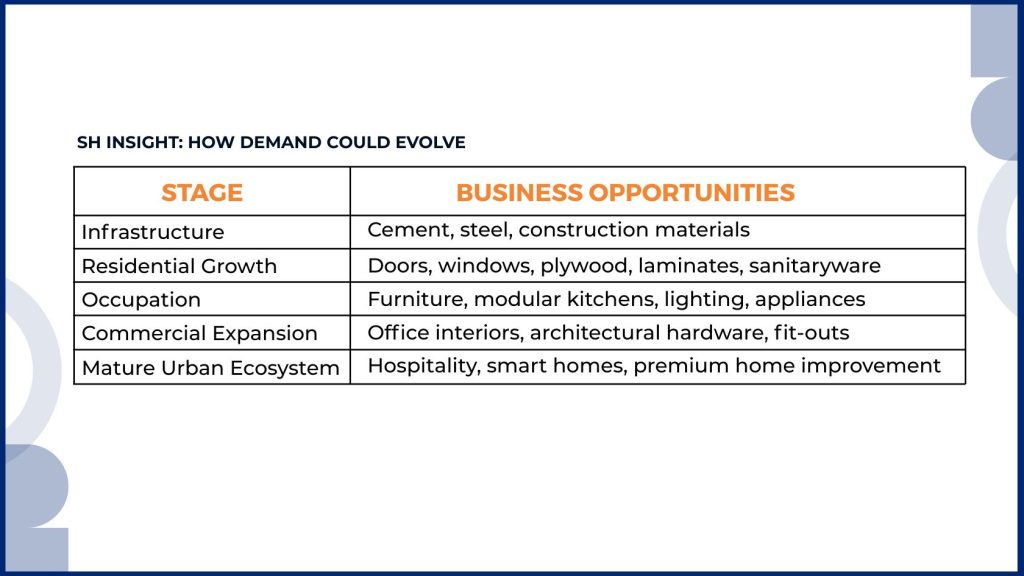
For businesses supplying the built environment, that shift has important implications. A city does not become a market overnight. It evolves in stages—first through infrastructure, then housing, followed by schools, hospitals, retail, offices and eventually mature urban communities. Businesses that recognise these transitions early are often better positioned than those that wait for markets to become fully established.
Beyond Housing: A New Demand Story for Building Products
Real estate is often viewed through the lens of land values and housing sales. Yet for the building products industry, those are only the beginning of the story.
Every new residential corridor sets off a chain reaction across multiple industries.
Construction creates demand for structural materials. Housing generates demand for doors, windows, plywood, laminates, paints, electrical products and sanitaryware. As families move in, demand expands further to furniture, modular kitchens, lighting, appliances, wardrobes, flooring and home décor. Commercial development follows with offices, retail spaces, hotels and institutional buildings, creating additional opportunities for interior fit-outs and specialised building solutions.
Vijay offers an equally useful way of understanding this evolution. According to him, “housing and warehousing are likely to respond first” as new corridors begin attracting investment. Retail typically follows as residential communities become established. Office development takes longer because it depends on employment generation, while hospitality usually matures only after sustained commercial activity has taken root.
That sequence provides valuable business intelligence for companies serving the construction and interiors ecosystem.
Manufacturers of core building materials may see opportunities emerge during the early stages of development. Furniture, modular kitchen and home improvement companies are likely to benefit as residential occupation increases. Businesses specialising in commercial interiors, office fit-outs and hospitality products may find demand developing over a longer period.
Equally important is the distribution story. As NCR’s urban footprint expands, dealer networks that have traditionally focused on Delhi, Gurugram and Noida may need to gradually strengthen their presence across emerging markets such as Sonipat, Meerut, Sohna, Jewar, Greater Noida West and Alwar. Regional warehousing, project sales teams and channel partnerships may also need to evolve alongside the geography of development.
For the building products industry, RP-2041 is therefore not simply a housing story. It is an early indicator of where future markets, customers and distribution opportunities may emerge.
Vision Meets Execution
Despite the optimism surrounding the Regional Plan, industry stakeholders are equally clear that ambition alone will not transform the NCR. Execution will.
For Reddy, the challenge lies less in preparing the master plan than in ensuring coordinated implementation across multiple states and planning authorities.
“A well-prepared master plan is only the first step,” he says.
Infrastructure projects, land-use planning and development approvals must move together if new growth corridors are to develop as intended. Delays in roads, metro systems or approvals inevitably slow private investment, while timely provision of water supply,
sewerage, power and other trunk infrastructure determines how quickly new locations become viable.
Knight Frank reaches a similar conclusion, describing RP-2041 as “a directional commitment with execution discount.” The advisory argues that unlike earlier regional plans, today’s proposal benefits from stronger foundations, including the operational Delhi-Meerut RRTS, the Kundli-Manesar-Palwal corridor and the upcoming Noida International Airport. These projects provide greater confidence than previous plans enjoyed.
However, significant challenges remain. Land acquisition, financing of large infrastructure projects, coordination between four state governments and timely rollout of transit systems will all influence whether proposed growth corridors develop as envisioned. The effectiveness with which individual states implement transit-oriented development policies and planning regulations could also determine the pace at which private investment follows public infrastructure.
The industry’s optimism, therefore, is accompanied by cautious realism. Stakeholders broadly agree that the direction of travel is right. The real test will be whether implementation can match the scale of the vision.
Looking Ahead
The proposed NCR Regional Plan 2041 is ultimately about much more than urban planning. It represents an attempt to reshape the economic geography of North India’s largest metropolitan region by linking infrastructure, housing, industry and mobility into a more
integrated model of development.
For real estate developers, that could translate into new residential and commercial markets.
For manufacturers, distributors and suppliers serving the built environment, it offers something equally important: an early indication of where the next wave of demand may emerge.
As Reddy observes, every new township creates demand that extends far beyond real estate itself—from cement, steel and electrical products to furniture, kitchens, lighting, home décor and interior solutions. The growing emphasis on sustainability is also expected to create opportunities for green building materials, prefabricated construction technologies and energy-efficient products.
The Regional Plan’s success will ultimately be judged by the quality of its execution. But its significance lies elsewhere as well.
It encourages businesses to look beyond today’s established markets and begin preparing for tomorrow’s.
For the building products and home improvement industry, that may be the most important takeaway of all.
ALSO READ