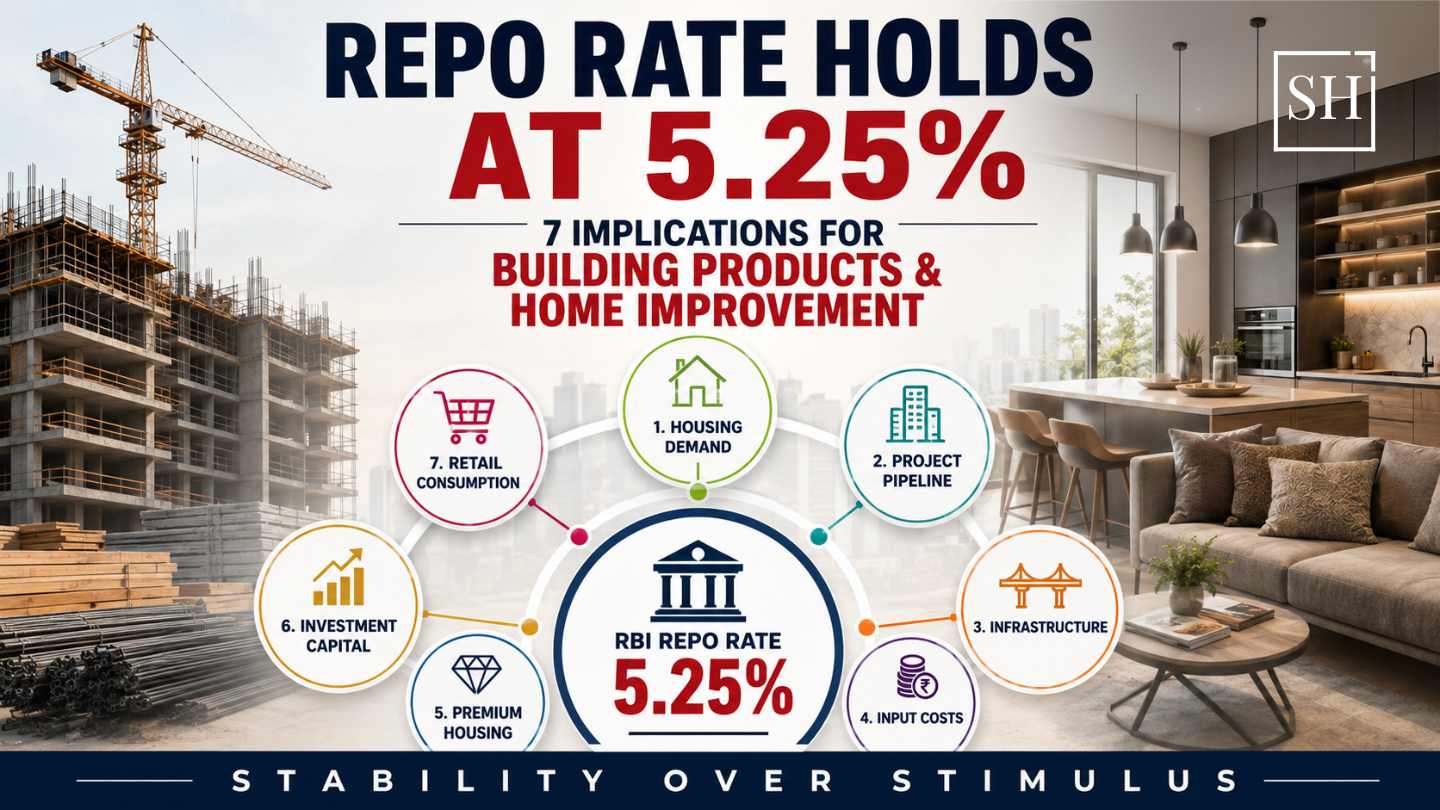
RBI Repo Rate Impact on Building Products: 7 insights for manufacturers, distributors and
home improvement businesses following the RBI’s latest policy.
The Reserve Bank of India’s decision to keep the repo rate unchanged at 5.25% has been welcomed across the real estate and infrastructure sectors. The RBI repo rate impact on building products is expected to be largely positive, offering greater visibility on housing demand, project execution and investment activity.
For stakeholders in the building products and home improvement ecosystem, the
significance of the decision extends beyond home loan rates. Housing demand, project
launches, infrastructure spending, construction costs, and investment flows are all
influenced—directly or indirectly—by the interest-rate environment.
An assessment of industry reactions suggests seven key implications for manufacturers,
distributors, retailers, and solution providers serving India’s construction and interiors
market.
1. Housing Demand Continues to Support Industry Growth
The strongest argument in favour of the RBI’s decision comes from the housing market
itself. Industry leaders across multiple segments believe that stable borrowing costs help
preserve buyer confidence, particularly among end-users.
According to ANAROCK Research, residential sales in Q1 2026 declined 7% sequentially to
approximately 1.02 lakh units. However, on a year-on-year basis, demand remained healthy, with sales volumes rising 9% compared to Q1 2025.
For first-time buyers and salaried households, even modest changes in EMI outgo can
influence purchase decisions. By maintaining the current rate environment, the RBI has
removed one element of uncertainty from the home-buying equation.
For suppliers of kitchens, furniture, hardware, lighting, surfaces, appliances and other home improvement products, the implication is straightforward: as long as homes continue to sell, demand for interior fit-outs and finishing products will continue to flow through the value chain.
“Since the only changing factor in the housing demand equation is the buyer sentiment, this decision will help maintain positive buyer sentiment and will keep sales growing in the emerging markets of Pune and PCMC, where the demand is primarily led by infrastructure development.”
– Akash Pharande, Managing Director, Pharande Spaces
2. Rising Project Inventory Expands Future Business Opportunities
One of the clearest signs of the RBI repo rate impact on building products can be seen in the growing pipeline of residential projects.
Developers launched more than 1.26 lakh housing units during Q1 2026, exceeding the pace of sales. As a result, unsold inventory has risen above six lakh units across major markets.
For developers, this trend warrants careful monitoring. For suppliers to the construction and interiors industry, however, it also points to a growing pipeline of projects moving through various stages of execution.
Every residential project eventually translates into demand for cabinetry, modular kitchens,
architectural hardware, furniture, decorative surfaces, lighting systems, bathroom products
and smart-home solutions.
The opportunity is evident, but so is the need for caution. Suppliers will need to distinguish
between announced projects and projects that are actually progressing towards completion, since procurement decisions are ultimately driven by execution rather than launch activity.
3. Infrastructure Spending Continues to Provide Support
The implications of the RBI’s decision extend beyond residential real estate.
Industry observers note that a stable borrowing environment helps infrastructure developers refinance existing debt and manage project cash flows more efficiently. While
few expect a surge of entirely new projects, ongoing investments in roads, logistics, urban
infrastructure and industrial development are likely to continue moving forward.
For companies supplying products to commercial, institutional and infrastructure projects,
this provides an additional source of demand beyond the housing market.
In sectors where project timelines often stretch over several years, financing stability
remains an important contributor to execution momentum.
“The present rate helps state-owned enterprises and private concessionaires swap out their older high-cost borrowings, it eases financing expenses while letting them keep things running and win new contracts. There’s even a small uplift in support for the National Infrastructure Pipeline.
– Hardik Shah, Director, Shyam Group – Dholera SIR
4. Input Cost Inflation Remains a Key Concern
The RBI repo rate impact on building products is not entirely positive, however, as rising
input costs continue to challenge manufacturers and developers.
The RBI repo rate impact on building products is not entirely positive, however, as rising
input costs continue to challenge manufacturers and developers.
For building product manufacturers and distributors, this creates a familiar challenge:
balancing volume growth with margin protection.
In such an environment, operational discipline becomes as important as sales growth.
Companies that can manage procurement efficiently, optimise inventories and maintain
pricing power will be better positioned than competitors relying solely on market expansion.
5. Premium Housing Continues to Support Imported Product Categories
ANAROCK also points to another trend that deserves attention—the growing importance of
the luxury housing segment.
Luxury housing now accounts for nearly one-fifth of residential supply in India. Buyers in this segment tend to be less sensitive to interest-rate movements and continue to invest in
premium products and imported solutions.
The RBI’s efforts to support currency stability may also benefit import-dependent categories by reducing volatility in landed costs.
For brands dealing in premium hardware, designer kitchens, luxury appliances, engineered
surfaces and smart-home technologies, the current environment remains broadly supportive despite wider economic uncertainties.
“The Central Bank’s efforts to stabilise the Indian rupee will help boost import of fixtures and fittings in the luxury segment, which currently accounts for 20% of the housing supply as of Q1 2026.”
– Anuj Puri, Chairman – ANAROCK Group
6. Investment Capital is Becoming More Selective
Investor behaviour appears to be changing as well.
Several industry experts believe that lower interest rates make traditional fixed-income
instruments relatively less attractive, encouraging investors to explore real estate, REITs and income-generating assets.
Unlike previous real-estate cycles, however, the emphasis is increasingly on predictable
returns rather than speculative gains. Investors are showing greater preference for rental-
yield opportunities, professionally managed assets and organised developments.
This shift may ultimately benefit developers and suppliers that focus on quality,
transparency and long-term value creation rather than short-term market momentum.
“Right now the market doesn’t feel a 2008-like euphoria because banks are staying firm on their lending rules and keeping loan-to-value ratios on the lower side. Investors will likely lean toward assets that can deliver about 6 to 7 percent net rental income, since these will give a small edge in overall profit. Fresh money should drift into REITs and InvITs because their distribution yields outperform their debt service costs.
– Siddharth Maurya, Founder and Managing Director of Vibhvangal Anukulakara Pvt Ltd
7. Retail Consumption Could Receive a Mild Boost
The retail sector may also see indirect benefits from stable interest rates.
With EMIs on housing, vehicle and personal loans remaining predictable, households are
likely to retain a greater degree of spending confidence. While this does not necessarily
translate into a surge in discretionary purchases, it can support categories linked to home
improvement, furniture and interior upgrades.
Retailers serving homeowners may therefore see steady demand, particularly in markets
where housing activity remains robust.
The gains are likely to be gradual rather than dramatic, but they reinforce the broader
theme emerging from the RBI’s policy stance: stability over stimulus.
“The decrease in interest rates enables people to pay lower EMIs for their personal and vehicle loans which results in increased available money. Banks that exercise caution will begin to enforce stricter credit score requirements, which creates disadvantages for some people. The retail real estate market which includes malls and high streets presents a divided situation. More people visit stores because their spending capacity increases but online shopping continues to compete strongly.”
– Raghunandan Saraf, Founder and CEO, Saraf Furniture
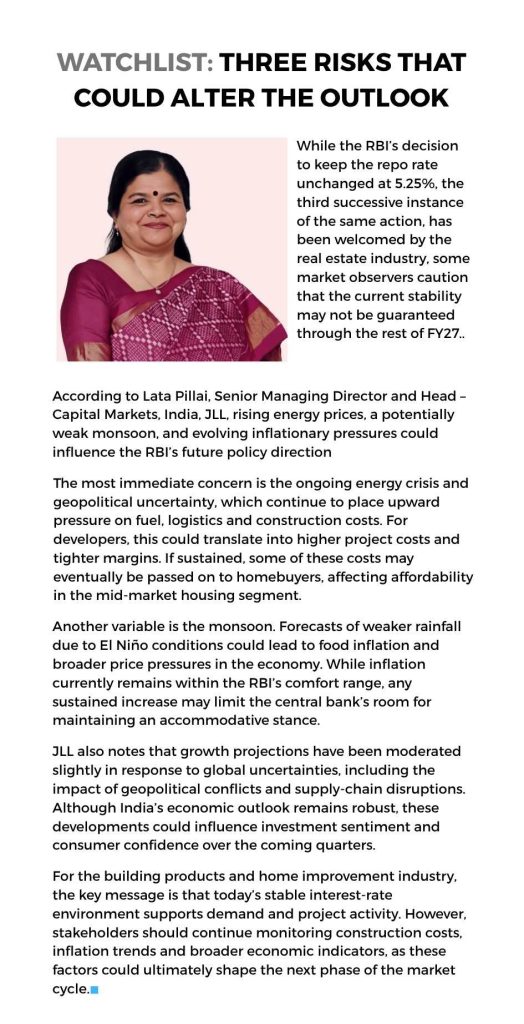
A Period of Stability, Not a Boom
Looking across housing, infrastructure and retail consumption, the RBI repo rate impact on building products appears supportive rather than transformational.
Housing demand remains resilient, project pipelines continue to expand, infrastructure spending is moving ahead, and borrowing costs remain manageable. At the same time, businesses must contend with rising construction costs and an increasingly selective investment environment.
For manufacturers, distributors and solution providers serving the building products and home improvement sector, the takeaway is not that demand will suddenly accelerate. Rather, the conditions remain supportive for steady business expansion.
Companies that understand the RBI repo rate impact on building products and align their
strategies accordingly are likely to derive the greatest advantage from this phase of
monetary stability.
ALSO READ