
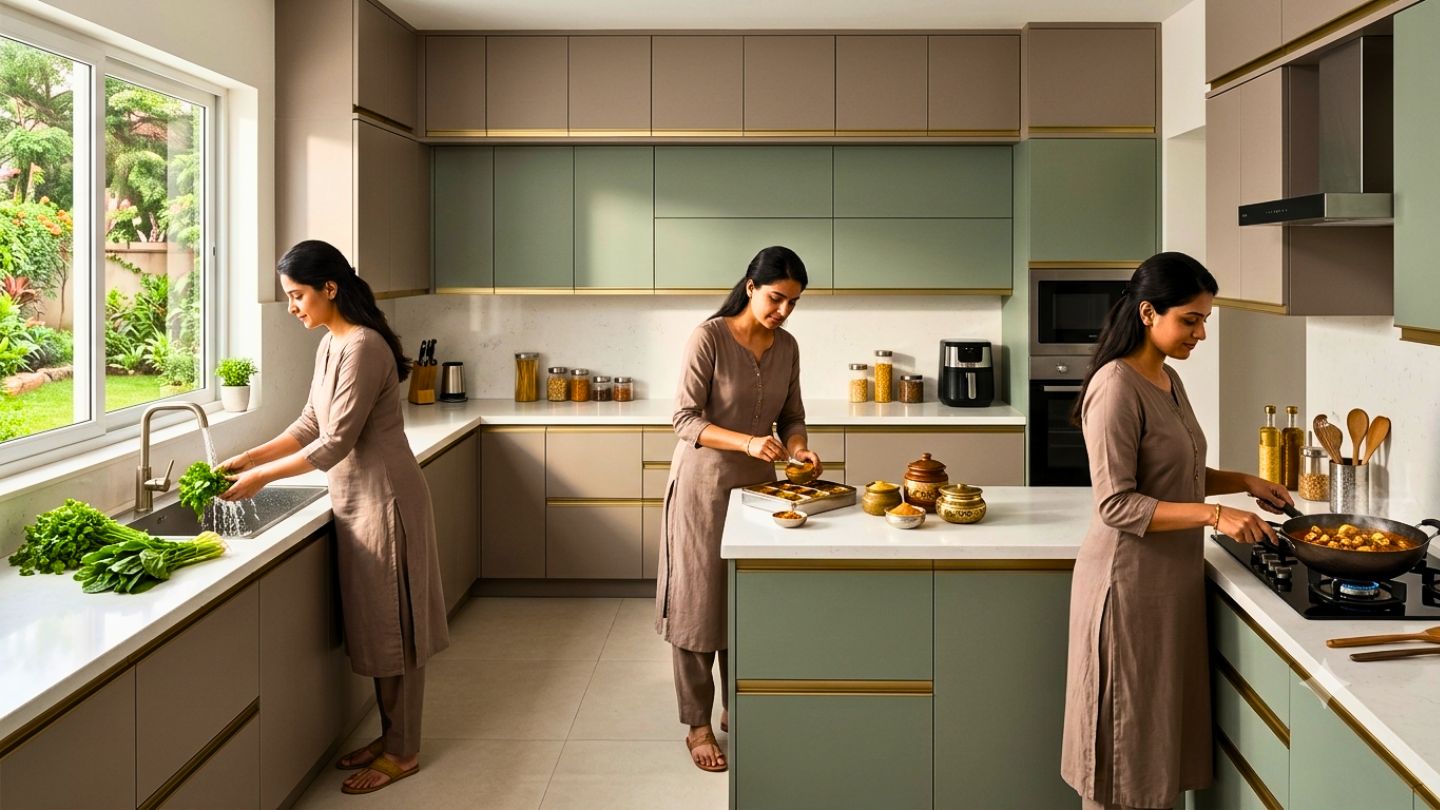
Indian kitchen design requires different specifications from Western kitchens. Learn why materials, ventilation and layouts must be engineered for Indian cooking.
In the world of residential real estate and interior design, the kitchen has long been celebrated as the heart of the home. Showrooms across London, Milan, and Frankfurt export glossy, minimalist kitchen systems worldwide, promising sleek lines, handle-less push-to-open cabinets, and whisper-quiet integrated appliances. Yet, when these imported luxury standards are installed unchanged into urban Indian apartments without adapting their specifications to local cooking habits and environmental conditions, performance issues can emerge over time. Drawers can sag, edge-bandings swell, countertops permanently stain yellow, and sleek re-circulating hoods may leave a fine film of oil across the living room sofa.
Indian kitchen design requires stripping away Western aesthetic defaults and addressing a simple reality: Indian culinary habits demand an industrial-grade workstation disguised as a home kitchen.
The Observation
The fundamental disconnect stems from a radical contrast in cooking culture. European culinary habits lean heavily toward baking, light sautéing, boiling, and pre-packaged ingredients, placing minimal physical strain on cabinetry and airflow. An Indian kitchen, by contrast, is a high-octane environment.
Everyday meal preparation involves high-heat deep frying (tadka sputtering at over 180°C), heavy spice grinding, relentless acidic steam from tamarind and vinegar, and daily floor-to-ceiling wet cleaning. Furthermore, storage requirements are vastly different: a single drawer in an Indian household routinely carries 15 to 20 kilograms of heavy cast-iron kadhai pans, brassware, or bulk bags of rice and flour.
Indian kitchen design expert Gopal Dwivedi highlights in his seminal work, Modular Kitchen Planning & Designing Guide, traditional Indian cooking relies on bulk storage of staples and intense manual prep—from mortar-and-pestle spice grinding to heavy-vessel cooking—which modern kitchens must actively plan for rather than force into European moulds. When European specification logic—built around particle board carcasses, low-suction recirculating hoods, and porous matte laminates—meets the daily reality of mustard seeds, turmeric, and standing water, it may not perform optimally.
Why It Matters
Material choice in an Indian kitchen isn’t an aesthetic preference; it’s a structural engineering decision. Turmeric (haldi) acts as an aggressive dye when suspended in hot oil vapour, penetrating low-grade matte laminates or porous natural marbles within seconds.
Standard particle board (chipboard) or low-density fibreboard (MDF) succumbs quickly to localised humidity, swelling around the sink area and creating an ideal breeding ground for termites and mould.
Data from the India Interior Trend & Modular Kitchen Report underlines this shift, revealing that over 60% of metro buyers and interior specifiers now explicitly demand high-density water-resistant substrates (like BWP marine-grade plywood or HDWR) for sink cabinets and
anti-fingerprint acrylic/PET/membrane, aluminium and glass combination finishes over traditional laminates for kitchen shutters, specifically to counter local humidity and intense cleaning routines.
Furthermore, traditional kitchen ergonomics fail to account for the unique multi-person workflow of Indian homes, where home cooks, domestic help, and family members often occupy the space simultaneously. Without a clear separation between a heavy-duty ‘wet zone’ (utensil washing, grain rinsing) and a ‘hot zone’ (frying, pressure cooking), operational bottlenecks and rapid wear-and-tear are guaranteed.
Business Implications
For real estate developers, interior design firms, and modular kitchen manufacturers, mis-judging Indian specification needs carries severe financial and brand consequences. High-end residential projects that market ‘Imported Modular Kitchens’ could possibly face bitter post-handover warranty claims, costly component replacements, and reputational damage when imported materials fail under local conditions.
To build sustainable margins and long-term brand equity, industry players must adopt a localised specification framework:
- Substrate Engineering over Surface Aesthetics: Standardising boiling water proof (BWP IS:710 grade) marine plywood or high-density water-resistant (HDWR) boards for at least sink units—or integrating stainless steel 304 sink modules—dramatically reduces post-handover defect claims.
- High-Volume Airflow Systems: Specifying filter-less or baffle-filter chimneys rated at minimum 1,200 to 1,500 m 3 /hr with direct exterior ducting, moving away from decorative recirculating hoods that fail in local contexts.
- Non-Porous Surface Standards: Defaulting to engineered quartz or jet black granite alongside acrylic/PET/membrane, aluminium and glass combination shutters, ensuring high stain resistance against turmeric and oil.
- Value-Add Layout Consulting: Offering floor plans featuring a wet/dry kitchen split (or attached utility zone) allows developers to command premium positioning among modern buyers who want aesthetic entertaining spaces without sacrificing heavy-duty culinary capacity.
A successful Indian kitchen design cannot be measured by how seamlessly it blends into a European design catalogue. It must be measured by its structural resilience against heat, moisture, turmeric, and load. When developers and designers prioritise local substrate engineering, high-suction ventilation, and practical zone planning, they create spaces that remain as flawless and functional in Year 10 as they were on Day 1.
[Explore more IITR INSIGHTS: Browse our growing collection of research-backed articles interpreting key findings from the ‘India Interior Trend Report’.]
Key Takeaways
The modern Indian kitchen represents a unique convergence of heritage cooking techniques and modern luxury expectations. True innovation in this market doesn’t come from simply importing Western aesthetic ideals, but from combining global design excellence with specifications engineered for local culinary realities.