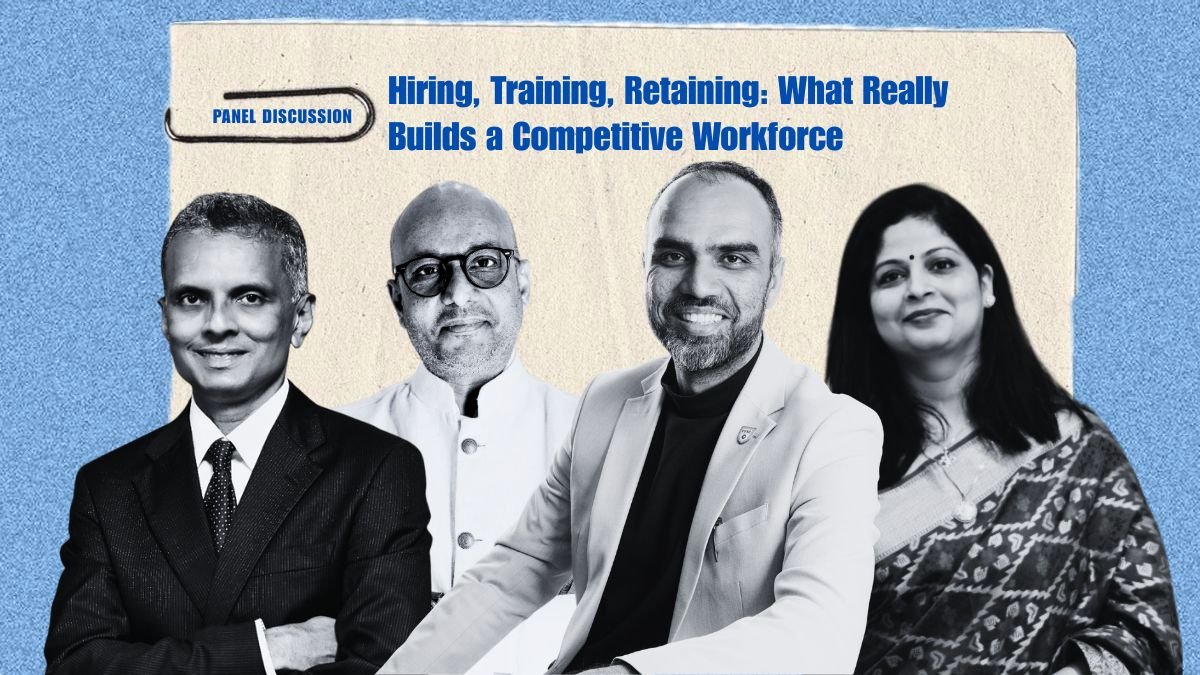
As the furniture and interiors industry looks to scale, hiring remains one of its biggest challenges. But the furniture workforce challenge goes well beyond finding people. At India Kitchen Congress 2026, a panel discussion examined what manufacturers need to put in place to attract and train people, while building the organisation structures and workplace practices that can support growth.
The discussion brought together Kuruvilla Kurian, Executive Director, Kbros Aristo; Padma Gupta, Director HR & Customer Experience, Hafele India; Nandkishore Mistry, MD & CEO, Swati Interiors and Co-Chairman, FFSC; and moderator Rahul Mehta, CEO, FFSC. They shared practical insights on organisation structure, hiring, training and the use of technology to improve workforce productivity.
Start With the Organisation Structure
As businesses grow, managing people cannot remain an informal process. In many organisations, one person can end up handling several responsibilities, making it difficult to measure productivity, define ownership and understand what a role is actually expected to deliver.
Gupta emphasised the need for greater clarity in organisation structure, job roles and responsibilities. “Can you define clean jobs with roles?” she asked. Once the role is clear, the company can define the expected output, the capabilities required and the training needed to deliver it.
In HR terms, this means defining the job description, capability set and key result areas. A clear organisation chart is equally important because it establishes responsibilities across the business.
Training, she added, can also be built within the organisation. While companies starting out may need outside support, businesses with experienced people can use their own teams to train others. At Hafele, 70% of training is conducted in-house, she said, with leaders also
participating in ongoing learning and development.
The reason, she added, is simple: “Otherwise we all become complacent and we think that we know it all.” With younger people entering the workforce with new skills and ideas, organisations also need to keep learning and adapting.
Make the Industry More Attractive to Talent
While finding the right talent is important, addressing the furniture workforce challenge also requires asking whether the industry is attractive enough to bring people in and create a larger talent pool. Kurian put it simply: “People are available. It’s that the jobs have to be
attractive for the people.”
He linked this to the way many businesses continue to be owner-driven, where limited empowerment can make it difficult to attract people, particularly from outside the industry. “I would say the companies have to become more attractive to hire people,” he said.
According to Gupta, the challenge is both the availability of skills and the willingness of people to join. The fragmented nature of the industry means manufacturers often look for “ready-made people” who can come in and perform immediately, but that talent pool is
relatively small.
At the same time, several factors determine whether people want to join the industry in the first place. Job design, the workplace, culture, clarity of roles and career progression, Gupta said, are all part of the equation. “That is where the attractiveness of the industry goes down a notch.”
The comparison with more developed sectors also highlights the gap. “Our attractiveness factor is pretty low if I compare it to a much-developed sector like, let’s say, an IT or automobile,” she said, pointing out that these sectors have a stronger pull because they are more developed and advanced.
Compensation is also part of the equation. “Money is definitely an important factor,” Gupta said. But for growing and unorganised businesses, the larger question is whether they are prepared to make the required investment in people when manpower and training already represent a significant cost.
For manufacturers, building a stronger talent pool may therefore start with making the workplace itself more attractive — through clearer roles, better job design, greater empowerment, career progression and a willingness to invest in people.
Train People Around the Business
As manufacturers look to expand their talent pool, relying only on people who can join and perform from day one may not be enough. Companies need to build people within the organisation and train them around the way the business actually works.
Mistry believes companies need to create “their own ecosystem” for bringing people into the business and training them. Instead of expecting every new hire to already understand the company’s systems, existing skills can be developed further by teaching people how to
work within the organisation’s processes. As he put it, “each and every person hired in your company is trained in your own ecosystem.”
But investment in people also needs to be linked to productivity. “Salary is a direct function of productivity,” Kurian said, adding that productivity in a typical manufacturing business can range from around Rs 1 lakh to Rs 5 lakh per person, depending on the nature of the
work.
ALSO READ: Furniture Manufacturing Workforce: Why Training Beats Hiring
He illustrated the point with a simple business calculation. A company generating Rs 50 crore in annual revenue with 250 employees works out to roughly Rs 2 lakh in revenue per person per month. If the business can improve this to Rs 4 lakh, it creates greater headroom to invest in and compensate its people.
Improving productivity, however, is not only about training people. Kurian pointed out that the way a business operates can itself consume disproportionate amounts of employee time. In his own company, he said, around 5% of orders can take up 60–70% of the team’s time, underlining the importance of measuring where people’s time is actually going.
For Gupta, the problem also lies in the way companies approach training. It is often left to happen organically on the job. “You give an initial brief and then say kaam pe seekh jaayega,” she said.
But when learning is left entirely to the job, the role, output and training intervention are not clearly defined. This makes it difficult to know whether the person is becoming productive or whether the company is getting value from the training.
According to Gupta, a fresher may require three to six months of training, depending on the job role, before becoming productive and generating a return on the company’s investment. Three months, she said, would be the bare minimum to start seeing ROI, with the period extending to six months depending on the role.
Companies, therefore, do not necessarily have to wait for a ready-made workforce. But training needs to be linked to a clearly defined role, expected output and measurable productivity.
Take Training to the Talent
Building a larger talent pool may also require training to move closer to where potential workers live. Mistry, who has been involved with the Skill India mission and has set up two FFSC-certified training academies, said travel and accommodation can be major barriers for people seeking training.
When his organisation initially provided accommodation, food and travel for trainees at its factory-based centre, it realised that taking training closer to where people lived could make a bigger difference. This led to the setting up of another centre closer to his hometown.
“A lot of people are keen in small, small villages to join these kind of skills,” Mistry said. For manufacturers looking to widen their talent pool, this may mean going beyond the metros and taking training closer to potential workers.
Mistry also believes that creating a sustainable training ecosystem cannot be the responsibility of individual companies alone. Based on his experience with two training centres, he sees a partnership between industry and government as the way forward. “If you want this to be sustainable, it should always be a partnership model,” he said.
Addressing the furniture workforce challenge may therefore require taking training closer to potential workers, widening the pool rather than having manufacturers compete for the same limited talent.
Put an HR System in Place as You Grow
As businesses grow, managing people becomes difficult alongside production, sales and other day-to-day responsibilities. Mehta said a survey of around 1,000 micro, small, medium and large companies conducted by his organisation found that nearly 70% did not have a dedicated HR function.
The finding raises a larger question for growing furniture manufacturers: does a business need a dedicated HR function, or can these responsibilities continue to be handled by the owner?
For Kurian, having an HR function is important not just for managing employees but also for how the company is perceived by potential talent. “If we didn’t have an HR department, people would not want to apply to us for a job,” he said, explaining that candidates could
see its absence as a sign that the company is “unstructured.”
Gupta looks at it from the perspective of the owner’s time. If an owner is spending time searching for people, finding the right talent, handling grievances and managing other employee-related responsibilities, the question is whether that time could be better spent
on higher-value business activities.
“If the value of your time you want to spend on other productive things with a higher ROI, you should get a specialist who will do that job in half the time,” she said.
For smaller manufacturers, this could mean starting with an outsourced HR specialist before building a dedicated team. The important part is to have a system for managing people rather than leaving hiring, employee development and other HR responsibilities entirely with the owner.
Mistry’s experience reflects this transition. His company did not initially have a formal HR system and relied largely on its own understanding of people when hiring. As the organisation grew, it introduced an HR department to take care of employees and assess whether they were doing well.
The shift, therefore, is not simply about hiring an HR person. It is about putting a system in place to manage people as the business moves beyond an owner-led structure.
Use AI to Improve Workforce Productivity
As furniture manufacturers look to become more productive and cost-efficient, AI is beginning to offer practical ways for teams to do more. Kurian described AI as a “double-edged sword”, but said the industry cannot afford to stay away from it. “If I don’t disrupt my business, somebody else is going to disrupt it for me,” he said.
For him, adopting AI is not simply about following a technology trend, but about improving the way businesses operate. One of the early applications his company is piloting is invoice processing, where AI can read information from vendor invoices and enter it into an ERP
system.
The company has also brought together an 11-member team across functions including marketing, sales, supply chain and finance to explore AI applications. The team is being taken through a boot camp and supported through the early stages of implementation.
Gupta sees similar opportunities in areas such as marketing, design, rendering, catalogue creation and back-end processes. She also believes smaller manufacturers can use AI to analyse their own business data, including pricing trends, products that sell more or less and customer buying patterns, without needing a large team to do the analysis.
The benefit, she said, is straightforward: “With a smaller team you can do much more.” Mistry takes the discussion further to how AI could change workforce requirements. If AI increasingly takes over activities such as design, quotations and parts of sales and marketing, he expects the need for people in manufacturing, installation and furniture supply to remain important, describing these as potential “future-proof job roles”.
For furniture manufacturers, therefore, the question is not simply whether AI will reduce manpower. It is where technology can take over repetitive work, where people can add more value and how businesses can become more productive with the workforce they have.
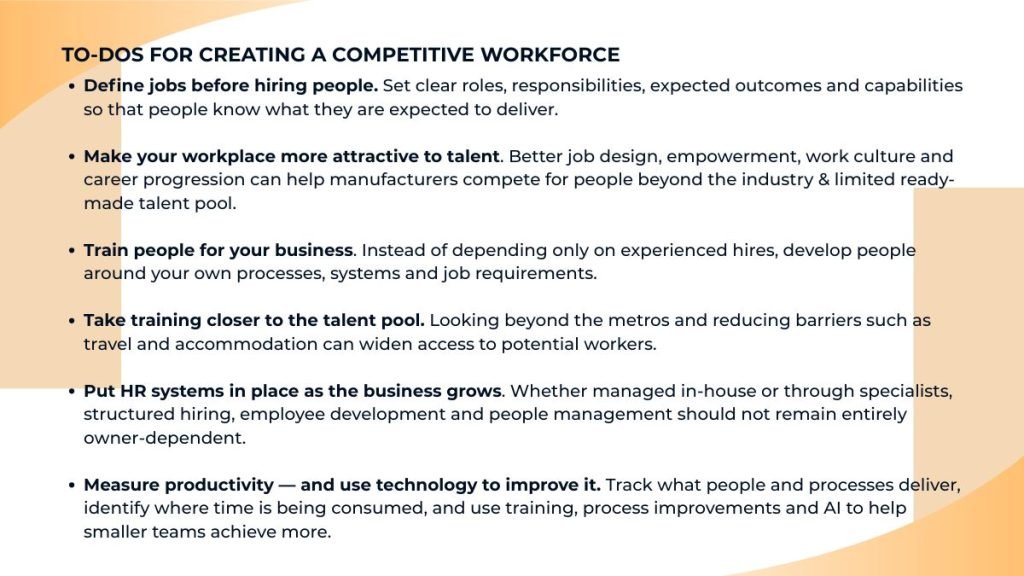
For manufacturers, solving the furniture workforce challenge will require looking beyond hiring alone. It means defining jobs clearly, making the workplace more attractive, training people around the needs of the business and putting systems in place to manage them as the organisation grows.
Ultimately, investment in people also has to translate into productivity. Better training, clearer roles and the right use of technology can help manufacturers build capability internally rather than depend only on a limited pool of ready-made talent.
Enjoyed this article?
Receive Kitchen & Cabinetry Intelligence directly in your inbox.
Subscribe to newsletter. Click.
–
ALSO READ