
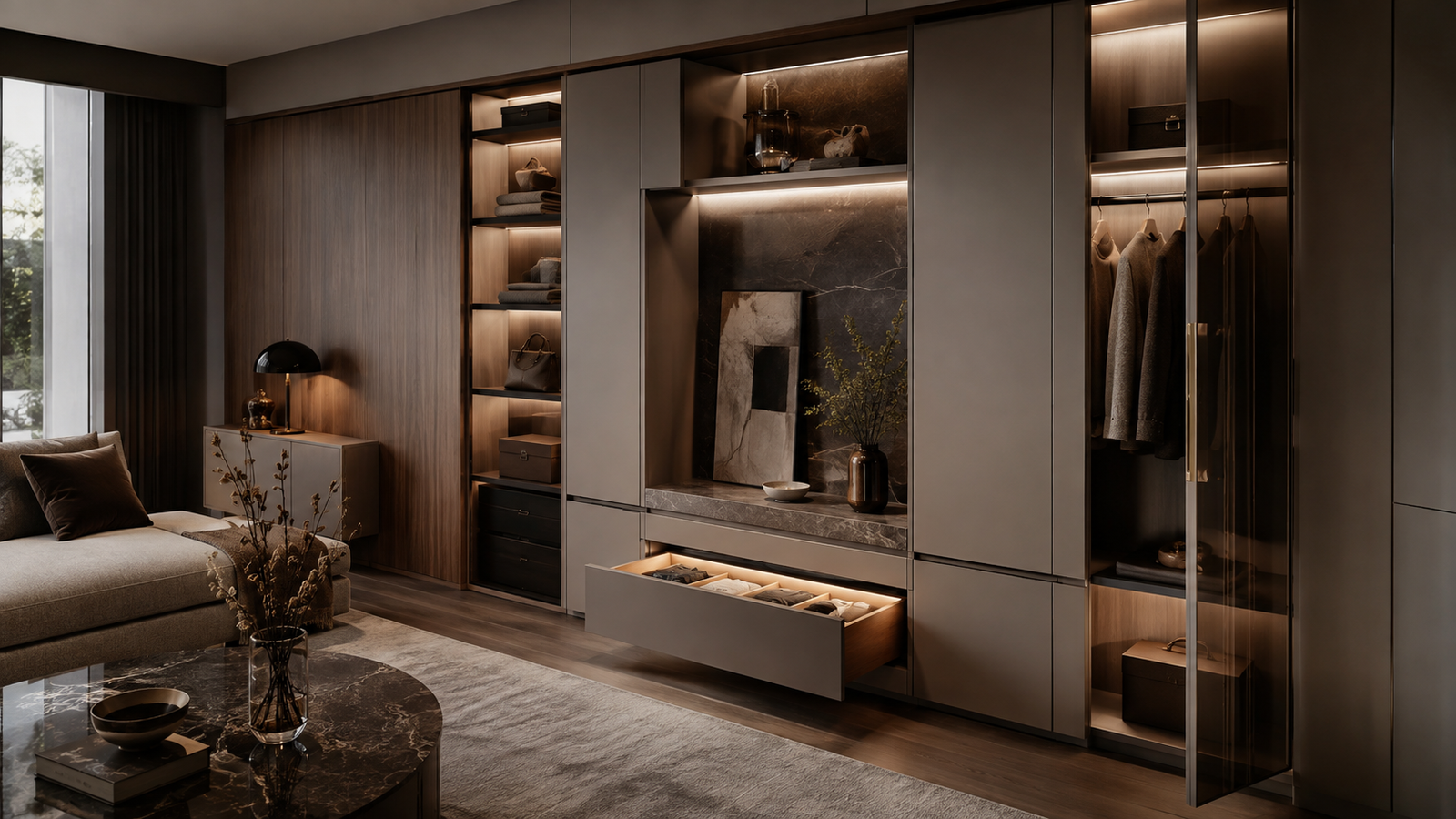
Trends in premium interiors are shifting towards sensory performance. A beautiful composition may create the first impression, but the quality we remember is often experienced differently: the softness of a shutter under the hand, the realism of a wood grain, the effortless movement of a drawer, the silence of a sliding wardrobe, or a light that appears exactly when it is needed.
The India Interior Trend Report (IITR) 2026–27 identifies hardware as one of the strongest “premium truth” signals in organised interiors, with value increasingly perceived through smoothness, sound, touch, load confidence and interaction. It also points to a broader surface shift, where material technology is enabling engineered products to deliver increasingly convincing tactile and visual experiences.
This aligns with the design philosophy advocated by Gopal Dwivedi, whose work in modular kitchens and wardrobes consistently places ergonomics, accessibility, material specification and user interaction alongside visual design. In this emerging definition, premium is becoming something a homeowner experiences repeatedly, rather than something that is simply displayed.
The Observation
The language of premium interiors in India is changing.
Earlier premiumisation was largely visible—high gloss, decorative veneers, glass, elaborate handles and statement materials. The new direction is subtler and considerably more sophisticated: surfaces feel richer, hardware moves better and lighting responds more intelligently.
Surface innovation is central to this transition.
A soft-touch supermatt laminate now creates a velvety, low-reflection surface that invites touch while reducing fingerprints. Advanced membrane surfaces can recreate the seamless visual softness associated with PU-painted shutters, including routed and contoured profiles. Highly reflective acrylics can create a glass-like depth and clarity, giving shutters a more architectural presence without using glass itself.
At the opposite end of the visual spectrum, textured technologies are becoming increasingly realistic. Open-pore veneers and synchronised wood surfaces reproduce the depth and grain structure associated with natural timber. Laminates can now visually and tactically approximate stone, concrete, leather and metal, allowing designers to build richer material experiences without depending entirely on natural materials.
The premium signal therefore increasingly lies in the gap between what something looks like and what the hand expects it to feel like.
Hardware follows exactly the same trajectory.
IITR describes the category moving simultaneously from visible to invisible, functional to experiential, and chrome to coordinated warmer finishes. Soft-close hinges and basic drawer dampening are steadily becoming expectations, while premium differentiation is moving towards near-silent operation, controlled acceleration, effortless lifting and highly refined movement.
The report identifies ‘The Silence Premium’ as a clear 2025–26 signal. Above the approximately ₹10 lakh organised-interior project value, soft-close itself is becoming closer to baseline; the next expectation is silence across the complete movement cycle.
Lighting adds another sensory layer. Under-cabinet LEDs are becoming standard in many Tier 1 kitchens above ₹4 lakh, while sensor-activated wardrobe lighting is identified by IITR as a particularly high satisfaction-to-cost intervention at approximately ₹2,000–₹2,800 per
bay installed.
Why It Matters
- Touch is becoming a quality test.
Soft-touch mattes, open-pore grains and realistic stone or metal textures allow consumers to experience material sophistication physically.
- Material realism creates perceived value.
Acrylic that approaches glass, membrane that recalls a PU finish, or engineered wood textures with genuine grain depth can elevate a product without depending only on expensive natural materials.
- Silence communicates engineering.
A drawer or sliding shutter that moves quietly and precisely immediately signals better hardware, calibration and installation.
- Light is moving inside the furniture.
Sensor LEDs, illuminated shelves and drawer lighting make furniture more usable while adding emotional value.
- Everyday interaction builds the premium memory.
IITR notes that an upgrade from economy channels to a tandem-box drawer system may add roughly ₹8,000–₹12,000 to a kitchen, yet creates a highly noticeable daily-use experience.
Business Truth: Premium is increasingly felt through the hand, heard through silence and experienced through movement.
Business Implication
For designers creating premium interiors, material selection should move beyond colour boards toward experience boards. Samples should be touched, reflected under different light, opened, closed and compared for depth, texture and movement.
For surface manufacturers, the opportunity is increasingly around sensory authenticity: supermatt finishes that feel softer, wood surfaces with deeper open pores, realistic stone and metallic textures, and reflective acrylics with greater optical depth. The objective is less about imitation and more about delivering a convincing material experience.
For hardware brands and OEMs, motion should be treated as an integral part of furniture design. Drawer load, damping quality, hinge calibration, sliding resistance, acoustic behaviour and lighting integration together determine how premium a finished interior actually feels.
And for dealers and premium showrooms, premium needs to be demonstrated rather than explained. Let the customer touch the supermatt shutter. Run a hand across the open-pore surface. Compare a conventional laminate with a stone-textured finish. Open the tandem drawer. Slide the wardrobe. Switch off the room lights and open the illuminated cabinet.
[Explore more IITR INSIGHTS: Browse our growing collection of research-backed articles interpreting key findings from the ‘India Interior Trend Report‘.]
The India Interior Trend Report 2026–27 captures this transition clearly: premium interiors are moving from visual luxury towards sensory performance.
The next generation of premium interiors may therefore communicate its quality very quietly—through a surface that feels unexpectedly real, a drawer that glides without effort, a wardrobe that closes without sound, and light that appears exactly where the user needs it.
Enjoyed this article?
Receive Kitchen & Cabinetry Intelligence directly in your inbox.
Subscribe to newsletter. Click.
–