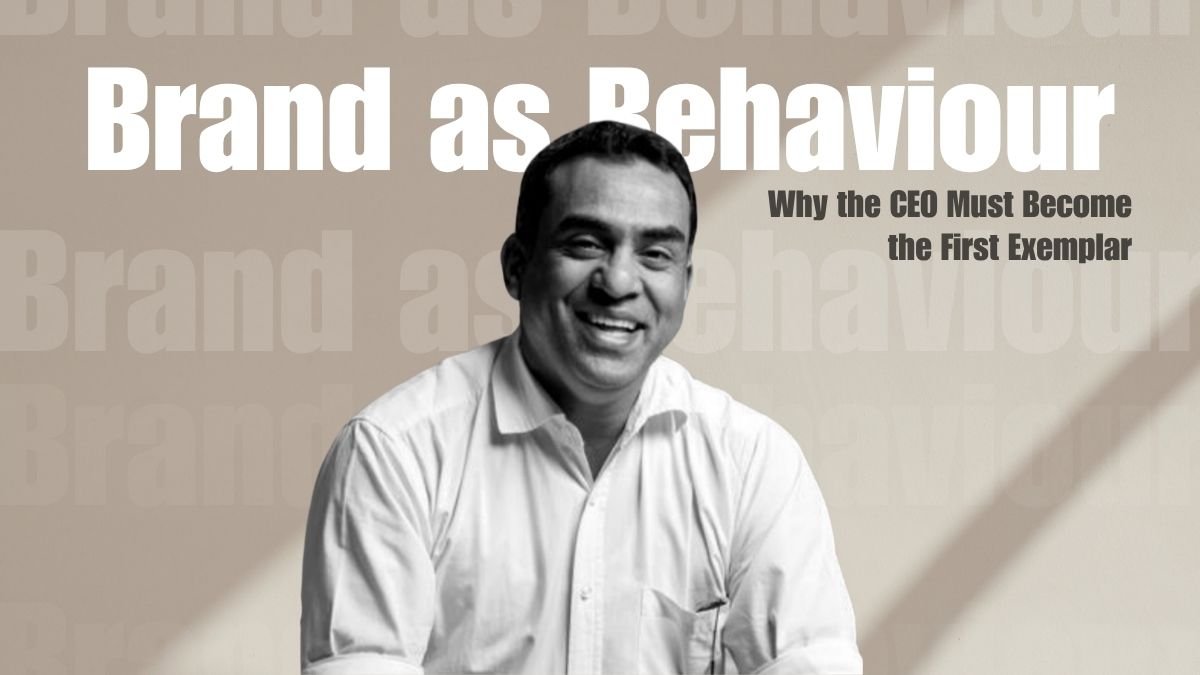
Branding has long been associated with selling — a name, a logo, an advertising campaign and a promise to the consumer. In ‘Brand as Behaviour: Why the CEO Must Become the First Exemplar’, Thomas Xavier argues that brands can do much more than shape a purchase decision. They can become a platform for the business itself, influencing how it operates, how its people behave and, most importantly, how its leadership is experienced.
Speaking during a session at the India Kitchen Congress 2026, Xavier – Principal at Transformer Brand Services – argued that the strongest brands are not created through communication alone. They are built through behaviour, with the leader becoming the first and most visible expression of what the brand stands for. “The best leaders in the world know how to be the best exemplar of the brand,” he said.
Through examples ranging from Captain Gopinath and Air Deccan to Dhruv Agarwal of Stahl and Sumant of Ivory Sense, Xavier’s framework explores how leaders can move from brand as communication to brand as behaviour and ultimately become the first exemplar of the brand they are building.
The CEO Gives the Business Its Language
For Xavier, a brand becomes powerful when a business can find the right language to express what it stands for beyond its product or service. He believes businesses need to define themselves not merely as commercial propositions, but potentially as a cause or a movement that can capture the imagination of employees, customers and other stakeholders.
Talking about Captain Gopinath and his brand Air Deccan, he explained that the business idea was straightforward: launch a low-fare airline in India. Coming from advertising and branding, Xavier was looking for an emotional hook that could give the business a stronger identity.
Gopinath, meanwhile, was trying to get the necessary approvals from Delhi and was finding little traction. One day, frustrated with the lack of interest, he told Xavier, “Here I’m trying to make the common man fly, and nobody in Delhi is interested.”
For Xavier, those words changed the proposition. “Captain, that’s what you’re doing. It’s not a low-fare airline. You are making the common man fly,” he told him.
The idea gave the business a language. Instead of simply talking about a cheaper airline, Gopinath could talk about why flying should not be restricted to the wealthy.
Xavier recalls how that shift changed the way people responded to the business. As Gopinath spoke about activating India’s more than 800 airports, drawing on his experience in the defence sector, the idea began to have relevance for MPs and communities that wanted better connectivity. It also gave employees frustrated with legacy airlines a reason to see the new venture as something they could believe in.
For Xavier, this is the power of finding the right language for a business. “Most times, when you are able to walk your brand as a leader, your business captures the imagination of people.”
The leader then has to take that language forward and become its evangelist. “A business needs to find its language in terms of a mission or a cause, and the leader must be the evangelist for that.”
Purpose Has to Be More Than a Statement
For Xavier, purpose is not something a business can arrive at by simply writing a statement. It comes from understanding three things: the talent you want to build, what makes your business stronger than the competition, and the challenge your client really needs you to solve.
Xavier brings these three questions together into a simple framework for defining purpose: “Take your talent, leverage your company’s strength, and serve the client’s challenge, you’ve got your purpose.”
That means identifying the qualities that define your best people, the traits you would want to multiply across the organisation; understanding what makes the business genuinely different beyond the usual answers around price, technology or product; and going deeper into the client’s challenge to understand what they really need.
“The best listeners go beyond the skin, ask deeper questions, and finally know that, you know what? The client doesn’t realise, but this is what the real challenge is, and I’m going to solve for it,” he said.
Bringing these three together can move a business beyond a generic purpose statement towards something that can actually energise the organisation. “When you really craft it well, across your company, you can see the difference,” he said.
But finding the purpose is only the beginning. Turning brand as behaviour into reality requires actions that make the purpose visible and tangible across the business. Xavier believes this is where a brand moves beyond communication and becomes behaviour, through the way a company expresses its story, builds its culture and, ultimately, how its leaders embody what the brand stands for.
That is where the CEO becomes the first exemplar of the brand.
The Brand Must Mean Something to the Leader
A strong brand needs a founder who has a genuine emotional connection with what the business is trying to create. For Xavier, “you need to have an emotional connect with what you do,” something that resonates with the founder and can be kept alive over time.
He illustrates this through Dhruv Agarwal, founder of Stahl, a cookware brand based in Pune. After spending four to five years studying in Germany, Dhruv returned to India with cookware from the German family he had lived with. As Dhruv told Xavier, “I didn’t care for cooking, but I found that I could enjoy cooking simply because of the cookware.”
Dhruv’s father was already involved in the cookware industry, so he understood the shortcomings of Indian cookware. He went on to engineer the product for India and introduce tri-ply technology. But over time, his enthusiasm for the business began to wane. In conversations with Xavier, they found the emotional connection he had with the category: Dhruv did not see cookware simply as cookware. He saw it as a creative tool.
This led to Dhruv’s belief that “exceptional design has the power to transform routine tasks into joyful rituals.” Stahl’s purpose therefore became bigger than making cookware – it was about reimagining the kitchen as a space for creativity and self-expression, where every day routines could become moments of inspiration and joy.
Even product innovation is viewed through this lens. The technology was important, but Xavier’s point was that Dhruv interpreted it through the freedom it gave the user to cook bindas, without worrying about scratches or handling the cookware too carefully.
For Xavier, that is what makes the founder-brand connection powerful: when something is emotionally resonant with the founder, it becomes something they can keep alive — and that belief can give the brand a much deeper meaning.
The Brand Defines the Talent You Need
If brand as behaviour is to extend across the organisation, leaders also need to understand the kind of talent their business actually needs. As Xavier said, “Talent is talent. When you want a cricket player, you want someone who can bat or bowl. You should know what you’re looking for.”
He believes every business has certain qualities that its strongest performers consistently demonstrate. The challenge is to identify those qualities and understand what you would want to multiply or bottle and give around across the organisation. That question becomes particularly important as businesses grapple with a wider workforce challenge: hiring people is only one part of building the capability an organisation needs.
Talking about his own experience in advertising, he explained – an account management professional may need to be organised, but at the heart of the role, Xavier believes, they need to be a clear thinker — someone who can make a decision after considering the options. A creative professional, on the other hand, needs to be comfortable with free association and generating a barrage of ideas.
Xavier believes leaders need to identify the trait that makes their best people exceptional and then build around it. This became particularly clear in his work with Sumanth of Ivory Sense, a Bengaluru-based building automation and solution-integration company. Despite hiring technically qualified people, Sumanth felt that execution often fell short. Through their conversations, they identified what he was really looking for: sensitivity to design.
For Sumanth, technical qualifications alone were not enough. He wanted people who cared enough about design to notice when something as small as a crooked switch or thermostat was wrong and who would take responsibility for fixing it.
That became a defining quality for Ivory Sense. As Xavier puts it, “A champion solution integrator who is relentlessly sensitive to design” became the kind of professional Sumanth wanted to build the company around.
The Brand Must Articulate What Makes You Different
Competitiveness cannot simply come down to the usual answers around price, technology or scale. Leaders need to go beyond the obvious and identify what their business does differently enough to create an “aha” moment, Xavier emphasized.
He describes this as the possibility of creating a kind of creative monopoly — identifying something others may not have recognised as a source of competitive advantage.
He explained this through the Ivory Sense example, stating that the company often works with RFPs where architects have already specified what they want. But Sumanth realised that simply delivering the brief was not necessarily the company’s strength. Its real strength was in questioning the brief and uncovering what the client had not articulated.
Instead of simply responding, “Here is the best version of what you asked for,” the team would push the conversation further and explore what the client was actually trying to achieve. Sometimes architects would reject the proposed solution, but they would still come back with the sense that Ivory Sense had advanced their thinking by questioning the question.
For Xavier, that is a much stronger competitive position than simply claiming to offer better solutions.
He also believes leaders should ask a less conventional question: “Who’s your enemy?” That does not necessarily mean a direct competitor. It could be an ideological enemy — an established way of thinking, a category convention or something the business believes should change.
What makes you stronger than the competition is therefore a question leaders need to answer beyond conventional vocabulary. The answer should be specific enough to make the organisation recognise, this is what makes us different.
Xavier also offers a caution. A powerful brand idea cannot compensate for a business that is unable to sustain what the brand promises. Recalling his experience with Subhiksha, he argued that the supermarket found a compelling language around fighting needless spending, but expanded faster than the business could support. “Sometimes great messaging can make a bad product fail faster,” he said. The brand idea, in other words, still has to be backed by the business.
For businesses looking to scale, that puts the spotlight back on the systems and operating discipline needed to make growth repeatable.
The CEO Becomes the First Exemplar
Xavier believes a business has to be able to articulate what it stands for in a way that people can understand, remember and believe in. Every business, however ordinary or generic, should be able to tell its story in a way that makes people stop and listen.
As he says, every business should have a TED-like talk, “an eight-minute version of its story that can make people say, wow”. A manifesto, a creation story and a clear understanding of what the brand stands for can help turn its purpose into something people can experience.
The CEO has to be able to explain why the business exists, what it believes in, what it is trying to change and why it matters.
That is when brand as behaviour moves beyond an idea and becomes something the organisation actually lives, with the CEO as its first exemplar.
Enjoyed this article?
Receive Kitchen & Cabinetry Intelligence directly in your inbox.
Subscribe to newsletter. Click.
–
ALSO READ