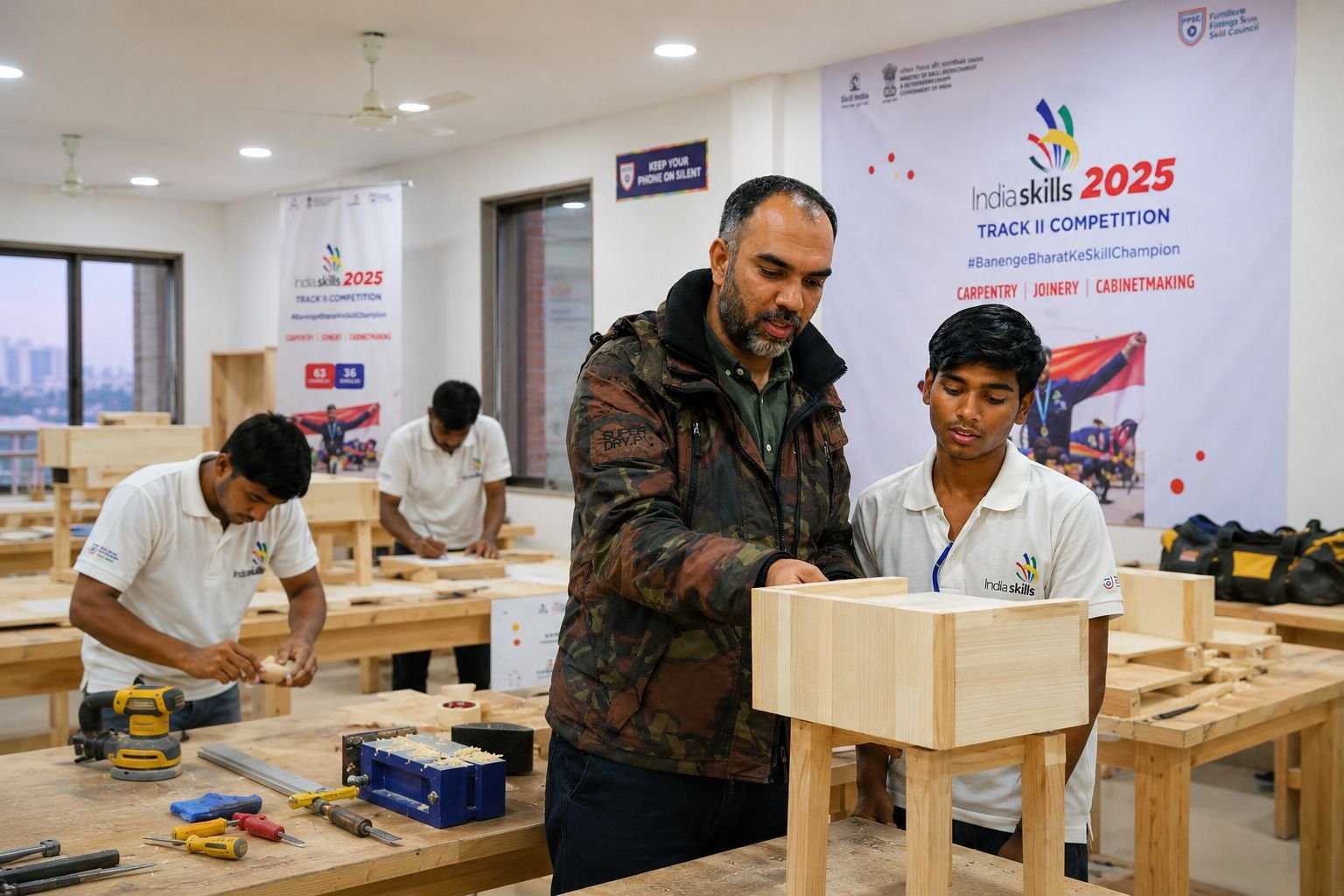
As IndiaSkills 2026–27 gets underway, implementing WorldSkills standards in furniture trades—such as cabinetmaking, carpentry, and joinery—is proving to be a game-changer for shopfloor productivity. Furniture & Fittings Skill Council is mobilising competitors and industry support for the three woodworking skills. Registrations are currently open across more than 60 skills under IndiaSkills 2026–27.
For Rahul Mehta, CEO of FFSC, however, the significance of these competitions goes well beyond identifying medal winners. They offer the furniture industry a very different way of thinking about skill itself — how it is defined, taught, measured and ultimately carried into the workplace.
“This is perhaps the most important point to understand,” says Mehta. “In India, the conventional trade encompassed everything to do with wood largely as carpentry.” Internationally, that broad definition gives way to specialisation.
“Much like we have specialisation in medicine, like different types of doctors, similarly there are different types of woodworkers — joiner, cabinetmaker and carpenter.”
In WorldSkills terminology, Carpentry is primarily associated with timber construction and installation; Joinery with the workshop production and fitting of components such as doors, windows and stairs; and Cabinetmaking with the manufacture of high-quality furniture and built-in units, where precision, materials, fit and finish assume particular importance.
The distinction is more than terminology. It goes to the heart of how a skilled professional is trained and expected to perform.
From Informal Skill to WorldSkills Standards in Furniture
“In India, for the longest period, carpenters have learnt things on the job, in an informal manner from their senior — in a guru-shishya, mentor-mentee model,” he says. That system has created generations of craftspeople. But it does not necessarily create common standards. “The chances that two carpenters from different regions work in the same manner or follow the same principles are less.”
Competition-level preparation is fundamentally different. “To be a competition-ready professional at WorldSkills, candidates have to learn to do it all as per a defined curriculum and standard: independently understand the drawing, plan the work, select the appropriate tools and materials, work within defined tolerances and deliver a high-quality outcome within a fixed time.”
Competitors from Japan, Korea or India may have somewhat different working styles, he says, but they are working to common guiding principles. “The distinction lies in the combination of precision, process discipline, speed, safety and consistency.”
For Mehta, this is where WorldSkills standards in furniture become relevant to a manufacturer who may have little interest in competitions themselves. “These are not abstract abilities. They directly influence material wastage, rework, production timelines, installation quality and customer satisfaction.”
India’s Medal of Excellence in Cabinetmaking at WorldSkills 2024, he says, demonstrated that Indian candidates can perform to high international standards when they receive the right preparation, exposure and industry support. “The opportunity now is to make these
practices more widely accessible across the sector.”
What Competition Can Teach the Shopfloor
A competition does not assess a participant simply on whether the finished piece looks good or whether the task gets completed. Candidates are evaluated on how accurately they interpret drawings, measure and prepare components, use tools and machinery, manage time and materials, achieve the required finish and maintain safe working practices.
“We have often seen at the IndiaSkills and WorldSkills level that just completing the module or project doesn’t guarantee that a candidate will score higher or win. They need to check all the boxes.” That discipline, he believes, provides a foundation for the work that subsequently happens on the shopfloor — and eventually at higher levels within an organisation.
A manufacturer does not need every employee to operate at WorldSkills level. But Mehta believes businesses can learn from the system that produces competition-level performance. “Every business can benefit from applying the underlying principles: clearer job roles, structured training, defined quality expectations and better supervision.”
This reinforces a larger argument for furniture manufacturing: workforce capability has to be developed through structured training, rather than addressed through recruitment alone.
He says he has experienced the impact himself, both in his previous manufacturing organisation and through WorldSkills competitors who subsequently joined FFSC as trainers. “With more and more candidates who are trained on the standards, our furniture industry is destined to raise its working standards, and thus productivity.”
For FFSC, therefore, the opportunity is not simply to produce better competitors. It is to translate competition learnings into workforce standards, training programmes and industry-facing tools that companies can use in their everyday operations.
Not Just a Competition, But a Career
There is another problem competitions can potentially address: the way woodworking careers are perceived. “One of the sector’s biggest challenges is that woodworking and furniture-related occupations are often viewed as traditional trades with limited growth,” says Mehta.
The reality of the industry is changing. Design interpretation, specialised machinery, digital tools, precision manufacturing and skilled installation are increasingly part of the job. IndiaSkills and WorldSkills make some of that transformation visible.
“When young people see someone representing their state or country, working with advanced equipment and being recognised for technical excellence, the perception of the occupation begins to change.”
But Mehta is careful not to suggest that recognition or medals alone can make woodworking careers aspirational. “For families, recognition alone is not enough. They also need to see a credible pathway to training, employment, income growth and professional advancement.”
That, he believes, places responsibility back on institutions and industry. “We must connect aspiration with actual opportunities so that a young person can see not just a competition, but a career.”
The Experience That Changed His View of Skills
Mehta’s own association with WorldSkills began in 2016, before he joined FFSC. His previous organisation, I.EVO, was approached by FFSC to train the candidate who was to represent India in Cabinetmaking at WorldSkills for the first time.
“And I’m being very candid here,” he recalls. “Before that, none of us knew about the competition, let alone the rules, standards, magnitude, etc.”
As the preparation progressed, his team was learning too. “We realised that there is a lot to be done, and if we do it right, it will surely solve the problem of not being able to find the right talent in Indian industry. This could actually change the way of work as we know it.”
Then came WorldSkills Abu Dhabi. “What we experienced in Abu Dhabi, the competition venue, was mind-blowing.” Mehta encountered competitors and experts from countries that had been investing in skill competitions and workforce development not merely for a few years, but for decades.
One encounter stayed with him. “I met a 70-plus-year-old Japanese person who was in a wheelchair, along with his son, and both of them were cheering for a young Japanese lad competing in Cabinetmaking.”
Mehta learnt that the elderly man had himself once been a competitor and winner. His son had also competed. Their company, he says, had made promoting young talent a matter of policy. For him, this connection between that culture and the strength of the skilled workforce in developed economies was difficult to miss.
“One could connect the dots easily and confidently say what’s the core reason behind the strong workforce and ethics of the developed countries. It’s not by coincidence, but by design where they are today.”
Bringing Industry Into the Competition Ecosystem
When Mehta joined FFSC in 2019, he says attracting the right people into the competition ecosystem became a personal mission. “We started onboarding WorldSkills and IndiaSkills candidates in FFSC, reaching out to industry experts and orienting them about the competitions, and more.”
Participation has grown. FFSC now has more experts, workshop managers and companies involved in supporting competitions. But Mehta believes the ecosystem remains small relative to the size of India’s furniture industry. “We are still just getting started.”
That is also the context for FFSC’s current call for industry experts for Cabinetmaking, Carpentry and Joinery, supported by trainers and training infrastructure. Experts can help identify promising candidates, guide technical preparation, mentor trainers and participants, review practice tasks, support mock assessments and improve training infrastructure.
Companies can nominate experienced professionals, provide access to workshops and machinery, contribute materials and consumables, host practice sessions or provide technical mentorship. “What we are looking for is meaningful involvement over the preparation cycle, not merely attendance on the competition day.”
And industry involvement need not be restricted to furniture manufacturers. Machinery manufacturers, material suppliers, designers and training institutions can all contribute equipment, expertise, demonstrations and structured learning opportunities.
For employers, there may also be a more direct benefit. “A participant’s ability to read drawings, solve problems, manage time, work accurately and respond under pressure provides strong evidence of professional potential.”
Those are capabilities that can be difficult to establish through a conventional recruitment interview. Companies that become involved early can therefore not only support promising candidates, but also see them develop before they enter the workforce.
When Competitors Come Back
For Mehta, however, a skill competition should never end with the competition. “A competition should not be treated as the end of the journey. Its real value depends on what happens afterwards.”
Participants leave with more than competition experience. They have been exposed to technical precision, process discipline, problem-solving, advanced methods and the pressure of performing against defined standards. Some move into employment, apprenticeships or
specialised manufacturing roles. Others can progress into advanced training, entrepreneurship, technical supervision or eventually mentoring another generation.
FFSC has been deliberately trying to bring some of that experience back into its own ecosystem. Since 2019, it has sought to create a pool of former IndiaSkills and WorldSkills participants who combine competition exposure with the skills and mindset to contribute to training and future competitions.
Three of them are now working with FFSC on its WorldSkills Mission: Keshar Singh, who competed in Cabinetmaking at WorldSkills 2019; Hrithik Patra, who competed in Joinery at IndiaSkills 2022; and Gulshan Kumar, who competed in Joinery at WorldSkills 2024.
Other former competitors now working across the furniture industry return during subsequent IndiaSkills and WorldSkills cycles as experts, jury members and workshop managers.
This begins to create the kind of cycle Mehta first witnessed in Abu Dhabi: people who have experienced WorldSkills standards in furniture passing that knowledge and culture to those who come after them. FFSC’s effort, he says, is to connect competition pathways with industry engagement, training opportunities and career progression so that the benefits extend beyond medals.
Mehta was named IKC Person of the Year 2026 at India Kitchen Congress earlier this year, in recognition of his contribution to advancing skilling and workforce development in India’s furniture industry.
For India’s furniture industry, that may ultimately be the bigger opportunity. WorldSkills establishes a benchmark for individual excellence. But if the standards, processes and people created around competition flow back into factories, training institutions and the next generation of workers, the impact can extend much further — into the capability of the industry itself.
Enjoyed this article?
Receive Kitchen & Cabinetry Intelligence directly in your inbox.
Subscribe to newsletter. Click.
–
ALSO READ