
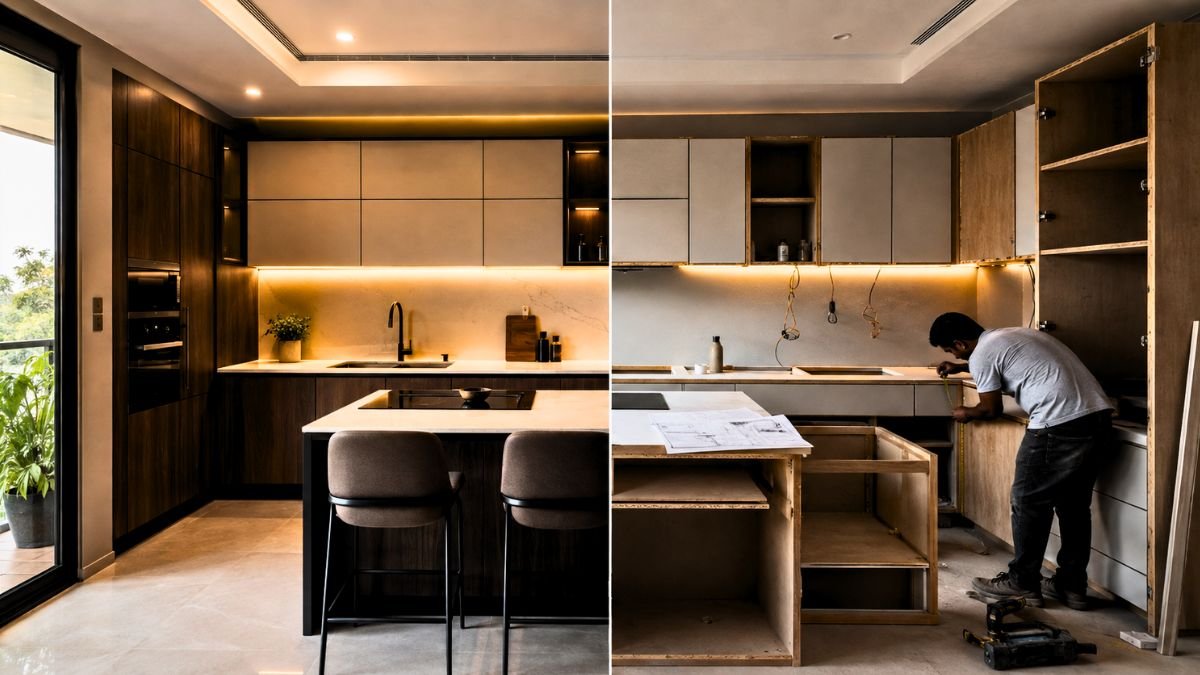
Across India, the landscape of interior material specification is expanding at remarkable speed. Laminates are reproducing the depth and grain of real veneer, digital printing is creating highly specific stone, textile and graphic effects, PET is moving from smooth supermatt into micro-textures, and membrane and thermoformable surfaces are opening new possibilities in routed and curved shutters.
The same evolution is visible in hardware and furniture systems. Aluminium profiles are becoming slimmer and more decorative, wardrobe doors are combining glass with fabric, cane or metallic mesh, lighting is moving inside cabinetry, accessories are becoming automated, handles are becoming more tactile, and premium kitchen systems are increasingly engineered around movement, integration and performance.
The market, in other words, has never had more to offer.
Yet one of the most important findings emerging from the India Interior Trend Report 2026–27 is that the quality of products available to the market is advancing faster than the quality of specification that finally reaches many Indian homes.
The Observation
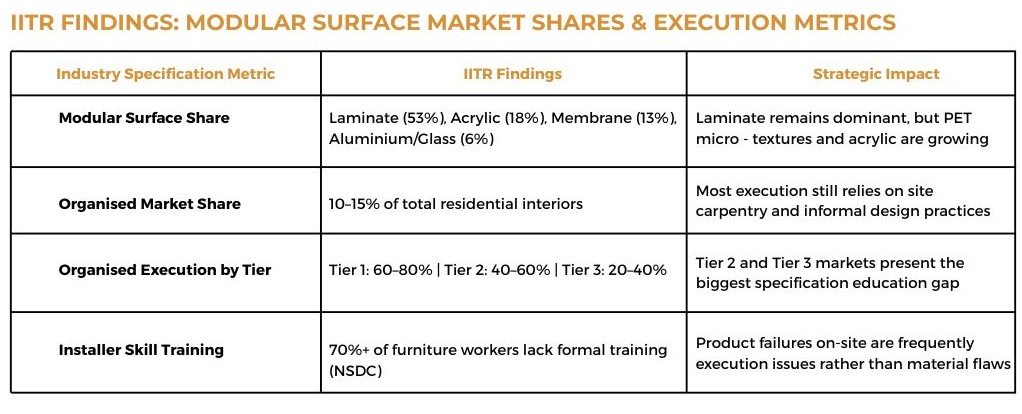
The organised surface industry is already highly sophisticated. IITR estimates laminate at around 53% of organised modular surface specification, followed by acrylic at 18%, membrane at 13%, aluminium and glass systems at 6%, PU at 4%, PET at 3% and veneer at 2%. More importantly, the report identifies texture, depth and tactility as some of the strongest premium signals now shaping product development.
This is visible in the products themselves. EGGER’s synchronised surfaces align embossing with the printed woodgrain so that the tactile pore follows what the eye sees. REHAU’s edgebanding ecosystem increasingly focuses on colour matching and near-invisible joint technologies. Similar developments are happening across PET, acrylic, membrane, aluminium, hardware, lighting and engineered stone.
What looks like a simple decorative shutter today may actually depend on a carefully coordinated system of surface, substrate, edge, adhesive, machining, hardware and installation.
This is where the specification gap begins.
A large part of India’s interior market still operates through site carpentry, contractors, hybrid execution models and relatively informal design practices. IITR notes that organised platforms and brands account for only around 10–15% of the total residential interiors market, while system-led execution becomes much stronger only when the denominator is narrowed to professionally designed projects. Within that professional segment, organised execution is estimated at 60–80% in Tier 1, 40–60% in Tier 2 and 20–40% in Tier 3.
This difference matters because the availability of advanced products does not automatically mean those products are being understood, engineered and executed correctly.
The Design Screen has Moved Faster Than the Site
Today, design inspiration is abundant. Pinterest, Instagram, international magazines, catalogues and trade exhibitions expose designers and homeowners to interiors that are technically sophisticated and visually refined. It is relatively easy to recreate the appearance of such references in a rendering or elevation. The difficulty begins when the image needs to become a physical product.
A designer may specify a dark supermatt shutter with an integrated profile and hidden lighting, but the final execution depends on a series of technical decisions that are rarely visible in the render. The correct substrate needs to be selected, the edge has to match, the adhesive system needs to suit the application, the hardware has to be compatible with the panel, and lighting channels must be planned before production.
The same applies to a full-height aluminium wardrobe, a seamless membrane shutter, a leather-wrapped door or a sensor-operated drawer. These ideas can look simple on screen, but their success depends on manufacturing logic, tolerances, machining and installation.
For many practitioners, AutoCAD still represents the principal technical tool. It is excellent for drawing, but a modern modular furniture workflow increasingly needs to go beyond drawings into quotations, BOQs, BOMs, production information, cutting lists, machining data and eventually machine files.
That transition from drawing to engineering is where much of the current capability gap sits.
New Products Demand Better Interior Material Specification
Consider something as small as an edge. As decorative surfaces become more realistic and refined, the edge becomes more visible as a quality marker. A beautiful wood-look panel can immediately lose its premium character if the edge is dark, mismatched or visibly glued. Modern edge-banding technologies can solve much of this, but only when the designer, manufacturer and installer understand how the surface and edge system work together.
The same is true of adhesives. PUR glue can offer stronger resistance in certain applications than conventional EVA systems, particularly where moisture and temperature are concerns, but the benefit only exists if the processing conditions, machinery and application method
are correct.
Hardware presents another example. A contemporary concealed fitting, tandem drawer or integrated sliding system cannot simply be added at the end of the project. It has to influence panel dimensions, drilling patterns, load calculations and machining from the beginning.
Lighting is moving in exactly the same direction. IITR identifies sensor-activated LEDs integrated into wardrobe backs, shelf edges, profiles and plinths as a growing premium specification. The report also points out that integrated lighting needs to enter the BOM before production because it cannot be cleanly improvised once the furniture is finished.
This is why modern interiors increasingly need to be understood as systems rather than collections of products.
Execution Remains the Final Test
The capability gap becomes even more visible at installation. IITR estimates that India has around 40–50 lakh workers in interior-related installation trades, with approximately 85% operating informally. The report also cites NSDC research indicating that more than 70% of furniture and furnishings workers lack formal training.
These numbers help explain why a well-designed and well-manufactured product can still fail at the last stage. Precision furniture demands accurate alignment, correct drilling, hardware calibration, careful edge handling and an understanding of how factory tolerances translate onto an imperfect site.
The installer is therefore not simply executing the designer’s idea. The installer is completing an engineered system.
When that skill is missing, the result can be familiar: misaligned shutters, visible gaps, poor edge finishing, badly integrated lighting, hardware that does not move correctly, or a material that performs differently from what the designer expected.
This is often interpreted by the homeowner as a product-quality problem. In reality, it may be a specification or execution problem.
The Consumer is Caught in the Middle
Homeowners usually have the least technical information in this process. They can compare colours, images, brands and prices, but rarely know how to compare adhesive systems, edge quality, hardware load ratings, substrate suitability, machining precision or long-term serviceability. As a result, they often evaluate a complex interior system through the simplest visible variables: appearance and price.
That makes mastery over interior material specification even more important on the professional side. The designer, dealer, contractor or showroom consultant becomes the person translating technology into an understandable recommendation. If that translation is weak, the client cannot make an informed decision.
IITR identifies this distributed decision-making structure as one of the key reasons compatibility gaps occur in Indian interiors. Surface selection may sit with the designer, core-material decisions with the dealer or OEM, hardware with the showroom consultant and installation with another team entirely. When these decisions are made independently, the final product may contain individually good components that do not work well together.
Why It Matters
- Material innovation is moving faster than specification capability.
New surfaces and systems are entering the market continuously, but their value depends on whether the full application is understood.
- Execution quality is now part of product quality.
Premium surfaces, hardware and lighting increasingly require factory precision and trained installation to deliver the experience they promise.
- Design software needs to connect with manufacturing.
The next stage of professional practice is moving from drawing and rendering toward BOM, BOQ, machining and production intelligence.
- Dealers and manufacturers are becoming knowledge partners.
As products become more technical, the ability to explain compatibility and application becomes as important as product availability.
- Consumer awareness will follow professional awareness.
Better-informed professionals create better-informed homeowners, which ultimately improves both specification and willingness to pay.
Business Truth: The next competitive advantage in Indian interiors will come from knowing how to specify, not simply knowing what is available.
The Business Implication
For material brands, this means the future cannot be built through catalogues and sample folders alone. A new-age surface should ideally arrive with matching edges, recommended substrates, processing guidelines, adhesive advice, machining information and application details that make correct specification easier.
Hardware companies have a similar opportunity. Rather than selling hinges, drawers, lights or profiles as independent products, they can help designers understand complete furniture applications and the manufacturing logic behind them.
For dealers, the opportunity is to move from product selling toward interior material specification advisory. For OEMs and platforms, it is to build digital workflows that connect design, costing, manufacturing and installation. For institutions and training organisations, it is to bring material technology, hardware, DFM, BOM and site execution closer to the way interior design is taught.
[Explore more IITR INSIGHTS: Browse our growing collection of research-backed articles interpreting key findings from the ‘India Interior Trend Report‘.]
And for designers, the shift is equally significant. The profession is becoming more technically demanding, but also more powerful. A designer who understands how surfaces, edges, cores, hardware, lighting and manufacturing work together can convert far more ambitious ideas into reliable physical outcomes.
India already has access to extraordinary material and hardware innovation. The next stage of progress will depend on how successfully that innovation travels from the showroom and exhibition floor into the drawing, from the drawing into the factory, and from the factory into the home.
That is the specification gap the industry now needs to close.
Enjoyed this article?
Receive Kitchen & Cabinetry Intelligence directly in your inbox.
Subscribe to newsletter. Click.