
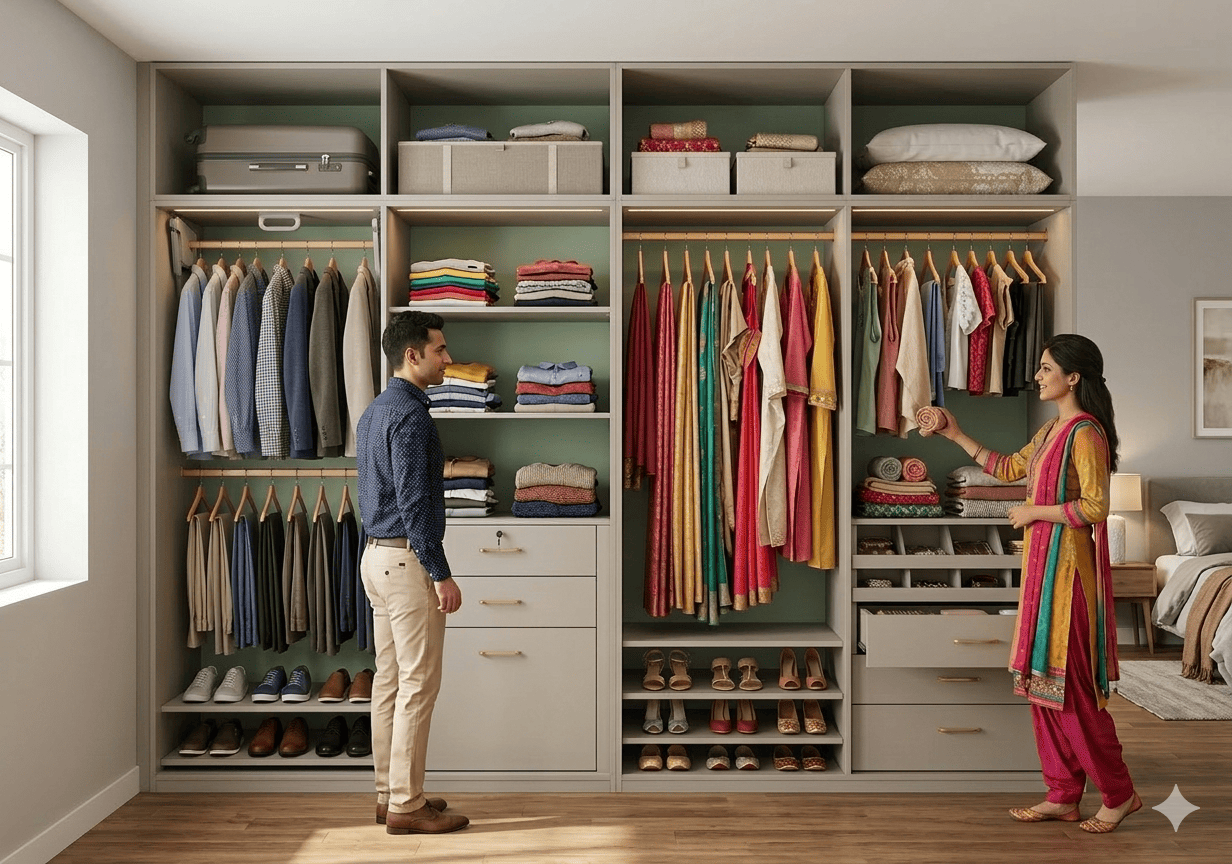
This IITR INSIGHT explains how modular wardrobe design for Indian homes is evolving, and offers key planning guidance for differing customer personas.
Storage in Indian homes is closely tied to the way families live. It reflects family size, clothing habits, festivals, seasonal change, travel, gifting traditions, inherited belongings, sentimental possessions and the tendency to keep useful objects for long periods. As homes become more compact and organised interiors become mainstream, modular wardrobe design for Indian homes is emerging as a discipline in its own right.
The India Interior Trend Report (IITR) 2026–27 places storage within a broader spatial reality. The same 2BHK or 3BHK can mean very different things across Indian cities. The report cites an average apartment size of around 904 sq ft in the Mumbai Metropolitan Region (MMR) versus 2,600 sq ft in Hyderabad, making a single storage template impractical across markets.
Gopal Dwivedi’s Modular Wardrobe Planning & Designing Guide reaches the same conclusion from the user’s perspective. It states that a standard wardrobe cannot adequately serve Indian users because geography, culture, seasons, family size and storage habits materially change the requirement from household to household.
The Observation
Indian wardrobes are expected to manage multiple layers of life simultaneously.
Daily clothing may sit alongside saris, lehengas, sherwanis, formalwear, winter clothing, bedding, handbags, jewellery, important documents, luggage, children’s belongings, keepsakes and festival wear. This creates a much broader storage brief than simply dividing
a wardrobe into hanging and shelving.
Gopal Dwivedi’s 200-user wardrobe survey across India demonstrates this clearly. 64.3% of users wanted a separate section for heavy occasion wear such as wedding dresses and sherwanis. For winter clothing, 35% wanted a separate section within the wardrobe, while another 22.5% used loft storage and 32.5% packed seasonal wear into under-bed storage.
The same survey shows how detailed the requirement becomes at everyday level. 33.3% of respondents kept more than 40 upper-body garments per person, while 40.3% required a long-hanging section for gowns and other longer garments.
Small-item organisation is equally important. 73.6% did not have an organiser drawer, yet 80.5% said they would like a dedicated organiser for watches, perfumes and similar daily-use items. Another 84.3% preferred a dedicated solution for belts, ties, pouches and small handbags.
This is why storage needs to be planned by frequency, behaviour and persona, not just available width.
Gopal Dwivedi’s modular wardrobe design guide divides storage into frequent, regular and occasional zones. Frequently used objects should sit in the most accessible ergonomic areas, while seasonal and memorable possessions can move into higher or less frequently accessed zones.
The logic extends well beyond the bedroom. The IITR 2026–27 notes that the second bedroom is often the most overloaded room in an Indian home, expected to function as a children’s room, guest room, study, work-from-home space and wardrobe zone simultaneously.
Utility storage adds another layer: laundry baskets, ironing equipment, cleaning supplies, household stock, spare bedding, buckets, appliances and occasionally luggage all require a considered place rather than leftover corners.

Why Modular Wardrobe Design Matters
- Storage has different speeds.
Daily-use, regular-use and occasional possessions require different accessibility and placement. - Lofts remain culturally and spatially relevant.
In one persona solution documented in Gopal Dwivedi’s guide, adding a loft increased storage capacity by around 30% within the same wardrobe footprint. - One wardrobe cannot serve every user.
Professionals, homemakers, children, senior citizens, travellers and fashion- conscious users all require different combinations of hanging, drawers, shelves and accessories. - Indian storage is both functional and emotional.
A wardrobe may hold daily clothes alongside heirloom saris, jewellery, old letters, photographs and objects collected over years. - Compact homes require distributed storage.Lofts, under-bed systems, utility units, passage storage, TV units and integrated walls increasingly form part of the total storage strategy.
BUSINESS TRUTH: Storage is not leftover space. It is an expression of how a household lives.
Business Implication
For designers, storage planning should begin with an inventory of life before an elevation of the wardrobe. Who uses the space? What do they own? What is accessed daily? What changes seasonally? What needs to be protected, displayed, hidden or kept for years?
For manufacturers, the opportunity lies in developing adaptable systems rather than standard boxes: lofts, luggage bays, saree storage, long-hanging sections, jewellery organisers, accessory drawers, high-load shelves, flexible internals, utility cabinets and senior-friendly mechanisms.
For dealers and premium showrooms, storage can become a powerful consultation tool. The conversation can move from “Which shutter finish do you like?” to “What does your family actually need to store?”
[Explore more IITR INSIGHTS: Browse our growing collection of research-backed articles interpreting key findings from the ‘India Interior Trend Report’.]
The IITR 2026–27 identifies wardrobes and storage as one of the major entry points for organised interior systems, with this system logic increasingly extending into TV units, study tables and built-in storage walls.
The opportunity for India’s organised home-interiors industry is therefore significant: to create a ‘storage language that is adaptive to space, sensitive to culture, ergonomic in use and intelligent enough to evolve with the family’.
Enjoyed this article?
Receive Kitchen & Cabinetry Intelligence directly in your inbox.
Subscribe to newsletter. Click.